
Introduction:
ICT includes all the tools and technologies that help people share, access, and use information. This can involve using computers, the internet, and other devices to communicate, learn, and solve problems. So, when you’re using a computer, tablet, or your phone to do things like play games, learn online, or send messages, you’re using ICT!
-
- Information and Communication Technologies (ICTs) is a broader term for Information Technology (IT), which refers to all communication technologies, including the internet, wireless networks, cell phones, computers, software, middleware, video-conferencing, social networking, and other media applications and services enabling users to access, retrieve, store, transmit, and manipulate information in a digital form.
- ICTs are also used to refer to the convergence of media technology such as audio-visual and telephone networks with computer networks, by means of a unified system of cabling (including signal distribution and management) or link system. However, there is no universally accepted definition of ICTs considering that the concepts, methods and tools involved in ICTs are steadily evolving on an almost daily basis.
- Information and Communication Technologies (ICT) have pervasive applications across various fields, transforming the way we communicate, work, and live.
- Communication:
- Internet: Facilitates global communication, information sharing, and online services.
- Email: Enables quick and efficient written communication.
- Social Media: Platforms like Facebook, Twitter, and Instagram connect people globally.
- Instant Messaging: Services like WhatsApp and Telegram offer real-time communication.
- Business and Commerce:
- E-commerce: Platforms like Amazon and Alibaba for online buying and selling.
- Enterprise Resource Planning (ERP): Manages business processes and data.
- Customer Relationship Management (CRM): Manages interactions with customers.
- Video Conferencing: Tools like Zoom and Microsoft Teams for virtual meetings.
- Education:
- E-learning: Platforms like Coursera, edX, and Khan Academy for online education.
- Learning Management Systems (LMS): Moodle, Blackboard for course management.
- Educational Apps: Interactive apps for learning on tablets and smartphones.
- Healthcare:
- Electronic Health Records (EHR): Digital records for patient information.
- Telemedicine: Remote medical consultations and treatment.
- Health Monitoring Apps: Fitness trackers, wearable devices for health tracking.
- Government Services:
- E-Government: Online platforms for citizen services and engagement.
- Digital IDs: Secure online identification for citizens.
- Smart Cities: ICT for efficient urban planning and management.
- Entertainment:
- Streaming Services: Netflix, Spotify, and others for on-demand content.
- Gaming: Online and mobile gaming platforms.
- Augmented Reality (AR) and Virtual Reality (VR): Enhancing user experiences.
- Transportation and Logistics:
- GPS and Navigation Systems: Real-time navigation services.
- Fleet Management Systems: Optimizing logistics operations.
- Ride-Sharing Apps: Uber, Lyft for on-demand transportation.
- Agriculture:
- Precision Farming: Use of sensors and data for efficient farming.
- Market Information Systems: Providing farmers with market data.
- Weather Forecasting: ICT for accurate weather predictions.
- Energy:
- Smart Grids: Efficient energy distribution and management.
- Energy Monitoring Systems: ICT for monitoring and optimizing energy use.
- Renewable Energy Management: Integrating data for renewable sources.
- Research and Development:
- Simulation Software: Used in engineering, science, and other fields.
- Collaborative Tools: Platforms for researchers to collaborate globally.
- Data Analysis Tools: ICT for processing and analyzing large datasets.
Communication
Wired Communication: Wired communication involves the transmission of information over physical channels, typically using cables or other tangible mediums. Here are some examples:
- Twisted Pair Cables:
- Description: Twisted pair cables consist of copper wires twisted together, widely used for telephone lines and local area network (LAN) connections.
- Example: Ethernet cables commonly used for connecting computers in a wired network.
- Coaxial Cables:
- Description: Coaxial cables have a central conductor surrounded by an insulating layer, a metallic shield, and an outer insulating layer.
- Example: Commonly used for cable television (CATV) connections and broadband internet.
- Fiber Optic Cables:
-
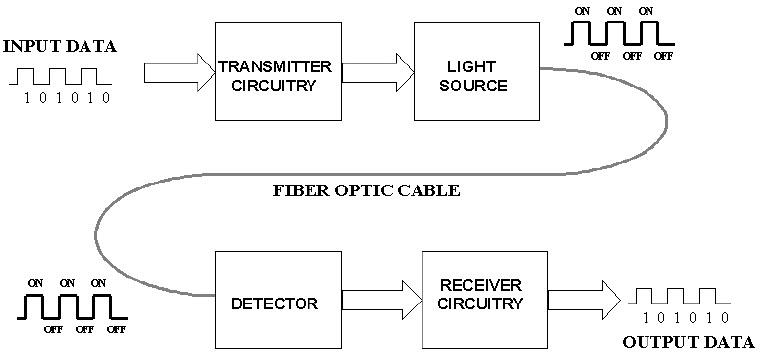
- Description: Fiber optic cables transmit data using light signals through thin strands of glass or plastic.
- Total Internal Reflection is an optical phenomenon that occurs when light traveling in a medium is incident on the boundary of another medium with a lower refractive index at an angle greater than the critical angle. This phenomenon results in the reflection of all the incident light back into the original medium, with none of it transmitted into the second medium.
- Total Internal Reflection is widely used in optical fibers, where light is transmitted through a core with a higher refractive index surrounded by a cladding with a lower refractive index.
- The critical angle is essential for guiding the light within the core, preventing significant loss of signal.
- Example: Used for long-distance communication, high-speed internet, and telecommunications.
- USB Cables:
- Description: USB (Universal Serial Bus) cables are used for connecting various devices to computers for data transfer and power.
- Example: Connecting a smartphone to a computer for file transfer or charging.
