
INDUSTRIES
Manufacturing: Production of goods in large quantities after processing from raw material to more valuable products is called “Manufacturing”.
Industry: Industry refers to the economic activities involved in producing goods, extracting minerals, or offering services.
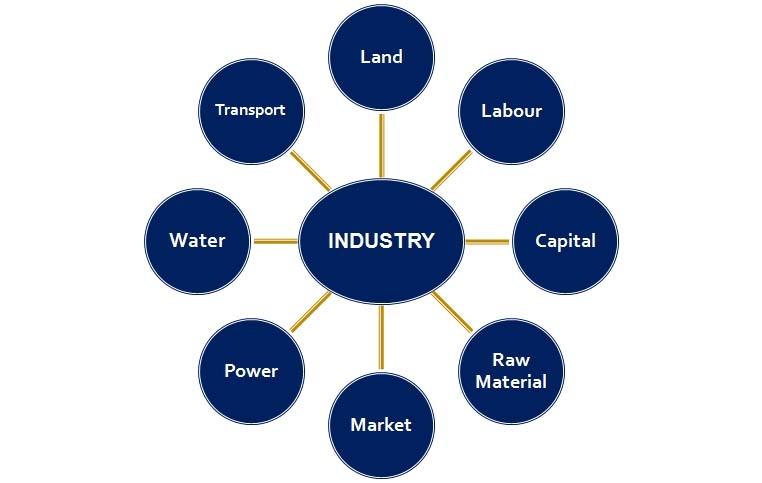 A country’s economic power is gauged by the advancement of its manufacturing industries.
The manufacturing sector serves as the foundation of a country’s economy:
- Industrial growth helps in modernising agricultural activities by providing machinery, chemicals, irrigation facilities, insecticides, pesticides, etc.
- Industrial growth helps in reducing unemployment and poverty. Industrial expansion can generate foreign exchange through the export of finished products, thereby boosting a nation’s trade and commerce.
Classification of Industries
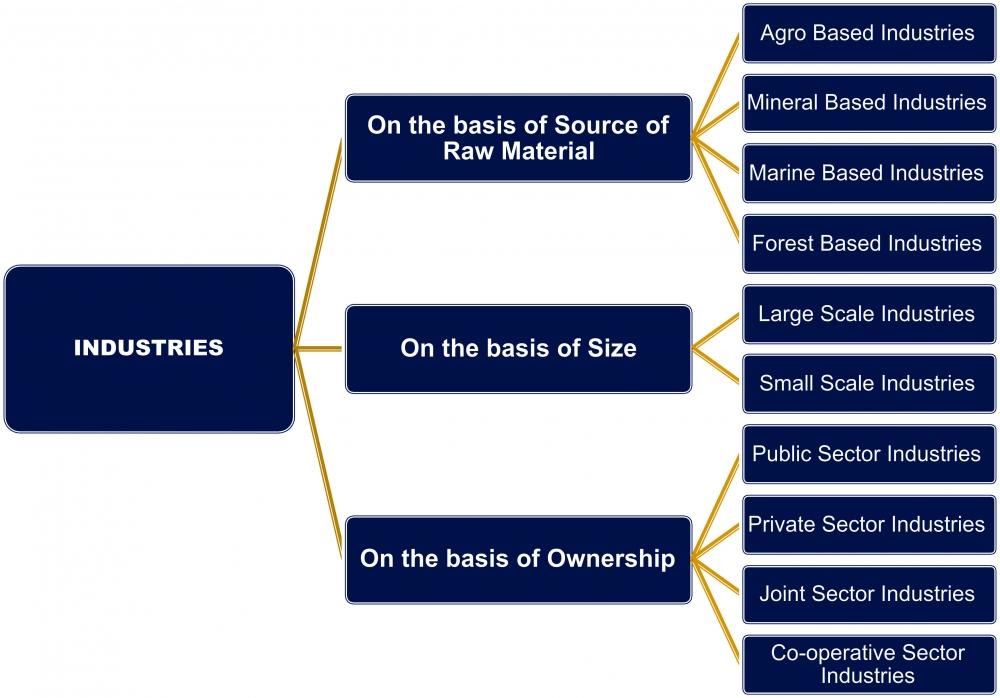
On the Basis of Raw Materials:
These types of industries are classified depending on the type of raw materials they use.
- Agro-Based Industries: These industries rely on raw materials derived from plants and animals. Examples include food processing, vegetable oil production, cotton textiles, and dairy products.
- Mineral-Based Industries: These core industries use mineral ores as their raw materials, with their products supporting other industries. For instance, iron produced from iron ore is a key output of mineral-based industries. Examples include iron & steel, cement, and machine tools.
- Marine-Based Industries: These industries utilize resources from the sea and oceans as raw materials, such as processed seafood and fish oil production.Agro-Based Industries: Use plant and animal-based products as their raw materials—E.g. Food processing, vegetable oil, cotton textile, dairy products, etc.
- Forest-Based Industries:Use forest produce as raw materials. E.g., pulp & paper, furniture. Pharmaceuticals, etc.
On the Basis of Size:
These types of industries are classified depending on the amount of capital invested, the number of people employed and the volume of production.
- Large Scale Industries: In India, In industry, if the capital invested in more than one crore, then it is called Large Scale Industry. E.g. Iron & Steel Industries, Automobile Industries, etc.
- Small Scale Industries: In India, in any industry, if the capital invested is less than one crore, then it is called Small Scale Industry. E.g., Silk weaving, Food processing industries, etc.
- Cottage or Household Industries are a type of small-scale industry where the products are manufactured by hand, by the artisans with the help of family members—e.g., Basket Weaving, pottery, handicrafts, etc.
On the Basis of Ownership:
These types of industries are classified on the basis of ownership.
- Private Sector Industries: Owned and operated by individuals or a group of individuals. E.g. Bajaj Auto, Reliance, etc.
- Public Sector Industries: These industries are owned and managed by the government. Examples include Hindustan Aeronautics Limited (HAL), Bharat Heavy Electronics Ltd. (BHEL), and Steel Authority of India Limited (SAIL).
- Joint Sector Industries: These are jointly owned and operated by the government and private individuals or groups. An example is Maruti Udyog Limited.
- Co-operative Sector Industries: These industries are owned and run by the producers, suppliers of raw materials, or workers, or a combination of both. Notable examples include IFFCO, Anand Milk Union Limited (AMUL), and Sudha Dairy.
Government policies also play a key factor in deciding the location of an industry.The government offers incentives such as discounted electricity, reduced transportation costs, and improved infrastructure.

Secondary Sector
- Definition: Involves transforming raw materials into valuable products. Examples include converting iron ore into steel and making yarn from cotton.
- Dependence: The secondary sector depends on the primary sector for the raw materials required for manufacturing.
- Profitability: The value added through the transformation of raw materials into finished goods generates greater profitability, leading to faster growth in developed countries.
- Workers: People engaged in secondary activities are known as blue-collar workers.
Manufacturing Industries
Nature: These are geographically located manufacturing units that transform raw materials into finished goods of high value for sale in local or distant markets.
Characteristics of Modern Large-Scale Manufacturing
- Specialization of Skills/Methods of Production
- Involves producing large quantities of standardized parts.
- Each worker performs only one task repeatedly, becoming specialized in that skill, enhancing efficiency and productivity.
- Mechanization
- Industries use machines for production processes.
- Automation is an advanced stage of mechanization where human thinking is not required during the manufacturing process, leading to increased efficiency and reduced human error.
- Technological Innovations
- Modern technology and constant innovations are integral.
- Research and development strategies focus on quality control, eliminating waste and inefficiency, and combating pollution, ensuring sustainable growth and competitiveness.
- Organizational Structure and Stratification
- Defined by advanced machinery and substantial capital investment.
- Involves extreme specialization and division of labor, with large organizations often having an executive bureaucracy to manage operations effectively.
- Uneven Geographic Distribution
- Manufacturing industries are concentrated in regions rich in minerals and other resources.
- These industries cover less than 10% of the world’s land area, making these regions centers of economic and political power.
Industrial System:
An industrial system is composed of inputs, processes, and outputs.
- Input: Raw materials, labour, costs of land, transport, power and other infrastructure.
- Process: All activities that convert the raw material into finished products.
- Output: End/ Final/Finished product and the income earned from it.
The common characteristic features of the industrial regions are:
- The large population engaged in industrial pursuits,
- The large industrial complex in hierarchical order,
- Integration of key industries with a network of supporting subsidiary industries.
- Large banking and credit facilities,
- A network of communication lines, and
- A vast labor market, among other factors.
Industrial Regions of the World
- Industrial regions around the world are geographically distributed for manufacturing, with a tendency to concentrate in specific areas that offer particular economic or geographic advantages.
- A majority of modern industries remain concentrated in developed nations, primarily located within the north temperate zone.
- The Major industrial regions of the world are:
- Great Lakes Industrial Region of North America.
- Ruhr-Saar Industrial Region of Europe.
- London Industrial Region.
- Ural-Ukraine Industrial Region of Russia.
- Sydney Industrial Region of Australia.
Industrial Locations: Influencing Factors
- Access to Market: The market consists of people who demand manufactured goods and have the purchasing power to buy them.Developed regions like Europe, North America, Australia, and Japan have high purchasing power.Densely populated regions in South and Southeast Asia also provide substantial markets.
- Access to Raw Materials:Industries that rely on inexpensive, bulky, and weight-reducing materials (such as sugar, steel, and cement) tend to be situated close to sources of raw materials.Industries processing perishable goods (e.g., agro-processing, dairy) are situated close to sources of farm produce or milk supply to ensure freshness and reduce transportation costs.
- Access to Labor Supply: A sufficient supply of labor is crucial for industrial locations.However, the rise of mechanization and automation has decreased the reliance on human labor, allowing industries to operate efficiently with fewer workers.
- Access to Sources of Energy: Power-intensive industries, such as aluminum production, are situated near energy sources.Common energy sources include coal, hydroelectricity, and petroleum, which provide the necessary power for industrial operations.
- Access to Transportation and Communication Facilities: Efficient transportation and communication are essential for industrial development.Regions like Western Europe and Eastern North America have highly developed transportation systems, contributing to the growth and development of industries in these areas.
- Government Policies: Governments adopt regional policies to promote balanced economic development.These policies often involve setting up industries in particular areas to ensure equitable growth and development across regions.
 Access to Agglomeration Economies/Link between Industries: Agglomeration economies refer to the benefits derived from the linkages between different industries.These linkages can lead to reduced costs, shared services, and enhanced innovation through collaboration and proximity.
Traditional Large Scale Industrial Regions
Characteristics:
- Also known as smokestack industries due to high smoke emission and environmental pollution.
- Heavy industries often located near coal fields.
- Involved in metal smelting, heavy engineering, chemical manufacturing, or textile production.
- High employment, dense housing with poor services, and unhealthy environments (waste, pollution).
Challenges:
- Worldwide fall in demand can lead to unemployment and emigration due to industry closures.
- Example: The Ruhr Coal-field, Germany:
- Accounts for 80% of Germany’s steel production.
- Future prosperity relies on new industries like car assembly (e.g., Opel), chemical plants, and universities, rather than coal and steel.
Iron and Steel Industry
Characteristics:
- Fundamental industry that serves as the foundation for all other industries.
- Iron is extracted from iron ore via smelting in a blast furnace with carbon (coke) and limestone.
- Molten iron is molded into pig iron, then converted into steel by adding strengthening elements like manganese.
- Heavy industry involving large-scale raw materials and finished products.
- Capital intensive, traditionally located near raw material sources.
- Locations:
- Advanced countries in North America, Europe, and Asia.
- In India: Jamshedpur, Rourkela, Bhilai, Bokaro, Durgapur, Salem, Visakhapatnam, Kulti-Burnpur, and Bhadravati.
- Mini Steel Mills:
- Less expensive than heavy steel industries.
- Main input is scrap metal, allowing them to be located near markets with abundant scrap metals.
Cotton Textile Industry
- Sub-sectors:
- Handloom Sector:
- Small capital investment, labor intensive.
- Provides employment to semi-skilled workers.
- Includes spinning, weaving, and finishing fabrics.
- Powerloom Sector:
- Uses machines, less labor intensive.
- Higher production levels.
- Mill Sector:
- Highly capital intensive.
- Produces fine clothes in bulk.
- Handloom Sector:
- Major Producers: India, China, Pakistan, USA, Egypt, and Uzbekistan produce over half of the world’s raw cotton.
High-Technology Industries
Characteristics:
-
- Also called high-tech, representing the latest generation of manufacturing activities.
- Intense research and development (R&D) strategy.
- Products of advanced scientific and engineering character.
- Workforce consists of highly skilled professionals (“white collar”) who outnumber production labor (“blue collar”).
Examples:
-
- Robotics, computer-aided design (CAD) and manufacturing.
- Creation of new chemical compounds and pharmaceutical products.
Technopolis:
- High-tech industries that are geographically concentrated, self-sustaining, and highly specialized.
- Examples include Silicon Valley near San Francisco and Silicon Forest near Seattle.
Major Industrial Regions of the World
North American Region
- Overview:
- The United States and Canada are major industrial contributors.
- Significant industrial concentration in small land areas with high manufacturing output.
- Factors for Prominence:
- Early Settlement: Eastern cities had an initial advantage in becoming industrial centers due to early settlement.
- Access to Raw Materials: Essential raw materials were available through waterways or natural resources.
- Transportation: The Great Lakes and major rivers were crucial for early waterway transportation.
- Proximity to Fresh Water and Power: Close proximity to large lakes provided fresh water and power.
- Key Regions:
- Great Lakes Region:
- States: Illinois, Indiana, Michigan, Minnesota, New York, Ohio, Pennsylvania, Wisconsin.
- Canadian Province: Ontario.
- Known for: Advanced manufacturing and research and development (R&D).
- Characteristics: Navigable terrain, waterways, and ports that facilitated transportation and industrial growth.
- Great Lakes Region:
- New England Region:
- States: Maine, New Hampshire, Vermont, Massachusetts, Rhode Island, Connecticut.
- Known for: Historical industrial manufacturing and natural resource products (granite, lobster, codfish).
- Major Exports: Industrial products like specialized machines and weaponry.
- West Coast Region of Canada:
- Known for: Dominant industries in energy and agriculture.
- Major Exports: Oil, uranium, potash, wheat, coarse grains, and oilseeds.
- Characteristics: Major global exporter of energy and agricultural goods.
- Other Notable Regions:
- New York-Mid-Atlantic: Economic and industrial hub.
- Midwestern Region: Known for manufacturing and agriculture.
- North-East Region: High concentration of industries.
- South Region: Diverse industrial activities.
- West Region: Technological and entertainment industries.
- Pacific Region: Technology and agriculture.
European Region
- Overview:
- Europe, especially Western Europe, is highly industrialized with significant contributions from countries like Germany, the United Kingdom, Italy, France, and Spain.
- Historical importance as the birthplace of modern industrialization.
- Key Regions:
- United Kingdom:
- First highly industrialized country.
- Declining traditional industries due to overseas competition and domestic challenges.
- Major Industrial Areas: North East Coast: Close to coalfields, important for coal mining and steel production.
- Lorraine Region (France):
- Located in the northeast corner of France.
- Known for: Iron and steel industry and crystal works.
- Characteristics: Agricultural region located around the Meuse and Moselle rivers.
- Germany’s Ruhr and Silesia:
- Ruhr Valley: Densely populated, known for coal mining and steel industries.
- Silesia: Significant industrial activities in metal and chemical production.
- Other Notable Regions:
- Saar and Middle Rhine: Major industrial centers in Germany.
- Hamburg, Berlin, Leipzig: Prominent industrial regions in Germany.Saar and Middle Rhine: Industrial hubs in Germany.
- Paris Industrial Region: Major industrial and economic center in France.
- Northern and Southern Regions of Italy: Industrial activities in Lombardy, Piedmont, Liguria, and Naples.
- Moscow-Tula Industrial Region (Russia):
- One of the oldest industrial regions.
- Major industries: Iron-steel, heavy chemicals, metallurgy, machine tools, refineries, textiles, electrical, and automobiles.
- Southern Industrial Region (Ukraine):
- Largest industrial area in CIS.
- Major industries: Iron steel, metallurgical products, coal mining, and iron ore processing.
- Ural Industrial Region (Russia):
- Development based on iron ore deposits in Magnitogorsk, Nizhny Tagil, and Serov.
- Industries: Machine tools, agricultural machinery, chemicals.
Asian Regions
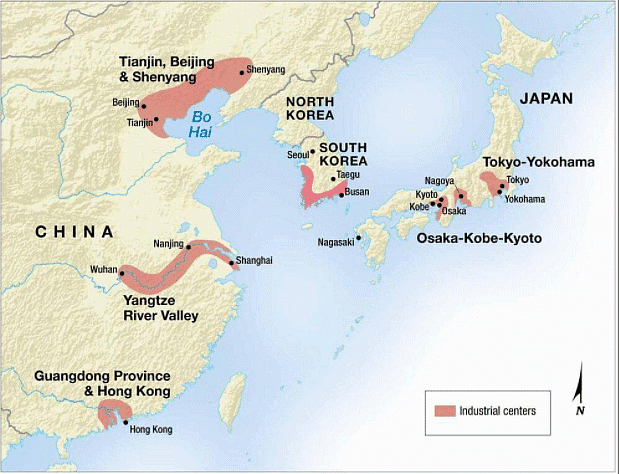
- Overview: Rapid industrial growth in recent times with significant contributions from Japan, China, India, Korea, and Taiwan.
- Key Regions:
- Japan’s Yokohama Region:
- Capital city of Kanagawa Prefecture, significant commercial hub.
- Industries: Shipping, biotechnology, semiconductors.
- China’s Manchurian Region:
- Major industrial hub with coal mines, iron and steelworks, aluminium reduction plants, paper mills, heavy machinery factories.
- Key Cities: Dalian (main commercial port).
- Calcutta Conurbation (India):
- India’s oldest and largest industrial region along the Hooghly River.
- Industries: Jute mills, cotton textiles, chemicals, drugs and pharmaceuticals, engineering, machine tools, automobiles, tobacco, food processing, leather, paper.
- Other Notable Regions:
- Japan: Osaka-Kobe, Chukyo, North Kyushu regions.
- China: Yangtze Valley, North China, South China regions.
- India: Bombay-Poona Megalopolis, Ahmedabad-Vadodara, Southern Industrial Region, Damodar Valley.
Other Major Industrial Zones:
- Magnitogorsk (Russia):
- Known for: Large iron ore reserves and steel production.
- Historical Importance: Supplied steel for the Soviet war effort during WWII.
- Donbas (Ukraine):
- Historical coal mining and heavy industrialization.
- Challenges: Dangerous working conditions due to deep mining and high levels of methane explosion.
- Kuzbass Region (Russia):
- Located in southwestern Siberia.
- Known for: Large coal deposits and significant industrial activities in metallurgy, mining, mechanical engineering, and chemical production.
- Appalachian Region (USA):
- Spans from southern New York to northern Mississippi.
- Known for: Coal mining, forestry, agriculture, chemical industries, and heavy industry.
- Economic Diversification: Shift towards manufacturing and service industries.
- Sao Paulo Region (Brazil):
- Brazil’s largest city and financial capital.
- Known for: Strong industrial character shifting towards services and businesses.
