
Indian Forest Types
Forests in India can be classified in different ways, according to their position, atmosphere, weather condition etc. Some of the common characteristics of various types of natural vegetation in India includes:
- Tropical rain forests,
- Tropical deciduous forests,
- Temperate broad leaf forests.
- Temperate needle leaf or coniferous forests
- Alpine and tundra forests, etc.
Apart from these, there are also some other types of forests are found in India like tidal forests, Himalayan vegetation, rain forests of southern India, desert region, etc.
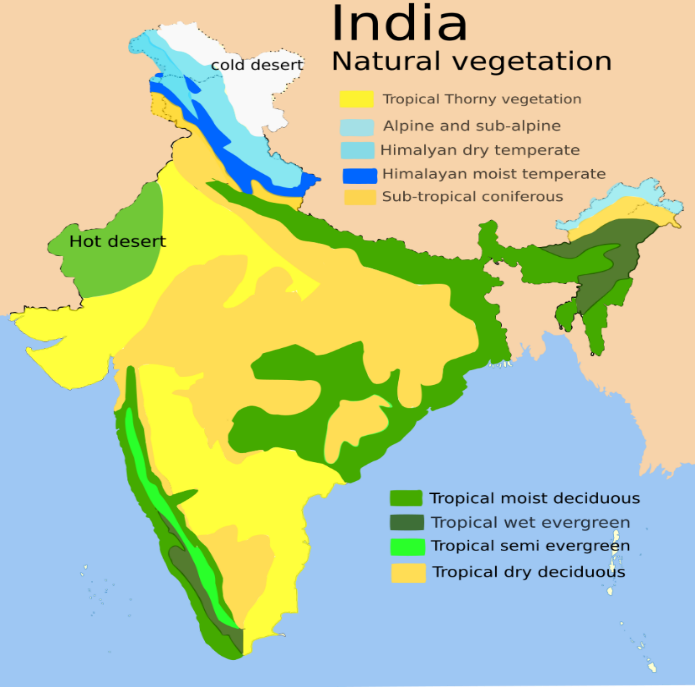
a. Tropical rain forests
The tropical rain forests are playing an important role in natural vegetation in India. These types of forests include the tropical evergreen forests and tropical semi-evergreen forests and they are mostly found in places where there is plenty of rainfall and sunshine throughout the year. Growth of the trees is usually at its best where rainfall is in surplus of 200 cm, with a short dry season. Such types of forests are found within rainy slopes of the Western Ghats, plains of West Bengal and Orissa and north-eastern India. Trees grow very briskly in these forests and attain heights of about 60 m and above. The number of species in these forests is too vast and too assorted to utilise each one of them commercially. Ebony, mahogany and rosewood are the main trees of these forests.
b. Tropical deciduous forests
Tropical deciduous forests are also known as deciduous (whether it is moist or dry) forests because they cast leaves for about six to eight weeks in summer. They are also called the monsoon forests with all their grandeur and beauty. This is so because they form a natural cover approximately all over India, especially within regions having 200 and 75 cm of annual rainfall. Most of the tropical deciduous forests are found in the state of Kerala in India. Apart from Kerala, these forests can be found in the eastern slopes of Western Ghats and also in the north eastern parts of the peninsular plateau and in the valleys of the Himalayas. The tropical deciduous forests are pretty substantial, cost- effective and they demand a lot of maintenance, as they are less resistant to fire. These forests can be divided into moist and dry deciduous forests. The moist deciduous forests are most commonly found on the eastern slopes of the Western Ghats. They are also found in the region of Chhotanagpur plateau, covering east Madhya Pradesh, south Bihar, and west Orissa, Shiwaliks in the northern India. Important trees of these forests are teak, sal, and sandalwood.
c. Temperate broad leaf forests
It mainly occur between 1500-2400 m altitudes in western Himalayas. Several species of Oak (Quercus) are found in these forests. Oak species are ever green in the Himalayan region. These species show peak leaf fall during summer but never become leafless. Height of the trees may be 25-30 m. Trees canopy is dense, herbaceaus layer is least developed and grasses are generally lacking. The Oak forests are often rich in epiphytic flora.
d. Temperate needle leaf or coniferous forests
This type of forests are found in the Himalaya over 1700 to 3000 m altitude. These forests contain economically valuable gymnospermous trees like pine (Pinus wallichiana) deodar (Cedrus deodara), Cypress (Cypressus torulosa), Spruce (Picea simthiana) and siver fir (Abies pindrow). Coniferous forests are taller 30-35 m and possess evergreen canopy of long needle like leaves. Canopy of these trees always remains green. In many species, it is cone-shaped.
e. Alpine and Tundra forests
The alpine and tundra forests is another kind of natural vegetation in India. Vegetation growing at altitudes above 3600 m is usually known as alpine vegetation and it can be noticed that with the increment of the altitude, the plants show stunted growth. The trees like silver fir, pine, juniper and birch belong to this category. The alpine grasslands are mainly found at higher altitudes in this region. The people belonging to the tribal groups like Gujjar and Bakarwal make extensive use of this region. The vegetations like lichen and mosses are also found in high altitudinal regions.
- The tidal forests provide another variety of natural vegetation in India. They can be found along the coasts and rivers and they are enshrouded by mangrove trees that can live in both fresh and salt water. Sundari is a renowned mangrove tree, mainly found in the tidal forests and it is after this tree that the name Sundarban has been entitled to the forested parts of the Ganga-Brahmaputra delta.
- The Himalayan vegetation is one of the major kinds of natural vegetation in India. The thick tropical forests in the eastern region of India have a sharp distinction with the pine and coniferous woodlands of the western Himalayas. Chir pine (Pinus roxburghii) grows throughout the northwest Himalayas, with the exception of Kashmir. Chilgoza (pine nut), oak, maple, ash (Fraxinus xanthoxyloides), etc also grow abundantly in the eastern Himalayas.
- The rain forests of Southern India are contributing hugely to the natural vegetation in India. The most luxuriant rain forests lie on the southwestern coast, in the state of Kerala. Here the lagoons are canopied by coconut trees and lead to the longest uninterrupted stretch of rain forests in the country. The Andaman and Nicobar Islands and the state of Arunachal Pradesh are some of the other regions with well preserved rain forests in India. Apart from that, dense sandal, teak and sisoo (Dalbergia sissoo) forests also flourish on the wet Karnataka plateau.
- The Thar Desert presents a wonderful picture of natural vegetation in India. The trees in this desert are short and stout, and stunted by the scorching sun. Cacti, reunjha (Acacia leucophloea), khejra (Prosopis spicigera), kanju (Holoptelia integrifolia), Oak (Calotropis gigantea) etc are common plants in this region. All the above-mentioned varieties of forests and areas are contributing hugely to the natural vegetation in India.
