
- India recognizes the crucial role of science, technology, and innovation in driving economic growth, societal development, and global competitiveness. In this regard India has formulated various policies and initiatives to foster a culture of innovation and research.
- Four major policies have been implemented since independence namely, Scientific Policy Resolution (SPR 1958), Technology Policy Statement 1983 (SPR 1958), Science and Technology Policy 2003 (STP 2003), and Science Technology Innovation Policy 2013 (STIP 2013)
Scientific Policy Resolution (SPR 1958)
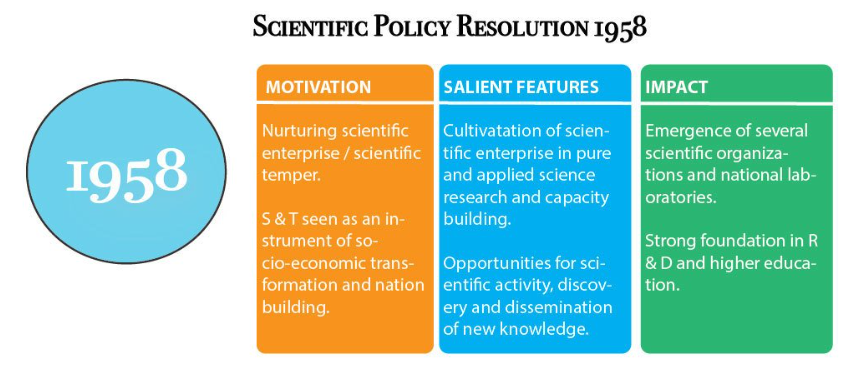
Technology Policy Statement (TPS 1983)
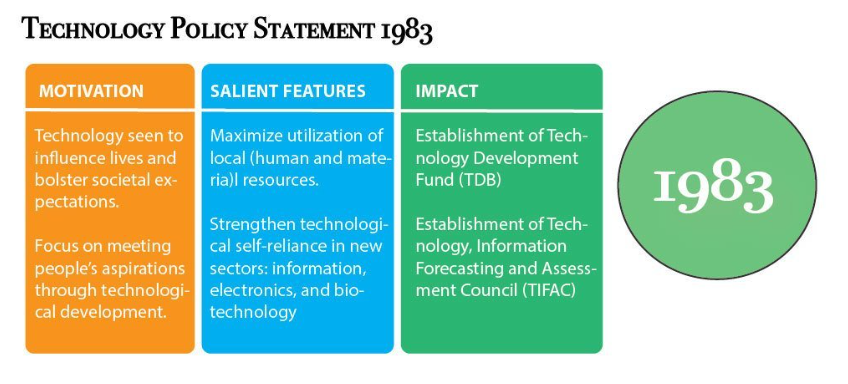
Science and Technology Policy (STP 2003)
-
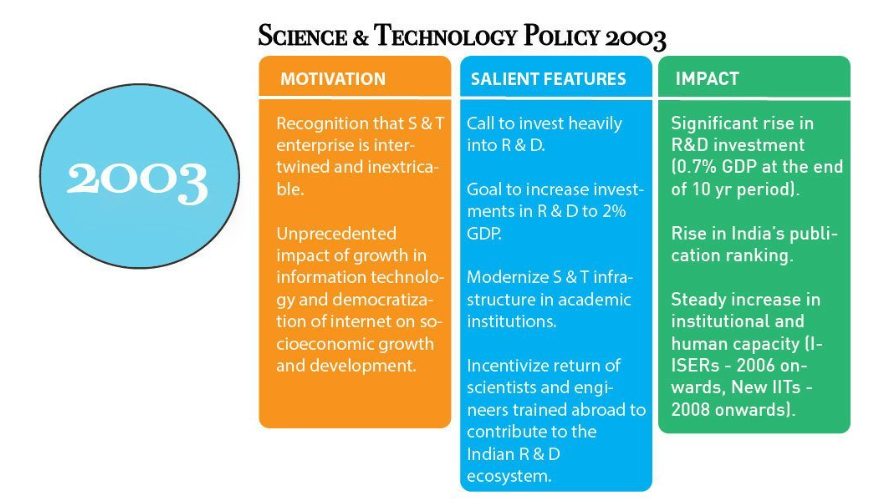
- Enacted to keep pace with global advancements, stay competitive, and achieve equitable and sustainable development.
- Emphasis on the simultaneous consideration of science and technology in policymaking.
Key Features:
-
- Mechanisms for gathering inputs from scientists and technologists for planning and policymaking.
- Call for increased R&D investment, aiming for 2% of GDP.
- Modernization of science and engineering infrastructure in academic institutions.
- Incentive mechanisms to attract Indian-origin scientists and engineers from abroad.
- Focus on R&D and innovation impacting the economy and society.
- Facilitation of interaction among stakeholders in the science and technology ecosystem.
- Cross-pollination of industry and scientific research.
- Establishment of intellectual rights regimes to protect and incentivize inventors.
- Emphasis on science diplomacy and international cooperation, especially with developing countries.
Science, Technology and Innovation Policy (STIP 2013)
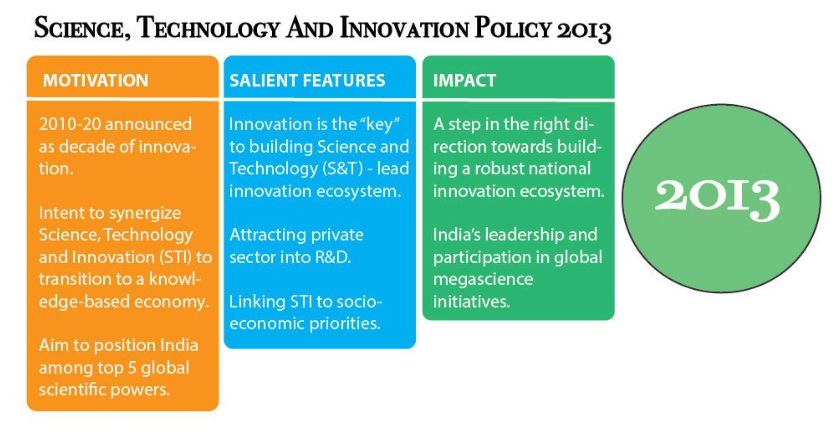
Decade of Innovation (2010-2020):
-
- Declared by Prime Minister Manmohan Singh to transition into a knowledge-based economy.
- Aimed at staying globally competitive and making India one of the top five global scientific powers.
Introduction of STIP 2013:
-
- Implemented to synergize science, technology, and innovation for national development.
- Placed a significant focus on the term “innovation.”
Key Objectives:
-
- Promotion of a science and technology-led innovation ecosystem.
- Linking science, technology, and innovation to socio-economic priorities.
National Innovation Ecosystem:
-
- Aimed at attracting private-sector contributions to the R&D ecosystem.
- Emphasis on directing scientific discoveries toward developmental priorities in key areas (agriculture, manufacturing, water, health, environment, and infrastructure).
Global Collaborations:
-
- Resulted in increased participation in global mega-science initiatives.
- Involvement in projects such as LIGO, LHC (CERN), ITER, SKA, showcasing India’s global scientific contributions.
Private-Sector Engagement:
-
- Encouraged private-sector involvement in research and development activities.
- Fostered collaboration between the public and private sectors for innovative solutions.
Impact Assessment:
-
- Ongoing assessment required to understand the policy’s comprehensive impact.
- Evaluation needed to measure the effectiveness of STIP 2013 in achieving its objectives.
STIP 2013 marked a crucial shift by integrating innovation into the science and technology policy framework. The focus on directing research outcomes towards socio-economic priorities and engaging the private sector reflected a strategic approach towards fostering a dynamic and impactful national innovation ecosystem.
Science, Technology and Innovation Policy (STIP 2020)
- The new policy, STIP 2020 revolves around the core principles of being decentralized, evidence informed, bottom-up, experts-driven, and inclusive. Also, it aims to be bring-in the concept of ‘dynamic policy’ with a robust policy governance mechanism incorporating features such as periodic review, policy evaluation, feedback, and adaptation, most importantly, a timely exit strategy for various policy instruments.
- STIP 2020 policy formulation framework involves 4 detailed tracks of activities and a coordination mechanism through a centralized secretariat. The STIP 2020 secretariat is coordinated, supported, and guided by Office of PSA, NITI Aayog and DST.
- The formulation process, by design, envisioned as a very inclusive and participative model with intense interconnectedness among different tracks of activities. As of today, some background work has been done in all the 4 tracks and an operational ground is prepared to take it further in full swing.
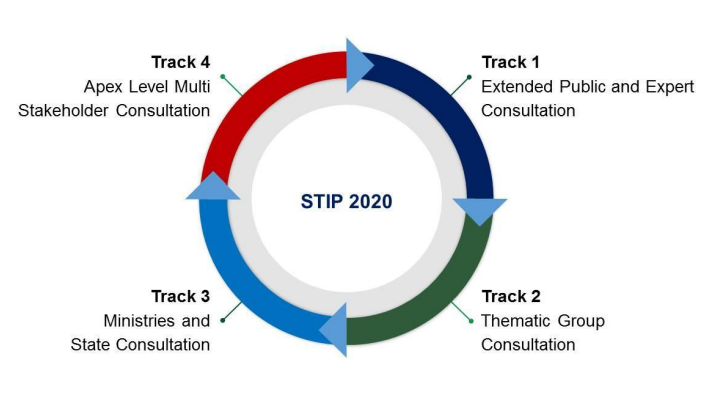
- Track-I (Public Consultation):
- Involves extensive public and expert consultations for broader stakeholder engagement.
- Aims to capture public aspirations and create a repository of voices guiding the drafting process.
- Includes six activities designed considering stakeholder limitations.
- Track-II (Thematic Group Consultations):
- Expert-driven thematic group consultations with 21 groups and 150+ experts.
- Focuses on providing evidence-informed recommendations for policy drafting.
- Track-III (Ministries and States Consultations):
- Connects ministries, departments, and states through nodal officers.
- Involves intra-state and intra-department consultations, strengthening regional STI ecosystems.
- Aims to create state-level STI policies aligned with the national STIP 2020.
- Track-IV (Institutional Coherence):
- Ensures institutional coherence by integrating inputs from all tracks.
- Involves apex-level multi-stakeholder engagement at national and global levels.
- Focuses on deliberations with young scientists, civil society organizations, ministries, state governments, and global partners.
