
Nuclear Triad
- India’s nuclear triad refers to its capability to deliver nuclear weapons from land, air, and sea platforms. India is considered to have developed a credible nuclear triad, enhancing its strategic deterrence capabilities. The three components of India’s nuclear triad are:
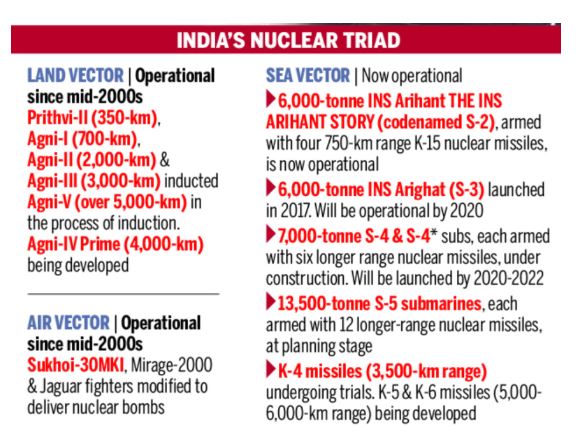
- Land-Based Missiles:
- Platforms: The land-based component of India’s nuclear triad primarily consists of ballistic missiles.
- Missile Systems: India has developed and deployed various land-based ballistic missile systems such as Agni series (Agni-I, Agni-II, Agni-III, Agni-IV, Agni-V), Prithvi series (Prithvi-I, Prithvi-II), and others.
- Locations: These missiles are deployed at different locations across the country.
- Air-Based Delivery:
- Platforms: The air-based component involves the use of strategic bombers or fighter aircraft capable of carrying nuclear weapons.
- Aircraft: India’s air-based nuclear capability is primarily maintained by the Indian Air Force (IAF). Aircraft like the Mirage 2000 and the Sukhoi Su-30MKI are considered part of the air-based nuclear delivery system.
- Nuclear-Capable Missiles: The IAF is equipped with air-launched nuclear-capable missiles like the BrahMos and Nirbhay.
- Sea-Based Delivery:
- Platforms: The sea-based component involves the deployment of nuclear-capable submarines.
- Submarine Fleet: India has developed nuclear-powered ballistic missile submarines (SSBNs) like INS Arihant. These submarines are equipped with ballistic missiles like the K-15 (Sagarika) and the K-4.
The nuclear triad is crucial for strategic stability and deterrence, as it ensures that even if one or two components are compromised, there is always a third option available for delivering nuclear weapons. The development of a nuclear triad enhances a country’s flexibility and robustness in maintaining a credible nuclear deterrent posture.
