Why in News?
The Government highlighted the transformation of India’s agricultural sector through higher public investment, increased production, expanded credit, insurance, irrigation, market access, food processing, digital technologies and growth in allied activities.
The policy approach has gradually shifted from limited welfare assistance towards a broader framework of productivity, income stability, risk protection, value addition and long-term agricultural resilience.
Growth of Agriculture and Allied Sectors
|
Crop Production and Food Security
- India’s total foodgrain production increased from 265.05 million tonnes in 2013–14 to 357.73 million tonnes in 2024–25, showing a substantial rise in agricultural output. This growth was driven by higher production of rice, wheat, maize and coarse cereals, including millets promoted as Shree Anna.
- The National Food Security and Nutrition Mission supported this expansion through improved seeds, better agronomic practices and wider adoption of technology in rice, wheat, pulses and coarse cereals.
- India emerged as the world’s largest rice producer, with production rising by 42.38% since 2014–15.
- Wheat production reached a record 117.94 million tonnes in 2024–25.
- Maize production increased by nearly 79% during the same period.
- Oilseed production rose from 27.51 million tonnes in 2014–15 to a record 42.99 million tonnes in 2024–25, an increase of about 56%.
- Edible-oil import dependence declined from 63.2% in 2015–16 to 56.25% in 2023–24, indicating gradual progress towards self-reliance.
- The horticulture sector has also emerged as a major source of agricultural growth. It contributes nearly 37% of the crop sector’s Gross Value Output, reflecting diversification towards high-value fruits, vegetables and other horticultural crops.
Farmer Welfare and Social Security
PM-KISAN
The Pradhan Mantri Kisan Samman Nidhi provides eligible farmer families with ₹6,000 annually through Direct Benefit Transfer. The scheme has reached more than 9.44 crore farmer families, with women receiving over 25% of the benefits.
Crop Insurance
- The Pradhan Mantri Fasal Bima Yojana provides affordable and comprehensive insurance against crop losses. It covers the entire crop cycle, including pre-sowing, standing crop and post-harvest risks.
- More than 4 crore farmers are insured annually, helping cultivators manage losses caused by natural disasters, pests and other uncertainties.
Pension Support
The Pradhan Mantri Kisan Maan-Dhan Yojana provides eligible small and marginal farmers with a monthly pension of ₹3,000 after the age of 60. Around 24.95 lakh farmers were enrolled under the scheme by February 2026.
MSP and Public Procurement
The Minimum Support Price protects farmers against sharp falls in market prices by providing a pre-announced price for agricultural produce.
- MSP is announced annually for 22 mandated crops.
- Since 2018–19, MSP has been fixed at least 50% above the cost of production.
- Public procurement has expanded significantly.
- The total value of MSP procurement during 2014–2026 was about 3.5 times the value recorded during 2004–2014.
These measures have strengthened price assurance, market support and income security for farmers.
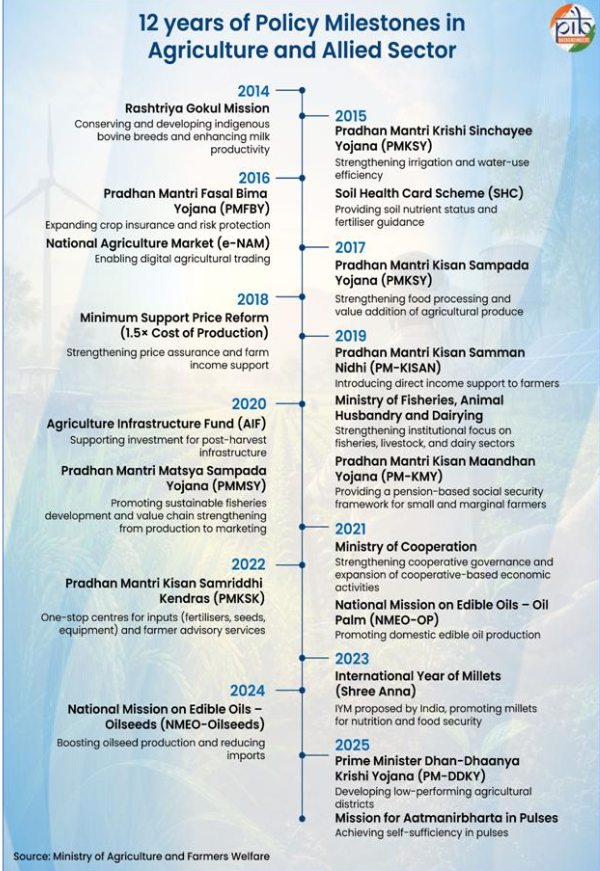
Agricultural Policy Reforms (2014-2026)
Livestock and Dairy: Drivers of Rural Economic Growth
India’s livestock sector has recorded strong growth, with a compound annual growth rate of 12.77% since 2014–15. The sector has become an important source of rural income, nutrition and employment.
India remains the world’s largest milk producer, contributing nearly 25% of global milk production.
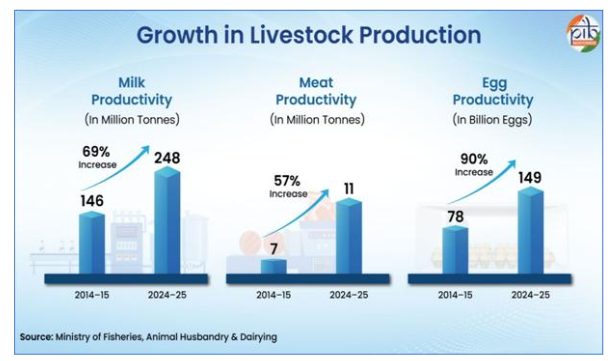
- Milk production increased from 146.31 million tonnes in 2014–15 to 247.87 million tonnes in 2024–25.
- This represents growth of more than 69%.
- Per capita milk availability rose to 485 grams per day, compared with the global average of 328 grams per day.
Productivity Improvements
- Indigenous cattle productivity increased from 927 kg in 2014–15 to 1,292 kg in 2023–24.
- Buffalo productivity increased from 1,880 kg to 2,161 kg.
- Overall bovine productivity improved from 1,648.17 kg in 2013–14 to 2,079 kg in 2024–25.
Poultry and Meat Production
India ranks second in egg production and fourth in meat production globally.
- Egg production increased from 78.48 billion in 2014–15 to 149.11 billion in 2024–25.
- Per capita egg availability rose from 62 to 106 eggs per year.
- Meat production increased from 6.69 million tonnes to 10.50 million tonnes.
These trends show the growing role of livestock, dairy and poultry in diversifying farm incomes and strengthening rural livelihoods.
Fisheries and Aquaculture
India’s fisheries sector has recorded an average annual growth rate of 8.74% over the past decade.
- Total fish production increased from 9.58 million tonnes in 2013–14 to 19.78 million tonnes in 2024–25.
- Inland fisheries and aquaculture production rose from 6.14 million tonnes to 15.16 million tonnes, an increase of about 147%.
Emerging Opportunities in Beekeeping and Bio Energy
Beekeeping and Honey Production
The National Beekeeping and Honey Mission, launched in 2020, promotes scientific beekeeping, pollination services and rural livelihoods.
- Honey production increased from 0.081 million tonnes to 0.152 million tonnes.
- Honey exports rose by about 240%.
Beekeeping provides additional income to farmers and supports crop productivity through pollination.
Bio-Energy and Ethanol Blending
Bio-energy has become an important part of agricultural diversification. It provides additional income to farmers while improving energy security.
Ethanol is produced from sugarcane by-products and foodgrains. The Ethanol Blended Petrol Programme promotes its blending with petrol to reduce crude-oil imports and support domestic production.
Major Progress
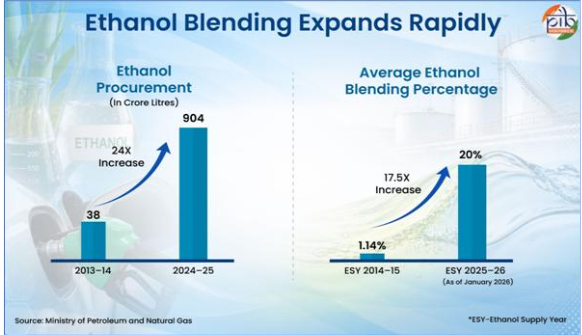
- Ethanol procurement increased from 38 crore litres in 2013–14 to 904 crore litres in 2024–25.
- The average blending level increased from 1.14% in 2014–15 to 20% in 2025–26.
- Sugar mills earned more than ₹1.29 lakh crore from ethanol sales.
- Investments of over ₹42,000 crore were mobilised in the sector.
The programme supports farmer income, sugar-industry stability and India’s clean-energy transition.
Agricultural and Processed Food Exports
India’s agricultural and allied exports have expanded due to higher production, improved processing capacity and better access to global markets.
- Agricultural exports increased from $37.29 billion in 2013–14 to $51.1 billion in 2024–25.
- This represents growth of nearly 37%.
India is a major global exporter of:
- Rice
- Spices
- Marine products
- Cotton
- Sugar
Growth of Processed Food Exports
- The share of processed food in agricultural exports increased from 13.7% in 2014–15 to 20.4% in 2024–25.
- This reflects greater value addition and improved global competitiveness.
Marine Exports
- Seafood exports increased from $3.64 billion in 2013–14 to around $7.52 billion in 2024–25.
- This represents growth of about 106%.
- Indian seafood now reaches more than 130 countries.
These developments show that India’s agricultural export basket is gradually moving from primary commodities towards processed, diversified and high-value products.Top of Form
Digital Agriculture and Precision Technologies
Technology is increasingly transforming Indian agriculture by improving planning, service delivery, risk management and access to timely information. Digital platforms are helping farmers obtain accurate advisories, government benefits and market-related services.
Digital Agriculture Mission
The Digital Agriculture Mission aims to create an integrated digital ecosystem by linking:
- Farmer databases
- Land records
- Crop information
- Agricultural services
- Government benefit-delivery systems
These systems improve beneficiary identification, agricultural planning and transparent delivery of government support.
Namo Drone Didi
The Namo Drone Didi initiative, launched in 2023, promotes the use of drones in agriculture through women Self-Help Groups.
- Total outlay: ₹1,261 crore
- Implementation period: 2023–24 to 2025–26
- 500 drones were distributed during 2023–24.
Women SHGs can provide drone-based agricultural services such as:
- Spraying fertilisers and pesticides
- Crop monitoring
- Precision application of inputs
- Field mapping
The initiative promotes modern farming while creating technology-based livelihood opportunities for rural women.
National Pest Surveillance System
The National Pest Surveillance System uses digital tools and field-level information to monitor pest attacks in real time.
Coverage
- 66 crops
- More than 432 pest species
- Over 10,000 field functionaries
The system provides early warnings and crop advisories, helping farmers respond quickly to pest outbreaks and reduce crop losses.
Kisan e-Mitra
Kisan e-Mitra provides farmers with digital information on agricultural schemes, services and government programmes.
- More than 95 lakh queries were handled by March 2026.
- The platform can process over 8,000 queries daily.
- It is available in 11 regional languages.
The multilingual platform improves the accessibility of agricultural information for farmers across different regions.
Agricultural Extension and Advisory Services
As agriculture becomes more technology-driven and climate-sensitive, farmer training and scientific advisory services have gained greater importance.
Extension services help farmers:
- Adopt improved farming practices
- Use new technologies
- Manage pests and diseases
- Respond to climate-related risks
- Improve productivity and resource efficiency
Krishi Vigyan Kendras
Krishi Vigyan Kendras, established by the Indian Council of Agricultural Research, serve as frontline agricultural training and knowledge centres.
- India has 731 KVKs.
KVKs conduct:
- Farmer training programmes
- Field demonstrations
- Technology testing
- Agricultural advisories
- Skill-development activities
They connect agricultural research institutions with farmers at the field level.
Agricultural Technology Management Agency
- The Agricultural Technology Management Agency supports decentralised agricultural extension at the district level.
- Overall, approximately 1.27 crore farmers were trained under ATMA between 2021 and 2025.
- ATMA strengthens district-level advisory services and promotes the adoption of locally suitable agricultural technologies.
Towards a Resilient Agricultural Ecosystem
India’s agricultural policy is gradually shifting towards a more integrated, technology-driven and farmer-centric system.
This transformation is supported by:
- Higher agricultural production
- Expanded institutional credit
- Crop insurance
- Increased MSP and procurement support
- Digital agricultural infrastructure
- Improved farm-to-market linkages
- Growth of food processing
- Expansion of livestock, fisheries and other allied activities
Digital technologies and extension services are improving the connection between scientific research, government institutions and farmers.
These interventions are strengthening productivity, income stability and risk management while laying the foundation for a more resilient, inclusive and sustainable agricultural sector.
Measures to Empower India’s Farmers
- Income and Insurance: Ensure timely PM-KISAN transfers and expand PMFBY coverage with faster claim settlement.
- Institutional Credit: Increase access to Kisan Credit Cards and affordable farm loans.
- Infrastructure: Develop warehouses, cold chains, processing units and farm-gate facilities.
- Technology: Promote Digital Agriculture, drones, Kisan e-Mitra, KVK and ATMA training.
- Sustainability: Expand natural farming, efficient irrigation, climate-resilient crops and solar pumps
Conclusion
Farmer empowerment requires an integrated approach combining income support, credit, insurance, infrastructure, technology and sustainability. The Centre must provide policy and financial support, while States and local institutions should adapt implementation to regional needs. Such coordination can improve productivity, resilience and income security.