
Generations of Mobile networks
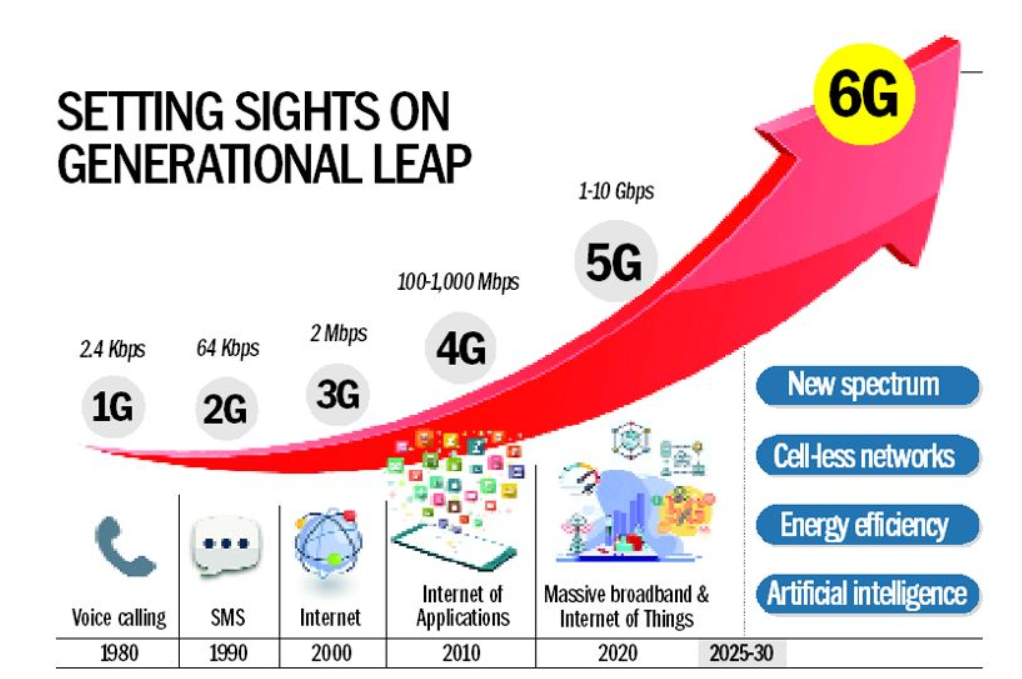
- 1G (First Generation):
- Timeline: 1980s
- Technology: Analog
- Peak Data Rate: 2.4 Kbps
- Key Features: Basic voice services
- Latency: High
- 2G (Second Generation):
- Timeline: Early 1990s
- Technology: GSM (Global System for Mobile Communications)
- Peak Data Rate: 9.6 Kbps to 384 Kbps
- Key Features: Digital networks, improved voice quality, SMS
- Latency: Medium to High
- 2.5G (General Packet Radio Service) (GPRS) and 2.75G Enhanced Data rates for GSM Evolution (EDGE):
- Timeline: Late 1990s (GPRS), Early 2000s (EDGE)
- Peak Data Rate: GPRS – Up to 171 Kbps, EDGE – Up to 1 Mbps
- Key Features: Introduction of packet-switched data
- Latency: Medium to Low
- 3G (Third Generation):
- Timeline: Early 2000s
- Technology: UMTS (Universal Mobile Telecommunications System)
- Peak Data Rate: Up to 14 Mbps
- Key Features: High-speed data transmission, video calling
- Latency: Medium to Low
- 3.5G High-Speed Packet Access (HSPA) and 3.9G (HSPA+):
- Timeline: Mid-2000s (HSPA), Late 2000s (HSPA+)
- Peak Data Rate: HSPA – Up to 42 Mbps, HSPA+ – Up to 168 Mbps
- Key Features: Improved data rates, network efficiency
- Latency: Medium to Very Low
- 4G (Fourth Generation – LTE):
- Timeline: 2009 onwards
- Technology: LTE (Long-Term Evolution)
- Peak Data Rate: Up to 1 Gbps
- Key Features: High-speed data, VoLTE, optimized IP-based communication
- Latency: Low
- 4.5G (LTE Advanced) and 4.9G (LTE Advanced Pro):
- Timeline: Late 2010s (LTE Advanced), Ongoing (LTE Advanced Pro)
- Peak Data Rate: LTE Advanced – Up to 3 Gbps
- Key Features: Enhanced LTE features, better IoT support
- Latency: Very Low
VoLTE, or Voice over Long-Term Evolution, is a telecommunications standard for the transmission of voice and multimedia communication services over 4G LTE (Long-Term Evolution) networks. It enables high-quality voice calls over LTE, offering faster call setup times and improved voice clarity compared to traditional 2G or 3G networks. VoLTE is commonly used in modern smartphones and mobile networks to provide voice services alongside high-speed data connectivity.Top of Form
- 5G (Fifth Generation – NR – New Radio):
- Timeline: 2020 onwards
- Technology: 5G NR
- Peak Data Rate: Up to 20 Gbps
- Key Features: Ultra-fast data, low latency, massive device connectivity, network slicing
- Latency: Extremely Low
- NSA (Non-Stand-Alone): Initial 5G deployment that relies on existing 4G infrastructure for control functions. Provides faster deployment but offers limited 5G features.
- SA (Stand-Alone): A complete and independent 5G implementation with its own 5G core network. Supports the full range of 5G features and capabilities.
100 5G Labs
- Prime Minister Narendra Modi announced the establishment of 100 5G labs across India that will serve as testing and breeding grounds for local innovators, students, and startups to develop a new range of applications in various sectors. This initiative unveiled at the India Mobile Congress 2023 will have a transformative impact on India’s technological landscape.
- It is believed that these 100 5G labs will play a crucial role in upskilling local innovators, students, and startups, fostering the development of a new generation of applications tailored to the country’s needs.
Bharat 6G
- “Design, develop and deploy 6G network technologies that provide ubiquitous, intelligent and secure connectivity for high quality living experience for the world”
- 6G Vision is based on principles of Affordability, Sustainability, and Ubiquity. The Vision for 6G is fully aligned with the national Vision of Atmanirbhar Bharat and will seek to empower every Indian to become Atmanirbhar (self-reliant) in their lives.
- At the same time, it ensures that India takes its rightful place in the world as a leading supplier of advanced telecom technologies and solutions that are affordable and contribute to the global good. The 6G Vision is thus timed just right for India’s Aazadi ka Amrit Kaal.
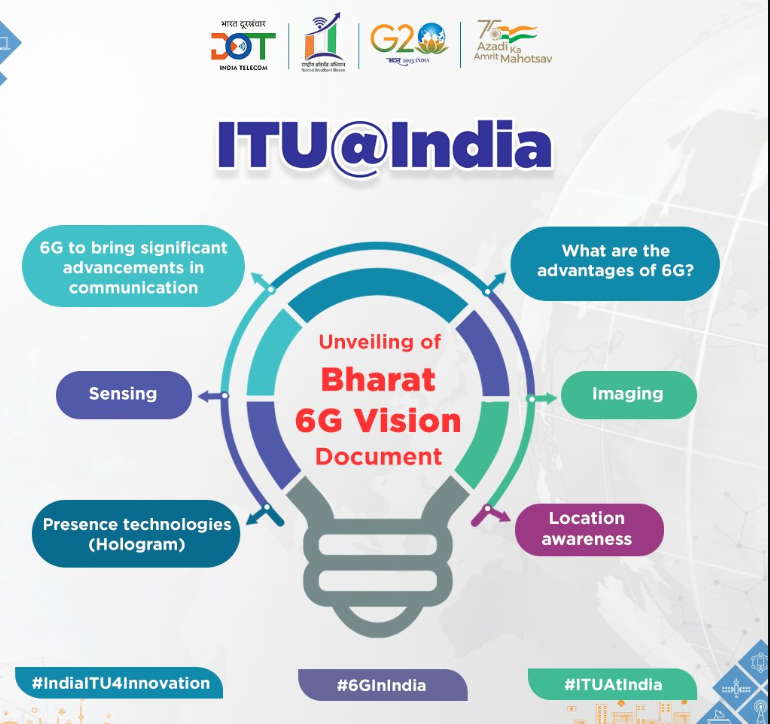
Bharat 6G Mission
- The research and start-up ecosystem will be tapped to bring innovations and new ideas to the table. Adequate provisions for financial support will be made available. The Mission will be completed in two phases:
- Phase 1 from 2023-2025 (2 years)
- Phase 2 from 2025-2030 (5 years)
Bharat 6G Mission – Objectives
- Facilitate and finance Research and Development, design and development of 6G technologies by Indian Startups/Companies/Research bodies/Universities;
- Enable India to become a leading global supplier of IP, products and solutions of affordable 6G telecom solutions;
- Deploy 6G technologies to act as a powerful force multiplier for India@2030;
- Enable inclusive and significant enhancement in the quality of living experience of citizens in India and across the world.
Bharat 6G Alliance – B6GA:
The Bharat 6G Alliance shall be an alliance of domestic industry, academia, national research institutions and standards organisations facilitated by the Government. The B6GA is expected to chart its own course of action based on the Bharat 6G Vision Document and further developments. B6GA will focus on the following:
- To help grow 5G Advanced/6G IPs and essential patents from India;
- Design and build Indian 5G Advanced/6G products and solutions;
- Support and energise Indian participation in 3GPP/ITU;
- To help build consortia of Indian Startups and companies;
- To facilitate market access for Indian 5G/6G technology products;
- Build coalition with like-minded 6G Global Alliances.
