Food Web
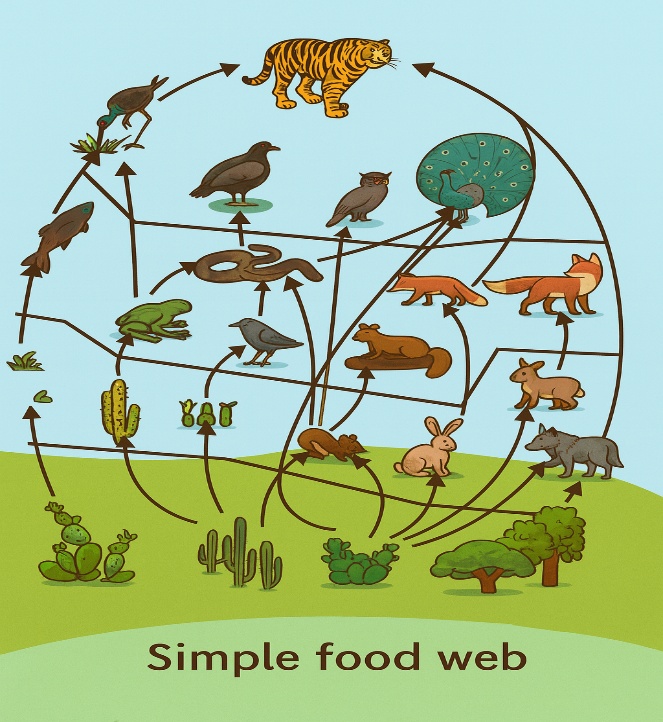
In an ecosystem, the trophic levels are not arranged in a simple linear sequence. Instead, they are interconnected, forming a complex network of food chains, known as a food web.
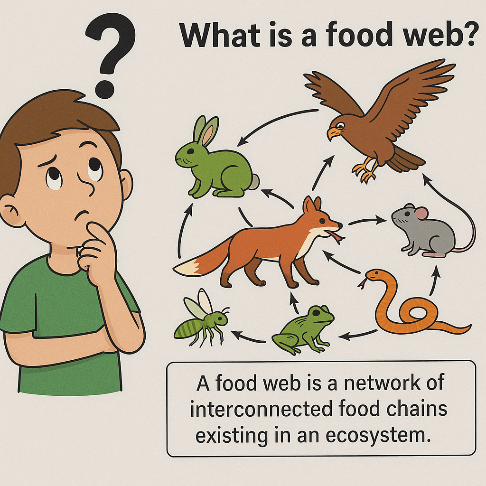
- A food web is defined as a network of interconnected food chains that operate simultaneously in an ecosystem. Since a single organism can participate in multiple food chains (feeding on different organisms and being eaten by various predators), food webs provide a more realistic representation of energy flow in nature.
- For example, an animal like a bird may eat both insects and fruits (occupying different positions in different chains) and can also be preyed upon by multiple predators.
Energy Flow in a Food Web
The flow of energy in an ecosystem, even within a food web, is always linear and one-way — from producers to successive trophic levels. At each trophic level, a portion of energy is used by the organism to sustain its own life processes, and only the remaining energy is passed on to the next level. This results in decreasing amounts of energy available at higher trophic levels, which is often illustrated by smaller boxes or narrower steps in diagrams.