
Faster Adoption and Manufacturing of Electric Vehicles (FAME) is the foremost policy providing direction to India’s new and emerging electric vehicle (EV) segment. Drafted by the Department of Heavy Industries (DHI) under the Ministry of Heavy Industries and Public Enterprises, two versions of this policy have been implemented – the FAME I announced in 2015 and the FAME II in 2019. The policy extends incentives only to specific EV models that meet certain policy criteria, such as category specifications and domestic content requirements.
FAME I (2015 – 2019)
- The first version of FAME came into effect in April 2015 for a two-year policy term, ending on 31 March 2017. Its term was later extended to 31 March 2019.
- This was the country’s first automotive policy aimed at encouraging sustainable mobility. The policy allotted INR 795 crore towards demand creation incentives, technology platforms, pilot projects and charging infrastructure; of which only INR 529 crore had been utilised.
- In its four years, it incentivised 2.78 lakh EVs by providing subsidies worth INR 343 crore and sanctioned 465 e-buses to various states.
- The first phase of the FAME I policy provided purchase incentives to all EV categories, namely – electric two-wheelers (e-2W), electric three-wheelers (e-3W), personal electric four-wheelers (e-4W), light commercial vehicles (LCV) and electric buses (e-buses).
FAME II (2019 – 2024)
- A new and improved FAME II policy was introduced by the DHI on 1 April 2019. The three-year policy term was subsequently extended for another two years, till 31 March 2024.
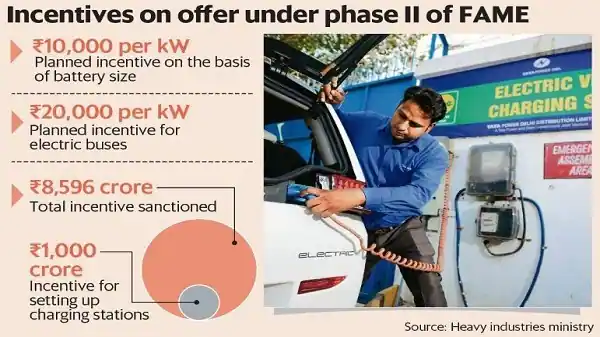
- With a whopping outlay of INR 10,000 crore, the policy focussed primarily on encouraging EV adoption through demand incentives and the creation of charging infrastructure.
- While the policy – still ongoing – covers all e-2Ws, demand incentives are directed explicitly towards ‘commercial’ vehicles only in all other categories. This includes e-3Ws, registered e-rickshaws, e-4Ws and e-buses.
- FAME II provides incentives of INR 10,000 for every kWh of battery capacity for all EVs, except e-buses. E-buses are provided a maximum demand incentive of INR 20,000/ kWh.
- National policies such as FAME I & II are crucial in boosting the adoption of electric vehicles in India. They play a key role in reversing EVs’ inherent price disadvantage and have helped grow the Indian EV sector over the past few years. Today, EV sales form more than 6 per cent of all vehicle sales in the country, as FY 2022-23 saw EV sales cross the 1 million unit mark for the first time.
