
Euclid Telescope
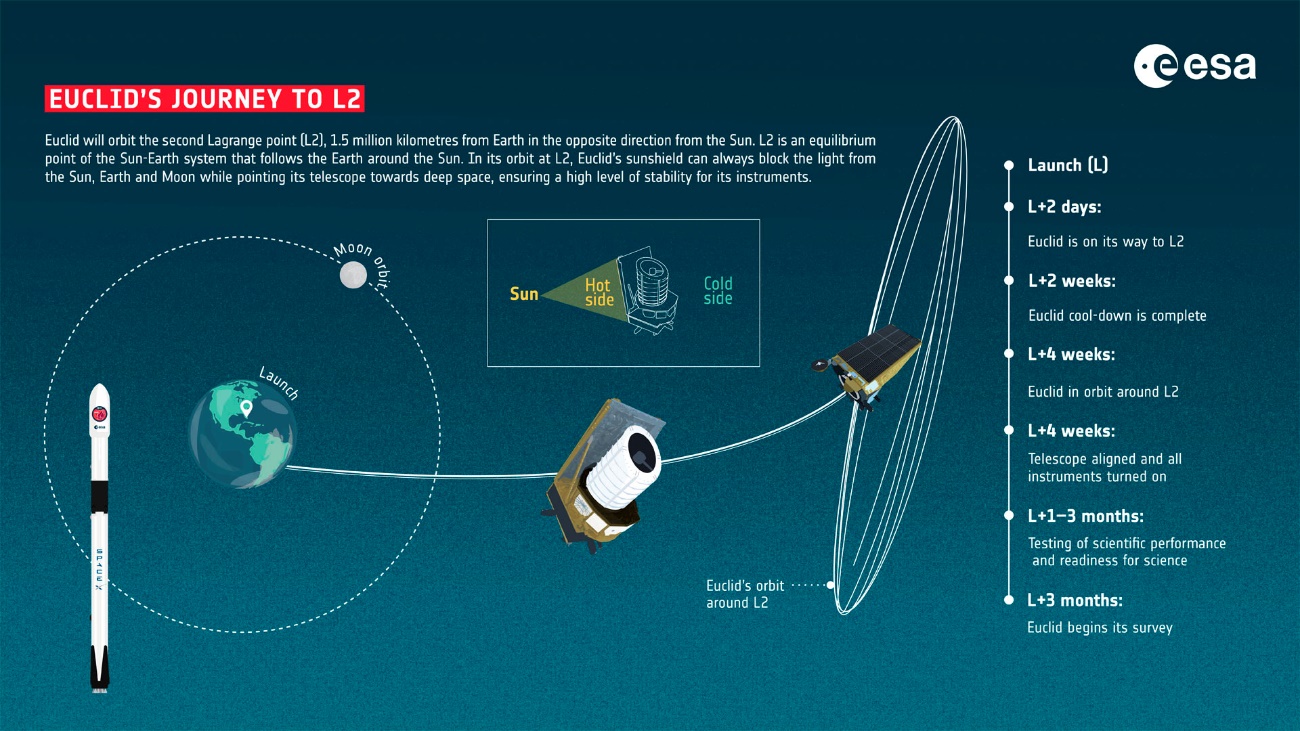
- Euclid spacecraft, developed by the European Space Agency, was successfully launched on a SpaceX Falcon 9 rocket from Cape Canaveral, Florida.
- The telescope’s mission is to create the most accurate three-dimensional map of the cosmos by recording over a third of the extragalactic sky over the next six years.
- Unlike the Hubble and James Webb Space Telescopes, Euclid will cover wide areas of the sky simultaneously, reaching back approximately one billion years after the Big Bang in three regions.
- The spacecraft will focus on understanding the influence of dark matter and dark energy on the universe’s structure and expansion.
- The data collected by Euclid is expected to provide insights into the distribution of dark matter, helping to refine efforts to detect and understand this elusive substance.
- The mission is also designed to test Albert Einstein’s theory of general relativity on cosmological scales and explore the dynamic properties of dark energy.
- Euclid will be positioned at the second Lagrange point (L2), nearly a million miles from Earth, to conduct its wide surveys without interference from Earth or the moon.
- Data analysis is set to begin in 2025, with subsequent releases in 2027 and 2030.
Fengyun-3F
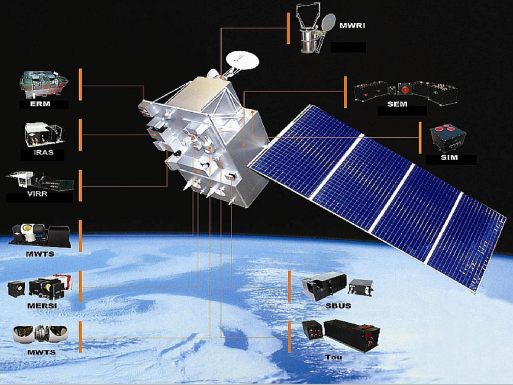
- China has successfully launched the Fengyun-3F satellite, adding it to the country’s fleet of meteorological spacecraft.
- The Long March 4C rocket lifted off from the Jiuquan Satellite Launch Center, carrying the satellite that will collect data for climate change, atmospheric chemistry, and atmospheric environment research.
- Fengyun-3F, developed by the Shanghai Academy of Spaceflight Technology, will operate in a nearly circular orbit at an altitude of around 501 miles (806 kilometers) with an inclination of 98 degrees, following a “morning orbit” as it passes the equator at 10:00 a.m. local time.
