

Ecology
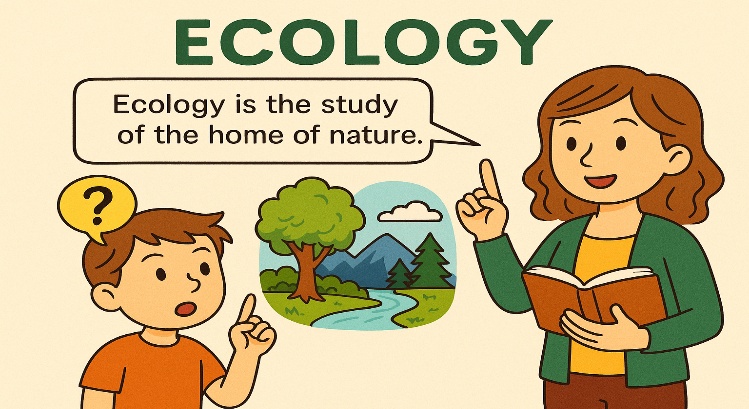
The word Ecology originates from the Greek words ‘Oikos’ (meaning home or place to live) and ‘Logos’ (meaning study). Thus, ecology literally means the study of the home of nature.
- Ecology focuses on how organisms adapt to their surroundings and how they utilize environmental resources like energy flow and mineral cycling.
Definition: Ecology is the scientific study of the relationship of living organisms with each other and with their environment |
History of Ecology
The roots of ecology lie in Natural History, which is as old as human civilization itself. Since early times, human beings have engaged with ecology in a practical manner, both knowingly and unknowingly. In primitive societies, each individual was required to have an intimate understanding of their environment for survival. This included knowledge about the forces of nature, as well as the plants and animals around them.
- Ancient Indian texts contain numerous references to ecological principles. Classical literature from the Vedic period, including the Vedas, Samhitas, Brahmanas, and the Aranyakas-Upanishads, frequently mention ecological ideas and concepts.
- The Charaka-Samhita, a renowned Indian treatise on medicine, and the Sushruta-Samhita, a surgical text, provide evidence that people during that era possessed a good understanding of plant and animal ecology. These texts classified animals based on their habits and habitats, and described land in terms of soil type, climate, and vegetation. Plants typical to different localities were also documented.
- Importantly, the Charaka-Samhita emphasized that air, land, water, and seasonal changes were essential for life. It also warned that polluted air and contaminated water could be harmful to health — a recognition of environmental hazards that remains relevant even today.
Environment and Its Components
The environment refers to everything that surrounds or affects an organism throughout its life. It includes all living and non-living components, as well as the various influences and events that occur around the organism.
Definition: The environment is the sum total of all living (biotic) and non-living (abiotic) components, along with the influences and interactions that surround and affect an organism. |
- Every organism—from a virus to a human being—relies on its environment and other organisms for essential needs such as food, energy, water, oxygen, and shelter.
- The relationship between organisms and their environment is highly dynamic and complex. It involves continuous interaction between biotic (living) and abiotic (non-living) components. These components are not static. Both biotic and abiotic factors are constantly in a state of change and flux, influenced by various natural and human-induced processes.
