
Ecological Succession
Biotic communities are dynamic in nature, meaning they change over time. The process by which one community of plants and animals in an area is replaced or transformed into another over time is called ecological succession.
- This process involves both biotic components (living organisms) and abiotic components (climate, soil, water, etc.) of the environment. The activities of the organisms and the physical conditions of the area together determine the nature, rate, direction, and limits of change.
- During succession, both plant and animal communities undergo gradual and predictable changes. Based on the starting conditions, ecological succession is classified into two types:
- Primary Succession
- Secondary Succession
Primary Succession
- Primary succession begins on bare, uninhabited areas, where no life previously existed and no soil is present.
- Such areas include bare rock outcrops, newly formed deltas, sand dunes, lava flows, volcanic islands, and glacial moraines exposed by retreating glaciers.
- The first plants to colonize such bare areas are called pioneer species, and together they form the pioneer community.
- Pioneer species typically have a high growth rate but short life span.
Primary succession is difficult to observe because very few places on Earth are completely devoid of life. It is also a slow process, since soil formation has to occur before most plants can grow.
- Over time, the pioneer community is replaced by another community with a different set of species. This process continues through a sequence of transitional stages, with each temporary community known as a seral stage or seral community.
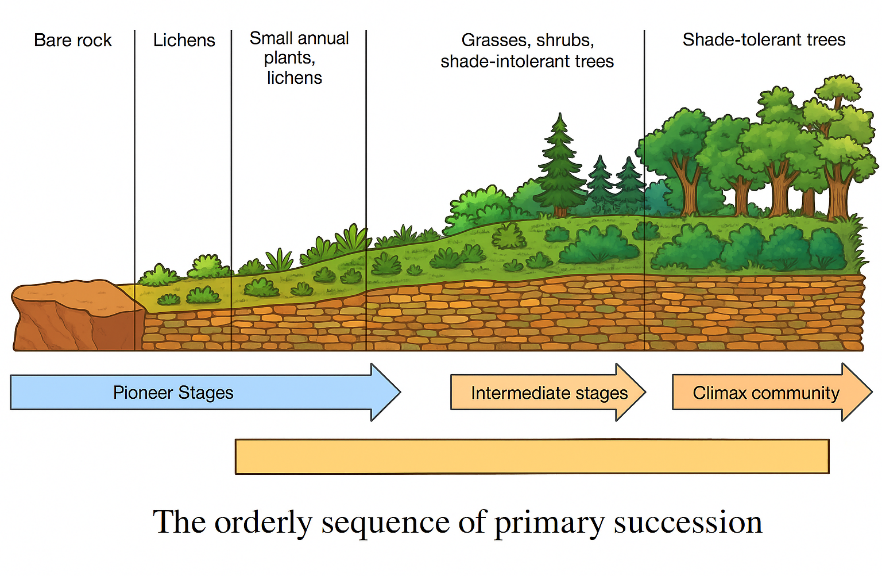
- Eventually, succession leads to the development of a climax community, which is mature, stable, and in dynamic equilibrium with the prevailing climate and habitat. The entire sequence of communities replacing one another during succession in an area is called a sere.
- Animal communities also undergo succession, largely influenced by plant succession and the ability of animals to migrate from neighboring areas.
Two special types of primary succession are:
- Xerarch succession: occurs in dry areas like bare rocks.
- Hydrarch succession: occurs in water bodies like ponds and lakes.
Secondary Succession
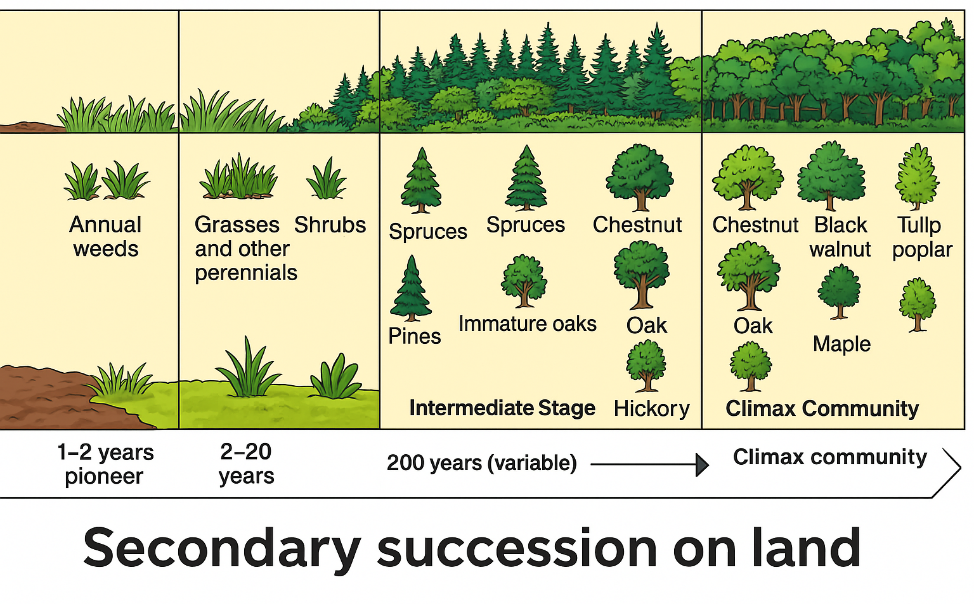
- Secondary succession occurs in areas where the original vegetation of a community has been disturbed, removed, or destroyed, but the soil and some living organisms remain.
- Such disturbances may be caused by natural events (like hurricanes, forest fires) or human activities (like farming, grazing, or deforestation).
- Since soil and dormant seeds are already present, secondary succession is faster compared to primary succession.
Autogenic and Allogenic Succession
- When ecological succession is driven by the living organisms of the community itself, it is called autogenic succession. For example, when plants modify the soil conditions, making it more suitable for the next seral community, it is an autogenic process.
On the other hand, when succession is initiated by external environmental forces (like wind, water, fire, or human activity) and not by the organisms themselves, it is called allogenic succession.
Autotrophic and Heterotrophic Succession
- When green plants (autotrophs) dominate the initial stages of succession and produce a large amount of biomass through photosynthesis, the process is called autotrophic succession.
Conversely, when heterotrophic organisms (like fungi, bacteria, and animals) dominate the early stages and depend on the breakdown of organic matter for their nutrition, the process is called heterotrophic succession.
