
coal
Coal, abundant in India, serves as a major fossil fuel for power generation, industrial, and domestic purposes. It exists in various forms based on compression levels, burial depth, and time. Peat, a low-grade form, is followed by lignite, mainly in Neyveli for electricity. Bituminous coal, widely used commercially, becomes metallurgical coal for iron smelting. Anthracite is the highest quality.
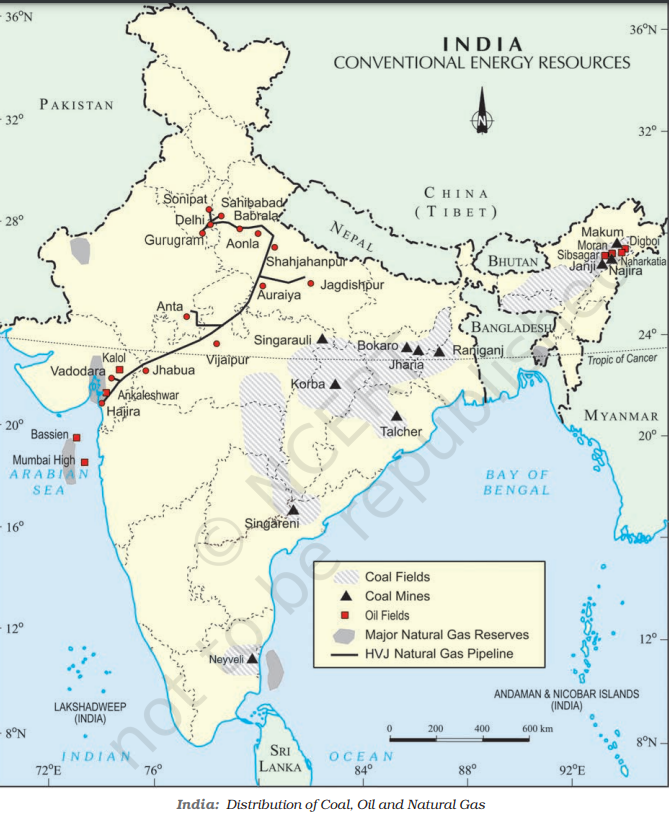
- In India, Gondwana coal, found in Damodar Valley, Jharia, Raniganj, and Bokaro, is over 200 million years old. Tertiary coals are in Meghalaya, Assam, Arunachal Pradesh, and Nagaland. Coal’s weight loss upon use makes coalfields proximity vital for heavy industries and thermal power stations.
Coal based thermal power plant
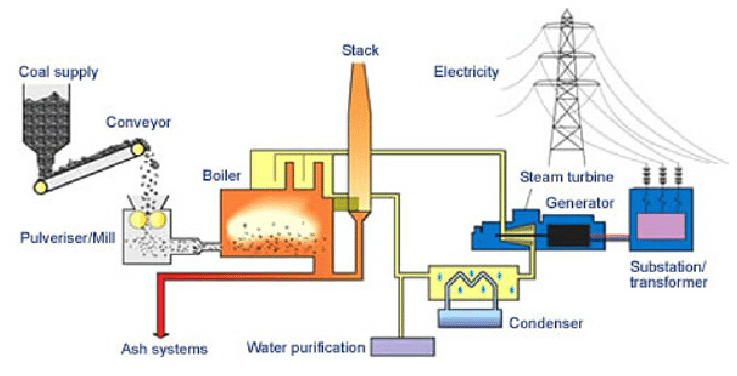
- A coal-based thermal power plant is a facility that generates electricity by burning coal to produce heat, which is then used to convert water into steam. The steam drives turbines connected to generators, ultimately producing electricity.
- After passing through the turbine, the steam is condensed back into water using a cooling system, often involving cooling towers or water from nearby rivers.
- The condensed water is returned to the boiler to be heated again, completing the cycle.
Petroleum
- Petroleum energy refers to the energy derived from petroleum, a fossil fuel that is a liquid mixture of hydrocarbons found beneath the Earth’s surface. Petroleum, commonly known as oil, is a crucial source of energy used for various applications, including transportation, electricity generation, and industrial processes.
- India’s petroleum reserves are often associated with anticlines and fault traps in tertiary rock formations. In regions of folding, like anticlines or domes, oil is trapped at the crest of upfolds. Mumbai High, Gujarat, and Assam are major petroleum production areas.
- Gujarat’s Ankeleshwar is significant, and Assam, the oldest oil-producing state, has fields like Digboi, Naharkatiya, and Moran-Hugrijan.
