
India’s diverse climatic conditions result from its vast latitudinal extent, geographical features like the Himalayas, and proximity to the Indian Ocean, Arabian Sea, and Bay of Bengal. Different climatic classification systems have been developed to categorize India’s varied climate. Koppen’s Classification is one of the most widely used systems. Here is an overview of Koppen’s classification and how it applies to India:
Koppen’s Classification of the Indian Climate
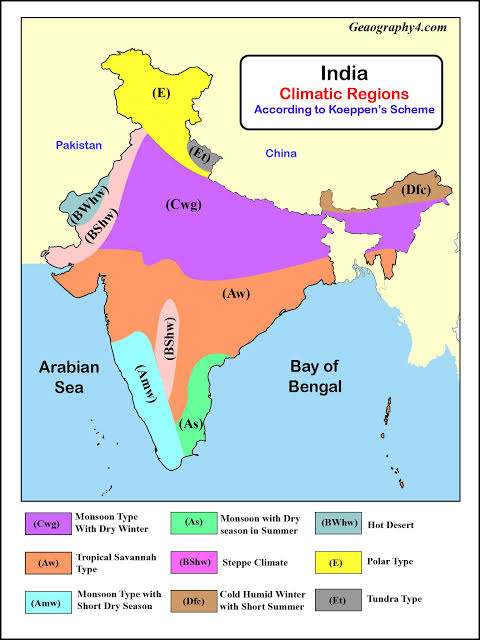 Koppen’s classification is empirical and based on climatic data, specifically mean monthly temperature and rainfall. It divides the world into different climatic types, each with subtypes reflecting seasonal variations. In India, these classifications help understand the diverse climatic regions across the subcontinent.
- Tropical Climates (A)
- Characteristics: Mean monthly temperatures exceed 18°C throughout the year.
- Subtypes in India:
- Tropical Rainforest (Af): High rainfall throughout the year with no significant dry season. Found in the Western Ghats, parts of North-East India, and the Andaman and Nicobar Islands.
- Tropical Monsoon (Am): Characterized by a short dry season and heavy monsoon rains. This type is found in parts of coastal Kerala, Karnataka, and Tamil Nadu.
- Tropical Savanna (Aw): Seasonal variation with a marked dry season. This type is prevalent in parts of Gujarat, Maharashtra, and parts of the Deccan Plateau.
- Dry Climates (B)
- Characteristics: Limited rainfall relative to temperature; classified into semi-arid and arid based on dryness.
- Subtypes in India:
- Semi-Arid (BSk): Occurs in regions with moderate rainfall, such as parts of Rajasthan, Gujarat, Punjab, Haryana, and the interior of the Deccan Plateau.
- Arid (BWk): Extremely dry with very low rainfall, found in the Thar Desert in Rajasthan and parts of Gujarat.
- Warm Temperate Climates (C)
- Characteristics: Mean temperature of the coldest month ranges from 18°C to -3°C.
- Subtypes in India:
- Humid Subtropical (Cwa): Characterized by hot summers, a cool winter, and a distinct dry season during winter. Found in parts of northern and eastern India, including the Gangetic plains.
- Subtropical Highland (Cwb): Cooler temperatures with mild winters, found in parts of the lower ranges of the Himalayas and the Western Ghats.
- Cool Temperate Climates (D)
- Characteristics: Mean temperature of the warmest month exceeds 10°C and that of the coldest month is below -3°C.
- Subtypes in India: Continental (Dfb): Found in the higher elevations of the Himalayas, with colder winters and warmer summers.
- Ice Climates (E)
- Characteristics: Mean temperature of the warmest month is below 10°C.
- Subtypes in India:
- Polar Tundra (ET): Found in the higher altitudes of the Himalayas where temperatures remain low throughout the year.
- Polar Ice Cap (EF): Extremely cold conditions with perpetual ice and snow, found in the highest peaks of the Himalayas.
Subtypes of Koppen’s Classification
Each major climatic type is further subdivided into subtypes based on specific characteristics of temperature and precipitation. The following small letters are used to denote these subtypes:
- f: Sufficient precipitation throughout the year.
- w: Winter dry season.
- s: Summer dry season.
- h: Hot and dry.
- g: Gangetic plain (specific to some areas).
- c: Less than four months with mean temperature over 10°C.
Example Subtypes:
- Af: Tropical Rainforest with adequate rainfall throughout the year.
- Aw: Tropical Savanna with a dry season in winter.
- BSk: Semi-Arid climate with less rainfall than the potential evaporation.
- Cwa: Humid Subtropical with dry winters and wet summers.
Based on Koppen’s climatic scheme, India can be divided into eight climatic regions
| Code | Climate type | Regions of India |
| Aw | Tropical Savanna | Most of the peninsular plateaus, south of the Tropic of Cancer. |
| Amw | Tropical monsoon with short dry season | West coast of India, south of Goa. |
| As | Tropical moist | Coromandel coast of Tamil Nadu |
| BShw | Semi Arid steppe | North-western Gujarat, parts of Rajasthan and Punjab. |
| Bwhw | Hot desert | Extreme western Rajasthan |
| Cwg | Monsoon with dry winters | Ganga plain, eastern Rajasthan, northern Madhya Pradesh, most of north-east India. |
| Dfc | Cold humid winter with short summer | Arunachal Pradesh. |
| E | Polar type | Jammu & Kashmir, Himachal Pradesh and Uttarakhand. |
