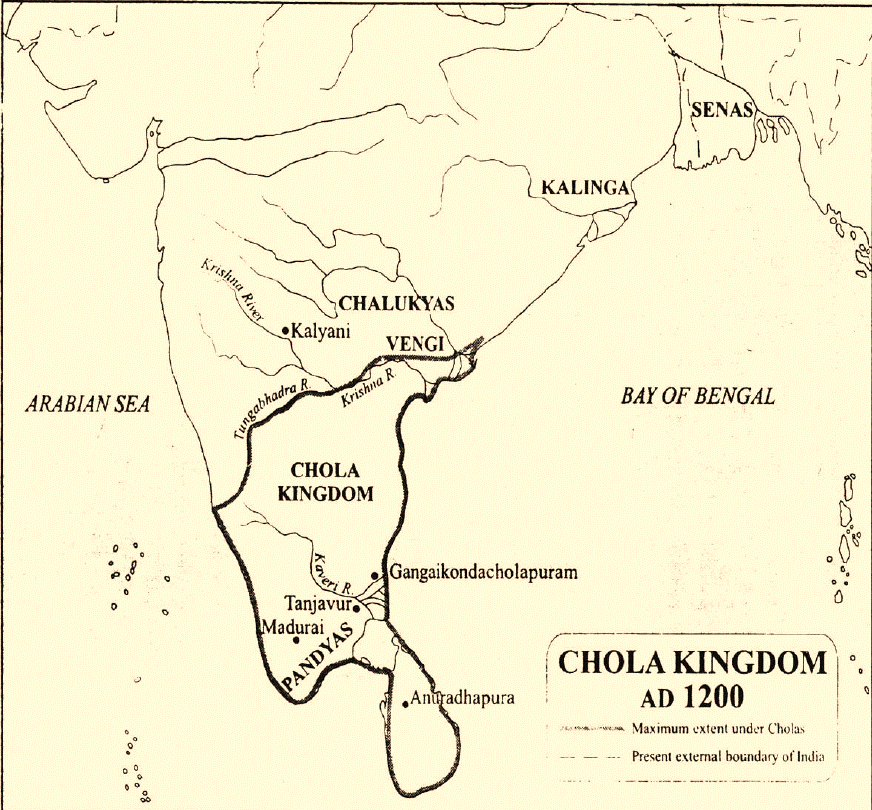
- Powerful kingdoms had risen in south India during the sixth and eighth centuries. The most important among them were the Pallavas and the Pandyas who dominated modern Tamil Nadu, the Cheras of modern Kerala, and the Chalukyas who dominated the Maharashtra area or the Deccan.
- Cholas became prominent in the ninth century and established an empire comprising the major portion of South India. Their capital was Tanjore. They also extended their sway in
- The Chola Empire, known for its vast territorial reach, extended its influence not only over South India but also over regions as far as Sri Lanka and the Malay Peninsula. This expansive rule earned them the title of the Imperial Cholas. Thousands of inscriptions discovered in temples offer valuable insights into various aspects of Chola governance, society, economy, and culture, providing detailed information about this significant period in history.
- The Chola Empire was founded by Vijayalaya, initially a feudatory of the Pallavas. He seized Tanjore in AD 850, marking the beginning of Chola dominance. By the late ninth century, the Cholas had not only defeated the Pallavas of Kanchi (Tondaimandalam) but also weakened the Pandyas, thereby asserting their control over the southern Tamil region.
- However, the Cholas faced challenges from the Rashtrakutas, particularly under the rule of Krishna III. In a significant setback, Krishna III defeated the Chola king and annexed the northern part of the Chola empire. Despite this setback, the Cholas quickly recuperated, especially following the demise of Krishna III in 965 and the subsequent decline of the Rashtrakuta empire. This period of turmoil eventually saw the resurgence of Chola power.
Chola Empire Founders and Key Rulers
Vijayalaya (847 – 871 AD)
- Founder of the Chola Empire: Vijayalaya captured Tanjore from the Muttaraiyars in 815 AD and built a Durga temple there.
- Establishment: Built the city of Thanjavur and established the Chola kingdom’s imperial line in 850 AD.
- Sources: The Kanyakumari inscription mentions the renovation of Tanjore by Vijayalaya.
Aditya (871 – 907 AD)
- Military Conquests: Aditya I ended the Pallava kingdom by defeating Aparajita and annexing Tondaimandalam.
- Relations with Cheras: Maintained cordial relations with the Cheras.
Parantaka I (907 – 955 AD)
- Title and Sources: Assumed the title “Madurain-konda” after capturing the Pandya capital, Madurai. The Uthiramerur inscriptions from his reign provide detailed accounts of village administration under the Cholas.
- Military Conflicts:
- Battle of Vellore: Defeated the Pandya ruler Rajasimha II and Kassapa V of Ceylon.
- Battle of Vallala: Defeated the Rashtrakuta ruler Krishna II in the Deccan.
- Battle of Takkolam: Was defeated by the Rashtrakutas in 948 AD, and his eldest son Rajaditya was killed in the battle.
- Relations with Cheras: Maintained friendly relations and married a Chera princess.
Period of Rapid Ascension (955 – 987 AD)
- This period saw rapid changes in the Chola throne from the death of Parantaka I to the ascension of Rajaraja I.
Rulers After Parantaka I:
- Gandaraditya Chola (955 – 956 AD): Second son of Parantaka I.
- Arinjaya Chola (957- 958 AD): Younger brother of Gandaraditya.
- Parantaka II Chola (958 – 973 AD): Son of Arinjaya. Defeated the Pandyas and Ceylon and recaptured Tondaimandalam from the Rashtrakutas.
- Uttama Chola (973 – 985 AD): Son of Gandaraditya. Ascended the throne after the assassination of Aditya II, son of Parantaka II.
Rajaraja I (985 – 1014 A.D.)
Under the reigns of Rajaraja I and his son Rajendra I, the Chola Empire reached its zenith, marked by several significant military conquests:
- Defeat of Chera Ruler Bhaskararavivarman: Rajaraja I achieved victory over the Chera ruler Bhaskararavivarman in the naval battle of Kandalursalai, leading to the destruction of the Chera navy.
- Defeat of Pandya Ruler Amarabhujanga: The Chola forces under Rajaraja I also defeated the Pandya ruler Amarabhujanga, asserting Chola authority over the Pandya country.
- Conquest of Gangavadi, Tadigaipadi, and Nolambapadi: Rajaraja I expanded Chola influence into the Mysore region by conquering territories such as Gangavadi, Tadigaipadi, and Nolambapadi.
- Invasion of Sri Lanka: Rajaraja I entrusted the invasion of Sri Lanka to his son, Rajendra I. The Cholas annexed northern Sri Lanka after the Sri Lankan king Mahinda V fled the country. Subsequently, the Chola capital was shifted from Anuradhapura to Polanaruva, where a grand Shiva temple was constructed.
- These military conquests not only expanded the territorial boundaries of the Chola Empire but also enhanced its prestige and influence in the region.
|
Chola Victory over the Western Chalukyas:
- Rajaraja I achieved a significant victory over the Western Chalukyas of Kalyani by defeating Satyasraya.
- This victory led to the capture of the Raichur Doab, Banavasi, and other strategic locations, extending Chola power up to the river Tungabhadra.
Restoration of the Vengi Throne:
- Rajaraja I restored the Vengi throne to its rightful rulers, Saktivarman and Vimaladitya, by defeating the Telugu Chodas.
- To strengthen this alliance, Rajaraja gave his daughter, Kundavai, in marriage to Vimaladitya.
Naval Expedition against the Maldives:
- Rajaraja’s last notable military achievement was a successful naval expedition against the Maldives, which he conquered.
Rajendra I (1012-1044 A.D.)
- Rajendra I, the son of Rajaraja I, demonstrated his military prowess early by participating in his father’s campaigns. Continuing his father’s aggressive expansionist policy, his significant military achievements include:
Conquest of Sri Lanka:
- Mahinda V, the king of Sri Lanka, attempted to reclaim the northern part of the island from the Cholas. Rajendra I defeated him, seizing southern Sri Lanka and thereby integrating the entire island into the Chola Empire.
Reassertion of Authority over Chera and Pandya Territories:
- Rajendra I reasserted Chola authority over the Chera and Pandya countries, ensuring the Chola dominance in the region.
Defeat of the Western Chalukyas:
- He defeated Jayasimha II, the Western Chalukya king, establishing the river Tungabhadra as the boundary between the Cholas and Chalukyas.
North Indian Expedition:
- Rajendra I’s most renowned military campaign was his expedition to North India. The Chola army crossed the Ganges, defeating several rulers along the way, including Mahipala I of Bengal.
- To commemorate this successful campaign, Rajendra I founded the city of Gangaikondacholapuram and constructed the famous Rajesvaram temple there. He also excavated a large irrigation tank called Cholagangam on the city’s western side.
- The Chola Empire continued to prosper during the twelfth century but declined in the early part of the thirteenth century. During this period, the Chalukyan empire in the Maharashtra region also collapsed, with the Pandyas and Hoysalas replacing the Cholas in the area.
- The Yadavas and the succeeding Chalukyas took the place of the former in the south, and Kakatiyas. These states provided support for the arts and architecture. Unfortunately, their constant conflict with one another made them weaker, often plundering the villages and even destroying the shrines. In the end, they were destroyed by the sultans of Delhi at the beginning of the fourteenth century.
Rajadhiraja (1044 – 1052 AD)
- Succession: Son of Rajendra I, ascended the throne in 1044.
- Titles: Jayamkonda Solan (The Victorious Cholan), Kalyanapuramkonda, Vijaya Rajendra Cholan.
- War Against Chalukyas: Lost his life at the Battle of Koppam against the Western Chalukyan King Someshwar. He was known as Yanai-mel-thunjina Devar (the king who died on an elephant).
Rajendra II (1052 – 1063 AD)
- Succession: Younger brother of Rajadhiraja, ascended the throne after Rajadhiraja’s death at the Battle of Koppam in 1052.
- Military Achievements:
- Defeated Western Chalukyan King Someshwar in the Battle of Kundal-Sangamam in 1062.
- Undertook expeditions to the Kalinga Kingdom (against King Vira Salamegha) and Sri Lanka (against Vijayabahu I).
- Contribution to Architecture:
- Expanded Ulagalantha Perumal Temple (Tamil Nadu) and Veetrirundha Perumal Temple, constructing a new shrine from fine black granite in Ulagalantha Perumal Temple.
- Granted the town of Ulakkaiyur gold to build the Agastheeswar Temple dedicated to Shiva.
Virarajendra Chola (1063 – 1067 AD)
- Military Conquests:
- Occupied Vengi after defeating Someshwar I and Vikramaditya VI (son of Someshwara I) of the Western Chalukyas.
- Defeated Someshwar II (son of Someshwara I).
- Led expeditions against Sri Lanka (against King Vijayabahu) and Kadaram.
Kulottunga I (1070 – 1122 AD)
- Succession: Grandson of Rajendra I through his daughter Ammangadevi, succeeded the Chola throne after Athirajendra Chola.
- Military Achievements:
- United the Vengi kingdom with the Chola Empire.
- Defeated Kalinga king Anantavarman Chodaganga.
- Contemporaries: Kamban and Jayakonda were scholars in his court.
Foreign Relations:
- Sent a large embassy of 72 merchants to China.
- Maintained cordial relations with the kingdom of Sri Vijaya.
Later Rulers
- Decline: Rulers after Kulottunga I were weak and unable to maintain the Chola empire.
- Last Chola King: Rajendra III, who was defeated by the Pandya King Jatavarman Sundarapandya II.