
Chandrayaan-3
- Launched on 14 July 2023
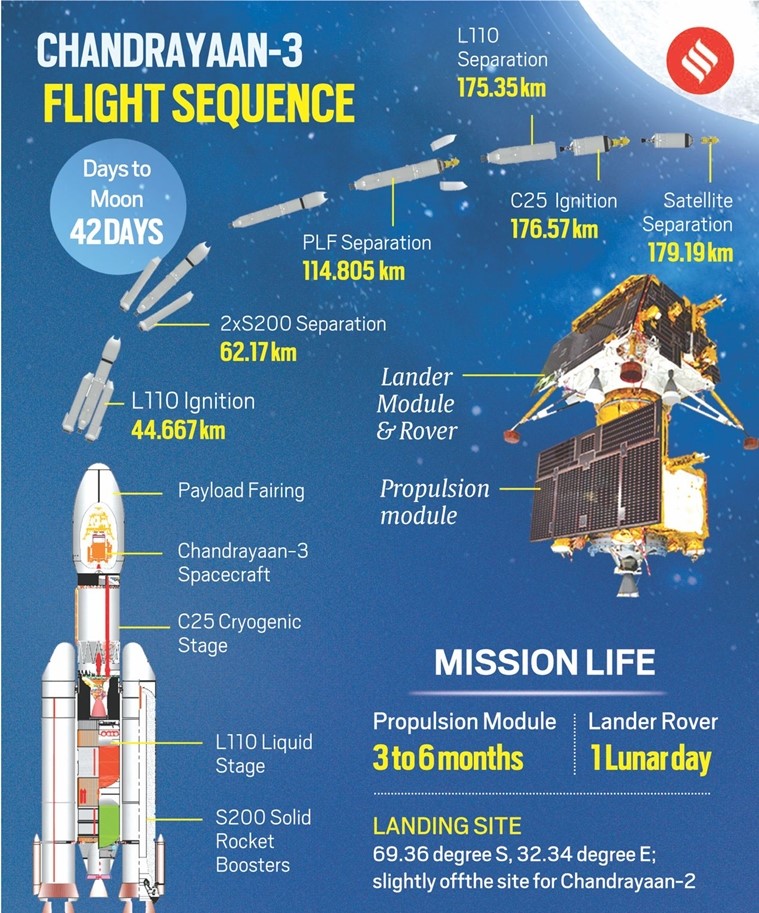
- Chandrayaan-3 is a follow-on mission to Chandrayaan-2 to demonstrate end-to-end capability in safe landing and roving on the lunar surface.
- It consists of Lander and Rover configuration.
- It will be launched by LVM3 from SDSC SHAR, Sriharikota.
- The propulsion module will carry the lander and rover configuration till 100 km lunar orbit.
- The propulsion module has Spectro-polarimetry of Habitable Planet Earth (SHAPE) payload to study the spectral and Polari metric measurements of Earth from the lunar orbit.
The mission objectives of Chandrayaan-3 are:
- To demonstrate Safe and Soft Landing on Lunar Surface
- To demonstrate Rover roving on the moon and
- To conduct in-situ scientific experiments.
Lander payloads:
- Chandra’s Surface Thermophysical Experiment (ChaSTE) to measure the thermal conductivity and temperature;
- Instrument for Lunar Seismic Activity (ILSA) for measuring the seismicity around the landing site; Langmuir Probe (LP) to estimate the plasma density and its variations.
- A passive Laser Retroreflector Array from NASA is accommodated for lunar laser ranging studies.
Rover payloads:
- Alpha Particle X-ray Spectrometer (APXS) and
- Laser Induced Breakdown Spectroscope (LIBS) for deriving the elemental composition in the vicinity of landing site.
Mission Life (Lander & Rover)- One lunar day (~14 Earth days)
In a momentous event that captured the historic landing of Chandrayaan-3, Prime Minister Narendra Modi announced the names of two significant lunar landing sites where Chandrayaan-3 landed and Chandrayaan-2 had crash-landed.
The spot where the Chandrayaan-3 landed on the south pole of the Moon will now be known by the name of Shivshakti Point, and the site where the Chandrayaan-2 lander crash-landed on the Moon’s surface in 2019 will be known as Tiranga Point.
PM Modi also declared that August 23, the date of Chandrayaan-3’s landing, will be celebrated as National Space Day in India, commemorating the historical achievement in the field of space exploration.
- Note: Chandrayaan-3’s Pragyan rover has found sulphur on the Moon’s south pole region. The discovery was made using the rover’s Alpha Particle X-ray Spectrometer (APXS). Sulphur is a relatively rare element on the Moon.
Chandrayaan-3’s historic landing: Unlocks mysteries of Moon
- With the successful landing of the Lander Module of ISRO’s third lunar mission Chandrayaan-3, India has reached the Moon. It has also become the first country to land near the Moon’s south pole.
- This achievement not only marks a monumental step for India but also offers substantial benefits for the world at large.
- The Moon’s south pole stands out with its extensive shadowed regions and frigid climate, suggesting the possibility of containing substantial deposits of water ice.
- These ice accumulations have formed over billions of years due to the extreme cold and limited exposure to sunlight. They hold immense value as resources for upcoming human missions, offering various applications such as drinking water, fuel generation, and life support systems.
- This unique region could play a crucial role in the establishment of potential lunar habitats.
- The scarcity of sunlight at the lunar south pole has preserved its surface in a pure state, safeguarding the Moon’s historical records. Geological formations, rock structures, and impact craters found here offer invaluable insights into the Moon’s origins, evolutionary processes, and geological changes over vast timescales.
- By studying these features, scientists can uncover valuable information about the Moon’s development spanning billions of years.
- The strategic proximity of water ice reserves near the Moon’s south pole presents an attractive prospect for the creation of lunar bases. The extraction and refinement of water resources become paramount for supporting extended missions and maintaining a human presence on the Moon. The perpetual shadowed areas in this region help stabilize temperature fluctuations, making them potential sites for constructing habitats that can bear up against extreme conditions.
- Polar craters have acted as cosmic collectors, capturing materials from the early phases of the Solar system, including comets and asteroids.
- The Moon’s south pole emerges as a treasure trove for investigating these celestial bodies, offering insights into their origins and structures. By studying these substances, researchers can enhance their understanding of the broader mechanisms that influenced the formation and progression of the Solar system.
- The Moon’s south pole provides great opportunities for conducting unhindered astronomical observations. With minimal interference from Earth’s atmosphere and light pollution, this location becomes ideal for conducting comprehensive explorations of space. Astronomers can delve into the study of remote galaxies, cosmic background radiation, and transient celestial events, yielding valuable information about the universe beyond our planet.
- Chandrayaan-3’s success will also offer invaluable opportunities for more collaborations with prominent space organisations like NASA and European Space Agency (ESA) in near future.
