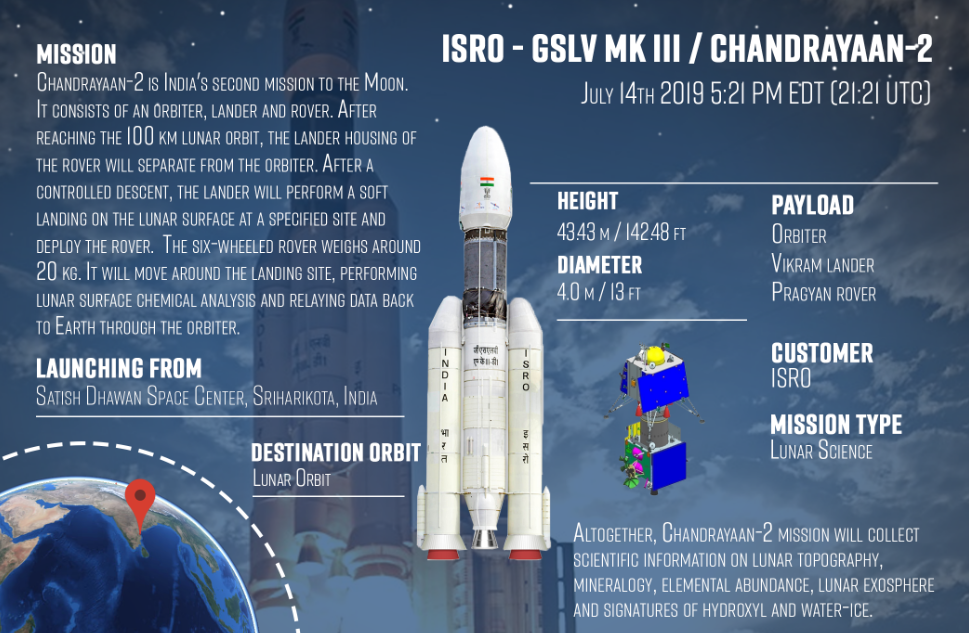
India’s Geosynchronous Satellite Launch Vehicle, GSLV MkIII-M1, successfully launched Chandrayaan-2 spacecraft on July 22, 2019 into its planned orbit with a perigee (nearest point to Earth) of 169.7 km and an apogee (farthest point to Earth) of 45,475 km.
Chandrayaan-2 mission is a highly complex mission, which represents a significant technological leap compared to the previous missions of ISRO.
It comprised an Orbiter, Lander (Vikram) and Rover (Pragya) to explore the unexplored South Pole of the Moon.
The mission is designed to expand the lunar scientific knowledge through detailed study of topography, seismography, mineral identification and distribution, surface chemical composition, thermo-physical characteristics of top soil and composition of the tenuous lunar atmosphere, leading to a new understanding of the origin and evolution of the Moon.
The Orbiter placed in its intended orbit around the Moon will enrich our understanding of the moon’s evolution and mapping of the minerals and water molecules in Polar regions, using its eight state-of-the-art scientific instruments.
The Orbiter camera is the highest resolution camera (0.3 m) in any lunar mission so far and will provide high resolution images which will be immensely useful to the global scientific community. The precise launch and mission management has ensured a long life of almost seven years instead of the planned one year.
However Vikram Lander failed to soft land on the Lunar surface.