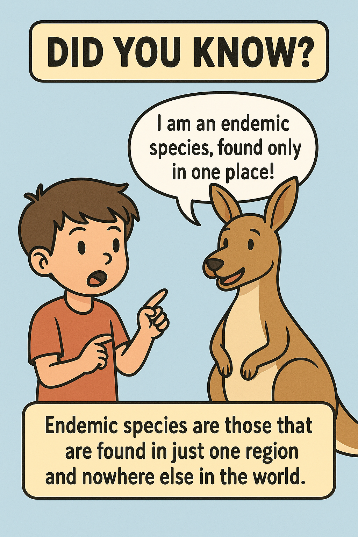
The term biodiversity hotspot was coined by Norman Myers in 1988 to highlight regions rich in endemic species but under severe threat from habitat loss. A biodiversity hotspot must meet two criteria:
- It must have at least 1,500 species of vascular plants as endemics (i.e., found nowhere else).
- It must have lost at least 70% of its original natural vegetation.
These areas are considered irreplaceable and highly threatened. Currently, there are 36 biodiversity hotspots globally, covering just 2.4% of Earth’s land surface, yet they shelter more than 50% of the world’s plant species and about 43% of bird, mammal, reptile, and amphibian species — all of which are endemic to these regions.
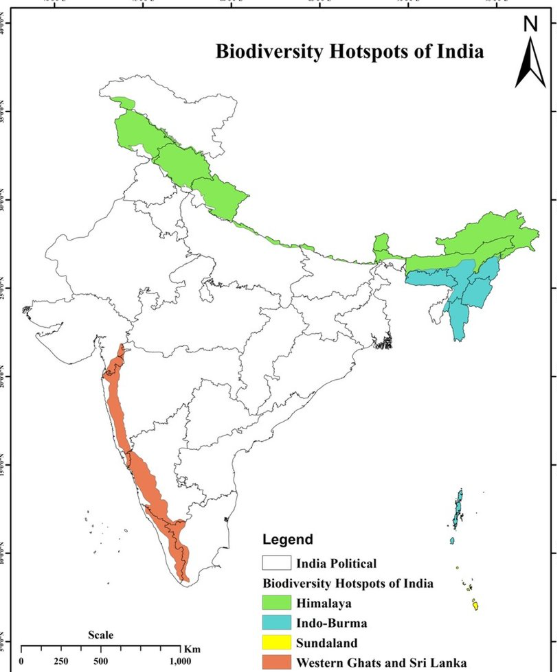
Among these, India hosts four biodiversity hotspots:
1. The Western Ghats and Sri Lanka Hotspot
The Western Ghats, extending about 1,600 km from northern Maharashtra to the southern tip of India, are among the most important biogeographic zones in the country. This region is home to a large number of endemic species, both floral and faunal.
- The Western Ghats have been recognized as a UNESCO World Heritage Site.
- The region includes 39 protected areas, such as national parks, wildlife sanctuaries, and reserve forests.
- The Ghats account for about 27% of India’s total flora.
- The Palghat Gap serves as an important ecological break in the mountain chain.
- Sri Lanka, located to the south of India and separated by the Palk Strait, also forms part of this hotspot.
2. The Nicobar Islands as part of the Sundaland Hotspot
The Andaman and Nicobar Islands lie in the Bay of Bengal, south of Myanmar. The Nicobar group of islands belongs to the Sundaland biodiversity hotspot, which extends into Southeast Asia.
- These islands receive high rainfall and support tropical evergreen forests.
- There are 11 major forest types found here.
- Although they make up just 0.25% of India’s land area, they harbor more than 10% of the country’s fauna species.
- The region supports many endemic and threatened species due to its geographic isolation and ecological richness.
3. The Indo-Burma Hotspot
This hotspot covers India’s northeastern states — Arunachal Pradesh, Assam, Manipur, Meghalaya, Mizoram, Nagaland, Tripura, and Sikkim — and extends into parts of Myanmar, Laos, Vietnam, and Cambodia.
- The region is part of the Eastern Himalayan ecosystem and is known for its rich floral and faunal diversity.
- It supports extraordinary plant species richness, including many species that are endemic and medicinally important.
- The Indo-Burma region is considered a priority zone for conservation by global organizations like IUCN and WWF.
4. The Eastern Himalayas as part of the Himalaya Hotspot
The Himalaya biodiversity hotspot includes the northeastern Himalayas of India, parts of Nepal, and Bhutan. This region contains some of the highest mountains in the world, including Mount Everest, and spans a wide range of altitudinal zones, creating diverse ecosystems.
- The Himalaya hotspot is home to nearly 10,000 plant species, of which 3,160 are endemic, along with 71 endemic genera.
- The largest plant family here is Orchidaceae, with around 750 species.
- The region supports nearly 980 species of birds (15 endemic) and around 300 species of mammals, including the golden langur and the critically endangered pygmy hog.
- Large mammals like tigers, rhinos, wild water buffalo, and elephants also thrive here, along with endangered vultures.