
Atmospheric Remote-sensing Infrared Exoplanet Large-survey- ESA
- The ARIEL mission from the European Space Agency (ESA) is a space telescope that can detect which atoms and molecules are present in the atmosphere of an exoplanet, looking to identify their temperatures and chemical processes. The mission will include a NASA instrument, CASE (the Contribution to ARIEL Spectroscopy of Exoplanets), which will observe clouds and hazes, and provide a more comprehensive picture of the exoplanet atmospheres ARIEL observes.
- LAUNCH- 2028
- OBJECTIVE- Explore the atmospheres of hundreds of exoplanets (planets orbiting stars beyond our Sun) for the first time
James Webb Space Telescope
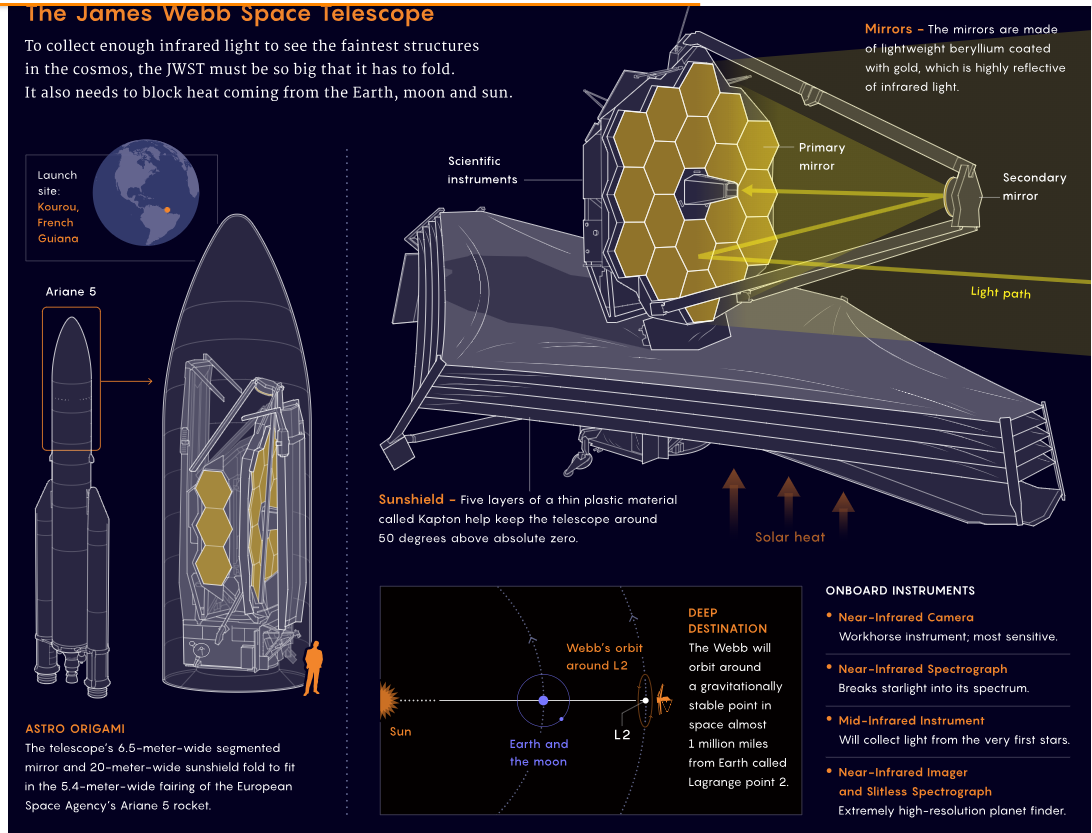
- Webb studies every phase in the history of our Universe, ranging from the first luminous glows after the Big Bang, to the formation of solar systems capable of supporting life on planets like Earth, to the evolution of our own Solar System.
- Webb launched on Dec. 25th 2021.
- It does not orbit around the Earth like the Hubble Space Telescope, it orbits the Sun 1.5 million kilometers (1 million miles) away from the Earth at what is called the second Lagrange point or L2.
- PARTNERS- NASA/ESA/CSA

Mars 2020: Perseverance Rover- NASA
- This rover and its aerial sidekick were assigned to study the geology of Mars and seek signs of ancient microbial life, collect samples of rock and soil for their possible return to Earth, and demonstrate the technology of the Ingenuity helicopter – the first aircraft to make a powered, controlled flight on another planet.
NASA’s Oxygen-Generating Experiment MOXIE Completes Mars Mission
- NASA’s MOXIE (Mars Oxygen In-Situ Resource Utilization Experiment) has successfully generated oxygen for the 16th and final time aboard the Perseverance rover on Mars.
- MOXIE has produced a total of 122 grams of oxygen during its operations, exceeding NASA’s original goals for the instrument.
- The device, about the size of a microwave oven, demonstrated the feasibility of extracting oxygen from Mars’ atmosphere, which could be used for future human exploration on the Red Planet.
- MOXIE’s success is seen as a crucial step in developing technologies for using local resources on the Moon and Mars, supporting long-term exploration efforts.
Top of Form

