APPSC Daily Current Affairs - 28th January 2026
Relevance:
GS Paper II: Governance, Urban Local Bodies, Government Policies & Interventions
GS Paper III: Disaster Management, Urban Flooding, Climate Resilience, Infrastructure
Why in News?
The Andhra Pradesh government has approved and implemented a Standard Operating Procedure (SOP) for scientific de-siltation and safe cleaning of urban drains across all Urban Local Bodies (ULBs) ahead of the monsoon, aiming to prevent flooding, improve sanitation, and ensure worker safety through technology-driven and accountable governance.
Key Features of the SOP
1. Shift from Ad Hoc to Scientific Drainage Management
- Replaces manual, irregular drain cleaning with planned, technology-driven maintenance
- Drain maintenance treated as core urban infrastructure function, not routine sanitation
2. Comprehensive Lifecycle Approach
Covers:
- Design and mapping of drains
- Routine maintenance schedules
- Monitoring and reporting
- Structural corrections to prevent recurring blockages
3. Classification-Based Maintenance
Drains classified into:
- Minor
- Medium
- Major
- Natural channels
Each category has separate, fixed cleaning schedules
4. Technology Integration
- GIS-based digital inventory of all urban drains
- Digital monitoring and reporting
- Mechanised cleaning using modern equipment
- Outcome-based contracts to ensure performance
5. Worker Safety and Accountability
- Mandatory use of Personal Protective Equipment (PPE)
- Municipal Commissioners made personally responsible for compliance
- Penalties for illegal dumping
- Citizen participation in monitoring
6. Climate-Resilient Urban Vision
Aligned with CM N. Chandrababu Naidu’s vision of:
- Flood-free cities
- Preventive governance
- Climate-resilient urban infrastructure
- Public health protection
Significance
- Reduces urban flooding and waterlogging
- Prevents vector-borne diseases
- Protects urban infrastructure
- Improves urban liveability
- Strengthens disaster preparedness before monsoon
- Promotes accountability-based urban governance
CARE MCQ
Q. With reference to Andhra Pradesh’s SOP for urban drain de-siltation, consider the following statements:
- It mandates GIS-based digital mapping of urban drains.
- Municipal commissioners are made accountable for implementation.
- The SOP focuses only on pre-monsoon drain cleaning.
- Statement 1 – Correct (GIS inventory mandated)
- Statement 2 – Correct (Commissioners responsible)
- Statement 3 – Incorrect (covers entire lifecycle, not only pre-monsoon)
Relevance:
GS Paper II – Federalism and Centre–State relations – Representation of the People Act and electoral reforms – Delimitation Commission
Important Keywords
For Prelims:
- Delimitation Commission, 84th Constitutional Amendment, Article 14, Lok Sabha seat allocation, Population vs representation.
For Mains:
- Federal justice, Democratic fairness, Moral paradox of governance, Cooperative federalism, Political equality vs numerical equality, Regional balance of power.
Why in News?
- The constitutional freeze on delimitation of Lok Sabha seats ends after the Census 2027, making redistribution of parliamentary seats unavoidable for the first time since 1976.
- The upcoming delimitation will fundamentally reshape political representation, federal balance, and democratic fairness in India.

Meaning and Significance of Delimitation
- Delimitation is the constitutional process of redrawing electoral boundaries and redistributing parliamentary seats based on population changes.
- While routine in theory, the exercise due after Census 2027 will be the most consequential since Independence.
- It will reshape:
- Representation in the Lok Sabha
- Federal balance among States
- Coalition politics
- The ethical idea of democratic fairness
Historical Context: The Frozen Constitution
- The Constitution originally mandated delimitation after every Census to ensure equal suffrage.
- In 1976, the inter-State distribution of Lok Sabha seats was frozen at 1971 population levels.
- Objective:
- Prevent States from being penalised for successfully controlling population growth.
- The 84th Constitutional Amendment (2001) extended this freeze until the first Census after 2026.
- Parliamentary representation still reflects an India of 548 million people, not today’s 1.47 billion.
- 2002–08 Delimitation Commission: Only redrew internal boundaries; did not reallocate seats among States.
- With Census 2027, the freeze expires, making redistribution constitutionally unavoidable.

Demographic Divergence among States
- In the 1970s, fertility rates across States were similar.
- Today, demographic patterns have diverged sharply:
- Southern and western States:
- Invested in education, health, women’s empowerment
- Achieved below-replacement fertility
- Northern States (U.P., Bihar, etc.):
- Continue to record higher population growth
- Southern and western States:
The Moral Paradox of Population-Based Delimitation
- Pure population-based redistribution would:
- Increase seats sharply for northern States
- Reduce proportional influence of southern States
- Projected Delimitation Impact (Lok Sabha ~888 seats)
- Uttar Pradesh → ~151 seats (from 80)
- Bihar → ~82 seats (from 40)
- Together → over 26% of total Parliament
- Tamil Nadu → ~53 seats (from 39)
- Kerala → ~23 seats (from 20)
- Change in Share of Lok Sabha (%)
- Tamil Nadu → from 7.2% to 6.0%
- Kerala → from 3.7% to 2.6%
- Southern States gain seats in absolute terms but lose share of total power.
- Moral paradox:
- States that followed national population policy lose influence
- States that failed gain power
- Hence, the ethical logic of the original freeze remains valid.

Arithmetic versus Political Assurances
- Political assurances that “no State will lose seats” offer limited comfort because:
- Parliamentary power depends on absolute numbers, not proportional retention.
- Even without seat loss:
- Bargaining power of southern States declines sharply.
- Extending the freeze indefinitely:
- Undermines democratic equality
- Risks violating Article 14 (Right to Equality)
Core Constitutional Dilemma
- The challenge is structural:
- Democratic equality demands representation based on population
- Federal justice demands protection for States that performed well
- Reconciling these two principles is the central problem of post-2027 delimitation.
Policy Options for Delimitation
1. Extend the Freeze
- Pros:
- Preserves current regional balance
- Cons:
- Denies fair representation to fast-growing States
- Constitutionally vulnerable under Article 14
2. Expand the Lok Sabha
- Increase strength to 750–900 seats
- Ensures no State loses seats
- But:
- Large States still dominate
- Southern concerns remain unresolved
3. Adopt a Weighted Formula
- Combine:
- Population (70–80%)
- Development indicators (20–30%)
- Indicators may include:
- Literacy
- Health
- Fertility control
- Rewards governance outcomes, not just numbers
- Similar to Finance Commission’s devolution formula
4. Strengthen the Rajya Sabha
- Restore domicile requirements for members
- Reform seat allocation to emphasise State equality
- Possible model:
- Large States – 15 seats
- Medium States – 10 seats
- Small States – 5 seats
- Revives Rajya Sabha as a true federal chamber
5. Bifurcate Uttar Pradesh
- Divide U.P. into 3–4 States
- Benefits:
- Prevents concentration of parliamentary power
- Addresses long-standing regional demands
- Acts as a federal solution, not just administrative reform
6. Phased Redistribution
- Implement delimitation over two election cycles:
- Half in 2034
- Remaining in 2039
- Reduces political shock
- Allows States and parties time to adjust
Why are Southern States Concerned About Delimitation After 2027?
1. Fear of Loss of Political Representation
Southern States with lower population growth may gain fewer seats compared to northern States.
- Example: Kerala may see no increase, Tamil Nadu about 26%, while Uttar Pradesh and Madhya Pradesh could see nearly 79% increase.
2. Threat to Federal Balance
A higher number of MPs from northern States could:
- Shift national policymaking priorities
- Increase pressure on southern States to accept unfavourable decisions
- Upset cooperative federalism
3. Discouragement to Good Governance
States that successfully implemented population control policies could be penalised with reduced representation, while high-fertility States gain advantage.
This creates a perverse incentive structure, undermining responsible governance.
4. Widening North–South Divide
Perceived political marginalisation may fuel:
- Demands for greater autonomy
- Calls for special status
- Regional alienation, affecting national unity
5. Skewed Resource Allocation
The Finance Commission uses population as a criterion for fund devolution.
Greater parliamentary strength of northern States may lead to:
- More central funds and schemes flowing northward
- Resource squeeze for better-performing southern States
6. Weakening of Regional Parties
Delimitation could tilt electoral arithmetic in favour of parties with strong northern bases, reducing the influence of southern regional parties in national politics.
Procedural Integrity and Democratic Trust
- Legitimacy depends on process, not just formulas.
- Delimitation Commission must:
- Include experts in demography, constitutional law, and federal studies
- Ensure meaningful State participation
- Conduct public consultations
- Special care required in:
- Redrawing SC/ST reserved constituencies
- Preventing perception of manipulatio
Significance of Delimitation 2027
- Will reshape coalition politics and centre–state power balance.
- Tests India’s commitment to:
- Federalism
- Political equality
- Cooperative democracy
- It is not just a technical exercise but a moral rebalancing of the Republic.
Conclusion
Delimitation after 2027 is inevitable, but its design is a political choice.
If guided by transparency, empathy, and innovation, it can modernise representation while reinforcing unity.
If driven by political arithmetic alone, it risks eroding trust and damaging India’s federal spirit.The Census will count India’s people; delimitation will judge its democracy.
UPSC PYQ
Q. How many Delimitation Commissions have been constituted by the Government of India till December 2023? (2024)
(a) One(b) Two
(c) Three
(d) Four
Ans (d)
CARE MCQ
Q. Consider the following statements regarding delimitation after 2027:
- The inter-State distribution of Lok Sabha seats has been frozen since 1976 based on 1971 population.
- The 84th Constitutional Amendment extended this freeze until after the Census 2026.
- Population-based delimitation may reduce the relative representation of southern States.
Which of the statements given above is/are correct?
A. 1 and 2 only
B. 2 and 3 only
C. 1 and 3 only
D. 1, 2 and 3
Answer: D
Explanation:
Statement 1 is correct.
The inter-State allocation of Lok Sabha seats was frozen by the 42nd Constitutional Amendment Act, 1976 on the basis of the 1971 Census population. This was done to ensure that States implementing effective population control measures were not penalized with a reduction in their political representation.
Statement 2 is correct.
The 84th Constitutional Amendment Act, 2001 extended this freeze on the inter-State distribution of Lok Sabha seats until after the first Census conducted after 2026 (i.e., Census 2027). However, it allowed for readjustment of constituency boundaries within States based on the 2001 Census without altering the total number of seats per State.
Statement 3 is correct.
If delimitation is carried out strictly on the basis of population after 2027, States with higher population growth—mainly in northern and central India—are likely to gain more seats, while southern States that have achieved lower fertility rates may see a decline in their relative share of representation in the Lok Sabha. This raises important federal and equity concerns.
Relevance:
GS Paper II – Indian Constitution; Parliament; Security Forces & their mandate
Democratic institutions; constitutional values
Important Keywords
For Prelims:
- Constitution of India, Purna Swaraj, Vande Mataram, Government of India Act, 1935, Bankim Chandra Chatterjee
For Mains:
- Historical significance of Republic Day; Purna Swaraj; transition from colonial rule to constitutional democracy
Why in News?
Republic Day 2026 marked the 77th anniversary of the Constitution of India coming into force on 26 January 1950. Celebrated under the theme “150 Years of Vande Mataram”, the observance blended constitutional values with cultural expression and mass public participation, reaffirming India’s transition from colonial rule to a constitutional democracy.
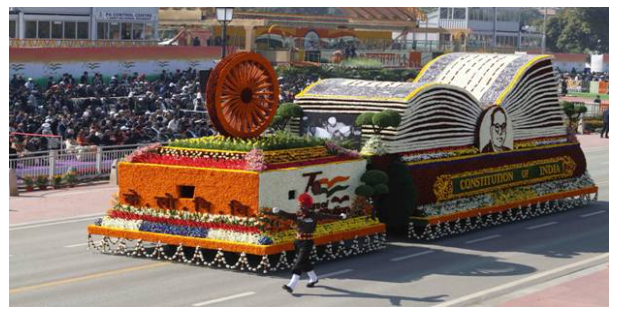
Republic Day: Completing India’s Democratic Transition
While Independence Day (15 August 1947) ended colonial rule, the adoption of the Constitution of India completed India’s transformation into a Sovereign Democratic Republic. Republic Day symbolizes the rule of law, institutional accountability, and sovereignty vested in the people.
Annual celebrations bring constitutional ideals into the public domain—most visibly through the national parade at Kartavya Path—and through nationwide flag-hoisting and civic programmes that make Republic Day a shared civic occasion.
77th Republic Day (2026): Theme & National Participation
Theme: “150 Years of Vande Mataram”
The theme linked the freedom struggle, cultural expression, and contemporary national aspirations, placing the national song at the heart of the celebrations.
Parade Highlights (Kartavya Path, New Delhi)
- 30 tableaux by States, Union Territories, and Ministries on:
- Swatantrata ka Mantra – Vande Mataram
- Samriddhi ka Mantra – Atmanirbhar Bharat
- 2,500 artists in cultural presentations
- ~10,000 Special Guests (farmers, artisans, scientists, innovators, women entrepreneurs, students, sportspersons, beneficiaries of flagship schemes, frontline workers)
- Military firsts:
- Debut of the Bhairav Battalion (specialised assault infantry unit)
- Participation of a European Union military contingent—EU’s first such participation outside Europe
Citizen-Centric Outreach
Through platforms like MyGov and MY Bharat, citizens—especially youth and creative communities—participated via:
- Essay competition on Swatantrata ka Mantra – Vande Mataram
- Painting contest on Samriddhi ka Mantra – Atmanirbhar Bharat
- Singing competitions featuring Vande Mataram
- Quizzes on the evolution of Vande Mataram, India’s achievements in space and sports, and national development initiatives
Selected winners were associated with Republic Day events, strengthening people-to-people engagement.
Why 26 January? From Purna Swaraj to the Republic
26 January 1930 – Purna Swaraj
At the INC Lahore Session (1929), presided over by Jawaharlal Nehru, the Purna Swaraj resolution was adopted. 26 January 1930 was observed nationwide as Purna Swaraj Day, rejecting dominion status and committing to complete independence. From 1930 to 1947, the date was celebrated as Independence/Poorna Swaraj Day.
9 December 1946 – Constituent Assembly Begins Work
The Constituent Assembly of India met at the Constitution Hall (now Central Hall of Parliament), initiating constitution-making.
- Worked for 2 years, 11 months, 17 days
- 11 sessions over 165 days, with 114 days on the Draft Constitution
- A representative, deliberative process
15 August 1947 – Independence
India attained independence but continued as a British Dominion until the Constitution came into force.
26 November 1949 – Constitution Adopted
After extensive debates on rights, governance, federal balance, and social justice, the Constitution was adopted—this date is recorded in the Preamble.
26 January 1950 – Constitution Comes into Force
Chosen deliberately to honour Purna Swaraj (1930), the Constitution replaced the Government of India Act, 1935, established the President of India as Head of State, and inaugurated constitutional governance.
The 42nd Constitutional Amendment (1976) later added Socialist and Secular to the Preamble.
Tableaux Highlights at the 77th Parade
- Assam: Asharikandi terracotta craft
- Gujarat: Tribute to Madam Bhikaji Cama; evolution of the National Flag (1906–1947); Mahatma Gandhi with the Charkha
- Uttar Pradesh: Bundelkhand’s cultural heritage and development
- Maharashtra: Ganeshotsav as a social movement (Lokmanya Tilak)
- West Bengal: Origins of Vande Mataram by Bankim Chandra Chatterjee; freedom fighters including Subhas Chandra Bose, Matangini Hazra, Khudiram Bose
- Punjab: Tribute to Sri Guru Tegh Bahadur Sahib Ji (350th martyrdom year)
- Kerala: Kochi Water Metro; 100% Digital Literacy
- Tri-Services (DMA): Operation Sindoor – Victory Through Jointness (Rafale with SCALP, BrahMos, S-400, HAROP)
- Ministry of Culture: 150-year journey of Vande Mataram
- MHA (NDMA & NDRF): Recovery after the 2001 Bhuj Earthquake
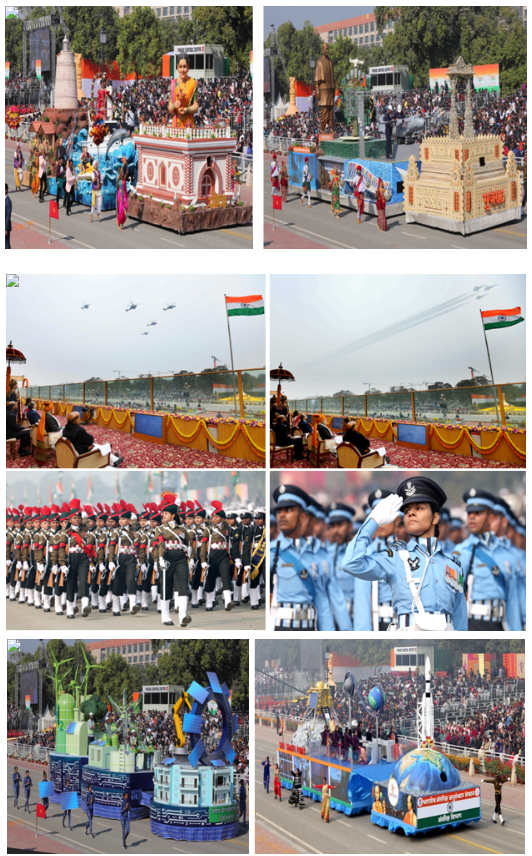
Honours, Gallantry & Service Recognition
- Padma Awards 2026: 131 (5 Padma Vibhushan, 13 Padma Bhushan, 113 Padma Shri)
- Armed Forces Gallantry: 70 awards (Ashok Chakra, Kirti Chakra, Shaurya Chakra; Sena/Nao Sena/Vayu Sena Medals)
- Military Decorations: 301 defence decorations, including PVSM, UYSM, AVSM, YSM, Sena Medal (Devotion to Duty) with Bars, VSM with Bars
- Coast Guard: President’s Tatrakshak Medal (PTM) and Tatrakshak Medal (TM)
- Police & Allied Services: 982 Gallantry and Service Medals (PMG, PGM, PSM, MSM)
- Jeevan Raksha Padak: Sarvottam, Uttam, and Jeevan Raksha Padak (including posthumous)
Republic Day Today: Living Constitutional Values
The day begins with homage at the National War Memorial, followed by the President’s arrival at Kartavya Path, flag unfurling with the National Anthem and 21-gun salute, ceremonial marches, tableaux, bravery awards, motorcycle display, and the IAF flypast. Celebrations conclude on 29 January with Beating the Retreat at Vijay Chowk—marking the formal close of the festivities.
Conclusion
Republic Day binds India’s political aspiration (Purna Swaraj, 1930) to its institutional realization (Constitution, 1950). The 77th Republic Day, themed “150 Years of Vande Mataram”, showcased how constitutionalism, culture, and citizen participation together sustain India’s democratic republic—where sovereignty rests with the people and constitutional values guide public life.
UPSC PYQ
Q. Tableaux of which one of the following States was adjudged the best in the Republic Day Parade, 2023? (NDA 2023)
- Uttarakhand
- Punjab
- Gujarat
- Uttar Pradesh
Answer: A
Explanation
- The tableau of Uttarakhand was adjudged the best among States and Union Territories participating in the Republic Day Parade 2023.
- The results were officially announced by the Ministry of Defence, based on the assessment of an expert jury.
Theme of Uttarakhand Tableau
- “Manaskhand”
- Featured:
- Jageshwar Dham (ancient temple complex, Almora)
- Corbett National Park
- State’s rich flora and fauna, including:
- Monal bird
- Musk deer
Other Rankings (Judges’ Category)
- Second: Maharashtra
- Theme: Sade Tin Shaktipithe and Nari Shakti
- Third: Uttar Pradesh
- Theme: Ayodhya Deepotsav
People’s Choice Category
CARE MCQ
Q. Consider the following statements:
- Purna Swaraj Day was observed on 26 January 1930.
- The Constituent Assembly first met on 9 December 1946.
- The Constitution of India came into force on 26 November 1949.
- Only one
- Only two
- All three
- None
- Statement 1: Correct On 26 January 1930, the Indian National Congress called upon people across the country to observe Purna Swaraj Day. This event marked a decisive shift in the freedom struggle by formally rejecting dominion status under British rule and asserting complete independence as the national goal.
- Statement 2: Correct The Constituent Assembly of India held its first meeting on 9 December 1946 in the Constitution Hall (now Central Hall of Parliament). This meeting initiated the constitution-making process for independent India, laying the foundation for a democratic and sovereign State.
- Statement 3: Incorrect The Constitution of India was adopted on 26 November 1949, but it came into force on 26 January 1950. The latter date was deliberately chosen to honour the historic Purna Swaraj Day of 1930. Therefore, the statement incorrectly mentions the date of enforcement.