

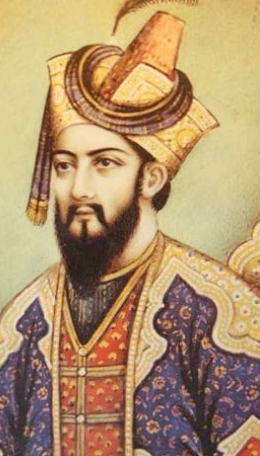
 Alauddin Khalji made enormous gifts to the hostile nobles and Amirs of Delhi to win over them to his side. Those who still opposed him accession were punished severely. He framed regulations to control the nobles. He was convinced that the general prosperity of the nobles, intermarriages between noble families, inefficient spy-system and drinking liquor were the basic reasons for the rebellions. Therefore, he passed four ordinances.
- He confiscated the properties of the nobles.
- The intelligence system was reorganized and all the secret activities of the nobles were immediately reported to the Sultan.
- The public sale of liquor and drugs was totally stopped.
- Social gatherings and festivities without the permission of Sultan were forbidden.
- By such harsh measures his reign was free from rebellions.
Mongol Invasions
- Ala-ud-Din had to face more than a dozen Mongol invasions. These invasions started from the end of 1296 and continued up to 1308 A.D. The Mongols threatened not only the Punjab, Multan and Sindh but even Delhi and the Ganga-Yamuna Doab.
- The First Mongol Invasion took place at the end of 1296. Zafar Khan was despatched against them. He defeated the Mongols near Jullundur and a large number of them were killed.
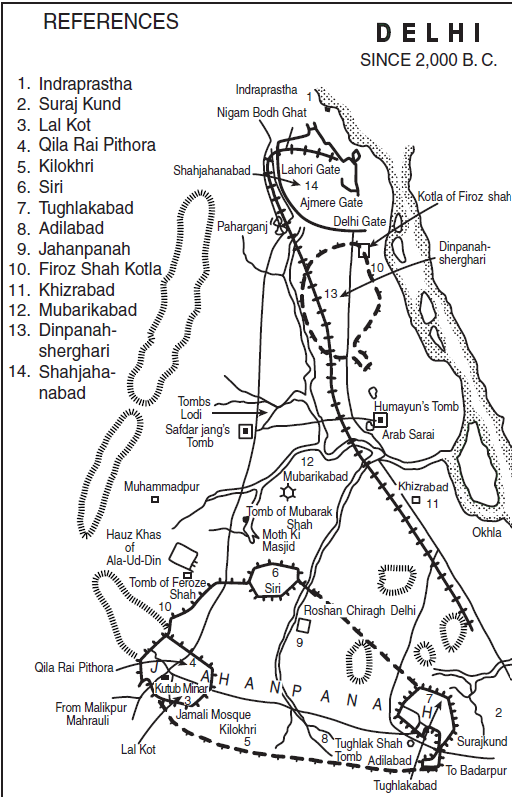
- The Second Mongol Invasion took place in 1297. The Mongols had become so bold that they were able to capture the fort of Siri near Delhi. However, Zafar Khan who was responsible for the defence of the north-western frontier, defeated the Mongols and recaptured the fort of Siri. The Mongol leader along with 1,700 followers was captured and brought to Delhi.
- The Third Mongol Invasion took places in 1299 under their leader Qutlugh Khwaja. The Mongols had come to India this time not to plunder but to conquer the territory. Consequently, they did not plunder the people on the way to Delhi and after reaching the capital, they besieged the same. Ala-ud-Din sent the advance guard of the army that was led by Zafar Khan who defeated the Mongols and pursued them relentlessly. However, Zafar Khan was surrounded by the Mongols and killed in the battle field. This did not improve matters as the terror created by Zafar Khan in the minds of the Mongols was so great and scary. So the Mongols lost heart and retreated.
- The Fourth Mongol Invasion took place in 1303 when Ala-ud-Din was busy with the siege of Chittor. A Mongol army 12,000 strong under Targhi, its leader, reached Delhi by forced marches. The movements of the Mongols were so quick that the governors were not able to send their contingents to Delhi. Ala-ud-Din was forced to take shelter in the fort of Siri which was besieged by the Mongols for two months. During this interval, the Mongols plundered not only the surrounding territory but also Delhi itself.
- The Mongols appeared once again in 1306. They crossed the Indus near Multan and proceeded towards the Himalayas. Ghazi Malik who had been appointed the Governor of the Punjab in 1305, intercepted the Mongols and a large number of them were killed 50,000 Mongols were made prisoners including Kubak, their leader. They were put to death the their children and wives were sold as slaves.
- The last Mongol invasion took place in 1307-08 under their leader Iqbalmand. It is true that he crossed the Indus but the could not make any headway after that. He was defeated along with his followers and also killed. A large number of Mongols were made prisoners and sent to Delhi where they were all put to death. The Mongols did not dare to attack India after 1308. Ala-ud-Din was able to reign in peace.
Mongol Policy of Ala-ud-din
- The seriousness of the Mongolian invasions forced Ala-ud-Din to take effective measures. Not only the old forts in the Punjab, Multan and Sindh were repaired, new ones were also built.Those forts were garrisoned with troops. Ala-ud-Din followed the forntier policy of Balban. He strengthened the defences of the frontier. The most capable and trusted officers were put in charge of that area. Ghazi Malik was appointed the Governor of the Punjab in 1305 and he was able to check the Mongol invasions. All important forts on the route of the Mongols were repaired. New workshops to manufacture improved types of weapons were set up. Powerful armies were stationed at Dipalpur, Samana and Multan. The Mongols who had embraced Islam and settled in India were massacred. Even their wives and children were brutally murdered. However, these harsh measures frightened the Mongols to such an extent that they gave up the idea of conquering India.
Military Campaigns
- The military conquests of Alauddin Khalji include his expedition against Gujarat, Mewar and the Deccan.
Conquest of Gujarat (1299)
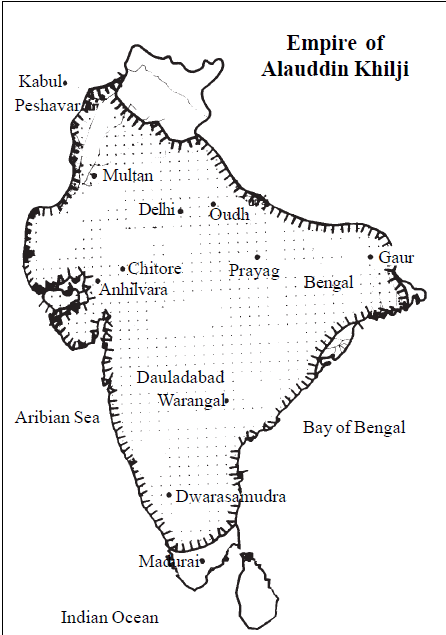
- He sent Nusrat Khan and Ulugh Khan to capture Gujarat in 1299. The king and his daughter escaped while the queen was caught and sent to Delhi. Kafur, an eunuch, was also taken to Delhi and later he was made the Malik Naib – military commander . This Kafur ultimately rose to be the most influenctial person in the state.The Delhi army plundered the rich ports of Gujarat and took away a large amount of booty.
Ranthambor (1301)
- Although Ranthambor had been conquered by Qutb-ud-Din and Iltutmish, it had become independent. At the time of Ala-ud-Din, it was being ruled by Hamir Deva, a Rajput chief. Two reasons have been given for the invasion of Ranthambor.
- The first reason was that Hamir Deva had given shelter to some New Muslims and this offended Ala-ud-Din.
- Another reason was that Ala-ud-Din considered it as his pious duty to recover a fortress that had once formed a part of the Sultanate of Delhi.
- After a three month’s siege Ranthambor fell to the Ala-ud-din.
Mewar (1303)
- The next expedition was sent by Ala-ud-Din against Mewar, the land of the brave Guhila Rajputs. This expedition was the outcome of the ambitions of Ala-ud-Din for territorial expansion. Chittor. It was the powerful state in Rajasthan. The siege lasted for several months. In 1303 Alauddin stormed the Chittor fort. Raja Ratan Singh and his soldiers fought valiantly but submitted. The Rajput women including Rani Padmini performed jauhar. This Padmini episode was graphically mentioned in the book Padmavath written by Jayasi.
- The Government of Chittor was put in the hands of Khizr Khan, the eldest son of Ala-ud-Din. Chittor was also named as Khizrabad after the name of Khizr Khan. On account of the pressure of Rajputs, Khizr Khan was forced to leave Chittor in 1311. When this happened, Chittor was given by Ala-ud-Din to Maldeva, the chief of Jalor. Chittor was again recovered by the Rajputs under Hamir or his son and it once again became the capital of Mewar.
Malwa (1305)
- In 1305, Ala-ud-Din sent an army to Malwa under Ain-ul-Mulk Multani. Rai Mahlak Deva of Malwa and his Pradhan, Koka, opposed the army but they were defeated. The victory helped the Muslims to occupy Ujjain, Mandu, Dhar and Chanderi. Ain-ul-Mulk was appointed the Governor of Malwa.
Jalor
- Kanera Deva was defeated and Jalor was annexed. In 1308, Ala-ud-Din himself with a large army to attack Sevana in Rajputana. Its ruler, Sital Deva, put up a stiff resistance but was defeated, captured and killed. His kingdom was placed under the charge of Malik Kamal-ud-Din Gurg.
Causes of Rajput Failure
- Almost all the important states of Rajputana submitted before Ala-ud-Din. The main causes which were responsible for the defeat of the Rajputs were:
- The Rajputs were disunited politically.
- Rajputs was their reliance on their forts. These forts were usually constructed on the top of some hillocks as a measure of defence. However, once a fort was besiged, it was cut off from the plains and provisions could not reach it.
- The age-old traditions of warfare. They did not bother about the new techniques of fighting evolved on other parts of the world. The Sultans possessed engines of war like Arrada, Gargach, etc., (i.e., stone-throwing machines). They also knew the art of constructing pashibs for escalading the fort walls.
- Limited Resources:Their country was hilly and barren. Crops and water were scarce. They could not fight successfully against the Sultans of Delhi who had at their command the resources of the Punjab and Avadh which were the most fertile regions of the country and thus could depend upon an unlimited supply of provisions and reinforcements.
Conquest of the Deccan
- By the end of 1305, practically the whole of Northern India fell into the hands of Ala-ud- Din and he could very easily afford to direct his attention towards the conquest of the Deccan.
- The first was the Yadava kingdom of Devagiri under Ram Chandra Deva (1271-1309).
- Telangana with its capital at Warangal was under Pratap Rudra Deva I of the Kakatiya dynasty.
- The Hoysala kingdom with its capital at Dwarsamudra was under Vira Ballala III (1292-1342).
- The Pandya kingdom of Madura was being ruled at that time by Maravarman Kulasekhara (1268-1311).
Conquest of Devagiri (1307)
- Ala-ud-Din sent an expedition under Malik Kafur against Ram Chandra Deva of Devagiri. Malik Kafur marched through Malwa and advanced to Devagiri. He destroyed the whole country and captured a lot of booty. Ram Chandra was forced to sue for peace. He was sent to Delhi where he was treated kindly by Ala-ud-Din. He was sent back to his kingdom after six months. Ram Chandra continued to rule Devagiri as a vassal of Ala-ud-Din.
Telangana (1310)
- After two attempts to annex telangana, the Delhi army marched via Devagiri and was given all assistance by Rama Chandra Deva. Pratap Rudra Deva, the ruler of Telangana, put up stiff resistance. The fort of Warangal was besieged. When the situation became critical, Pratap Rudra Deva sued for peace in March, 1310. The Raja gave Kafur 100 elephants, 7,000 horses and large quantities of jewels and coined money. He also agreed to send tribute to Delhi every year.
Dwarsamudra (1311)
- The next expedition was against Vira Ballala III, the Hoysala ruler who was defeated. His capital, Dwarsamudra, was captured. Malik Kafur plundered the rich temples of the town and got a lot of gold, silver, jewels and pearls. He sent to Delhi all the captured property and also the Hoysala Prince. The prince came back to Dwarsamudra in May, 1313 but the Hoysalas became the vassals of Delhi.
Pandya Kingdom (1311)
- From Dwarsamudra, Kafur Marched against the Pandya kingdom. At that time, there was going on a dispute for succession to the throne between two brothers, Sundara Pandya and Vira Pandya. Sundara was defeated by Vira Pandya. The former went to Delhi and asked for the help of Ala-ud-Din.Thus this situation was utilized by Ala-ud-din ,and conquest was made. As a result of this expedition was that the Pandya kingdom became a dependency of the Delhi Sultanate and a large amount of booty was carried back to Delhi.
Deccan Policy of Ala-ud-Din
- Like Samudra Gupta, Ala-ud-Din did not intend to annex the territories of the Rulers of Southern India. His main object was to get as much of wealth as possible so that he could pay for the expenses of a huge army which he was maintaining. The successful Deccan campaigns strengthened the position of Ala-ud-Din in the North. No ruler or governor could dare to defy Ala-ud-Din. The wealth of the South improved the financial position of Ala-ud-Din and helped him in his administration of the country.
Reforms of Alauddin Khalji
Military
- Alauddin Khalji maintained a large permanent standing army and paid them in cash from the royal treasury. According the Ferishta, he recruited 4,75,000 cavalrymen. He introduced the system of dagh (branding of horses) and prepared huliya (descriptive list of soldiers). Dewan-i-Arz was the head of the military establishment and was required to enforce the rules stringently. Spies were kept in every unit of the army and they were required to submit daily reports to the Sultan regarding the conduct of the military officers.
Land Revenue
- Ala-ud-Din made many reforms in the field of land revenue. It was ordered that all land was to be measured and then the share of the state was to be fixed. The post of a special officer called Mustakhraj was created and he was given the duty of collecting unrealised balance of land revenue from the peasants. In order to check bribery and corruption among the revenue officials, their salaries were increased. On certain occasions, the papers of the Patwaris were personally scrutinized.
Market Reforms
- The introduction of paying salaries in cash to the soldiers led to price regulations popularly called as Market Reforms. Alauddin Khalji established four separate markets in Delhi, one for grain; another for cloth, sugar, dried fruits, butter and oil; a third for horses, slaves and cattle; and a fourth for miscellaneous commodities. Each market was under the control of a high officer called Shahna-i- Mandi. Merchants were commandeered to transport grains from villages to Delhi. Grain was to be stored in government granaries. A machinery was devised to coerce the people to obey the regulations. The government was to see that the fixed price level was not disturbed even in times of famines which were frequent in those days.
- A separate department called Diwani Riyasat was created under an officer called Naib-i-Riyasat. Ala-ud-Din issued certain regulations under which a new government market named Sarai-Adl was established under the Badaun Gate. Merchants of Delhi and other provinces were required to be registered. Loans were advanced to the Multani merchants and they were given charge of the Sarai-Adl market. Passes were issued to those rich persons who wanted to buy costly goods.
- There were secret agents called munhiyans who sent reports to the Sultan regarding the functioning of these markets. The Sultan also sent slave boys to buy various commodities to check prices. Violation of regulations was severely punished. Harsh punishment was given if any shopkeeper charged a higher price, or tried to cheat by using false weights and measures.
End of Khalji
- Ala-un-Din was a great parton of learning. Amir Khusro was patronised by him. Amir Khusro wrote Tarikh-i-Alai or Khazain-ud-Futuh. In this book he gave an account of the conquests of Ala-ud-Din. He also lived in the court of Ghias-ud-Din Tughluq and wrote Tughluqnama in which he gave the story of Ghais-un-Din Tughluq. Khusro wrote a lot in Hindi and he is considered to be a great Hindi writer. Khusro is also known as Tuti-i-Hind or Parrot of India.
- Ala-ud-Din was fond of architecture. Many forts were built by his orders and the most important of them was Alai Fort or Koshak-i-Siri. Alauddin Khilji had grand plans for the Qutub complex, aiming to enlarge the Quwwat-ul-Islam Mosque and erect four gateways leading to it. However, his vision was left incomplete as he passed away after the completion of the first gateway, known as the Alai Darwaza, in 1311 AD. This 13th-century structure continues to stand as a remarkable architectural achievement.
- Mubarak Shah and Khusru Shah were the successors of Alauddin Khalji. Ghazi Malik, the governor of Dipalpur, killed the Sultan Khusru Shah and ascended the throne of Delhi under the title of Ghiyasuddin Tughlaq in 1320.
