

Mahmud of Ghazni and his Invasions
- By the end of the ninth century A.D., the Abbasid Caliphate had declined, leading to the rise of independent kingdoms established by Turkish governors, while the Caliph retained only ceremonial power. Among these governors was Alptigin, who made Ghazni his capital. His successor and son-in-law, Sabuktigin, aimed to conquer India from the northwest and managed to capture Peshawar from Jayapala. However, Sabuktigin’s raids did not have a lasting impact. He was succeeded by his son, Mahmud.
Mahmud of Ghazni (A.D. 997-1030):
- Mahmud is said to have conducted seventeen raids into India. During this period, North India was fragmented into several Hindu states. On the Indian frontier lay the Hindu Shahi kingdom, stretching from the Punjab to Kabul. Other notable kingdoms in North India included Kanauj, Gujarat, Kashmir, Nepal, Malwa, and Bundelkhand. Mahmud’s initial raids targeted the Hindu Shahi kingdom, where he defeated King Jayapala in 1001. Following this defeat, Jayapala, considering his loss a disgrace, committed self-immolation. His successor, Anandapala, also confronted Mahmud but was defeated in the Battle of Waihind, the Hindu Shahi capital near Peshawar, in 1008.
- Jayapala was defeated in 1001. After this defeat, Jayapala immolated himself because he thought that his defeat was a disgrace. His successor Anandapala fought against Mahmud but he was also defeated in the Battle of Waihind, the Hind Shahi capital near Peshawar in 1008.
- Mahmud’s later forays into India were intended to plunder the wealthy towns and temples in northern India. He conducted raids on Thaneshwar, which is close to Delhi, and Nagarkot in the Punjabi hills in 1011.
- In 1015 CE, Mahmud of Ghazni annexed Lahore, extending his empire up to the Jhelum River. Despite an alliance between Anandapala and the Muslim Sultan of Multan, Mahmud also conquered Multan. This strategic conquest allowed Mahmud to secure eastern Afghanistan and then Punjab and Multan, creating a pathway towards further incursions into India. Following these successes, Mahmud conducted three expeditions into the Gangetic plains primarily for the acquisition of wealth.
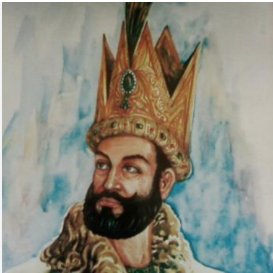
- Mahmud stormed Kanauj and looted the sacred city of Mathura in 1018. Rajyapala, the monarch of Kanauj, left the city and later perished. Mahmud brought incredible wealth back via Kalinjar. He targeted Gujarat in his following significant raid. In 1024, Mahmud crossed Rajaputana on foot from Multan, vanquished the Solanki king Bhimadeva I, robbed Anhilwad, and destroyed the renowned temple of Somanath. Then he headed back via the desert of Sind. His final campaign in India was this one. Mahmud died away in 1030A.D.
- Mahmud was more than just a raider and plunderer of wealth; he established a vast empire extending from the Punjab in the east to the Caspian Sea in the west, and from Samarkand in the north to Gujarat in the south. The Ghaznavid Empire encompassed regions including Persia, Transoxiana, Afghanistan, and Punjab. His successful expansion was attributed to his leadership and relentless efforts. Medieval historians celebrated Mahmud as a hero of Islam.
- He was a patron of both literature and art. During Mahmud’s reign, Firdausi was the poet laureate. He was the Shah Namah’s author. Alberuni remained at Mahmud’s court while writing the renowned Kitab-i-Hind, a history of India. The political landscape in India was drastically altered by his conquest of Multan and Punjab. He opened the door for future conquests and deeper inroads into the Gangetic valley by the Turks and Afghans. By conducting frequent raids, he drained India’s resources and removed her labor force. The exhaustion of India’s economic resources and man power had its adverse effect on the political future of India. The Hindu Shahi kingdom was guarding the gates of India against foreign invaders. Mahmud destroyed it and thus India’s frontiers became defenceless. The inclusion of Punjab and Afghanistan in Ghazni’s kingdom made the subsequent Muslim conquests of India comparatively easy.
Condition of India on the Eve of Mahmud Ghazni’s Invasion
- On the eve of Mahmud Ghazni’s invasion, North India was fragmented into numerous independent states:
- Hindushahi Kingdom: Located on India’s frontier, this kingdom stretched from the Punjab to Kabul, with its capital at Waihind. Prominent rulers included Jayapala and his son Anandapala.
- Kashmir: An independent state governed by the Lohara dynasty, which had familial ties with the Hindushahis.
- Kanauj: Ruled by Rajyapala of the Gurjara Pratihara dynasty.
- Bengal: Controlled by the Pala dynasty.
- Gujarat: Dominated by the Solanki dynasty.
- Malwa: Governed by the Paramara dynasty.
- Bundelkhand: Ruled by the Chandella dynasty.
- South India: Dominated by powerful kingdoms such as the later Chalukyas and the Cholas.
- This division into various independent states made the region vulnerable to external invasions, including those led by Mahmud Ghazni.
Muhammad Ghori, the real founder of Muslim Empire in India
- Muiz-ud-Din was the real founder of the Muslim Empire in India. Muhammad-bin-Sam is also known as Muhammad Ghori, Shihab-ud-Din, or Muhammad of Ghur. Muhammad-bin-Qasim was the first Muslim to conquer India, but due to his sudden passing, he was unable to establish a Muslim Empire there. In addition to failing to establish a Muslim Empire in India, Mahmud of Ghazni’s invasions only had the temporary effect of annexing the Punjab. It was Muhammad Ghori’s responsibility to establish an independent Muslim Empire in India.
- The district of Ghur is situated in hills between Ghazni and Heart. It was an independent state in the 10th century but its ruler, Muhammad-bin-Suri, was defeated by Mahmud of Ghazni in 1009 A.D. After that, the Rulers of Ghur continued to be the vassals of the Rulers of Ghazni. However, they took advantage of the falling fortunes of the house of Mahmud after 1030 A.D and came to power.
Rise of the Ghurids
- Towards the middle of the twelfth century, the power of the Seljuk Turks was shattered by a group of Turkish tribesmen who were partly Buddhist and partly Pagan. This power vacuum allowed two new empires to rise: the Khwarizmi Empire, based in Iran, and the Ghurid Empire, based in Ghur in northwest Afghanistan.
- The Khwarizmi Empire’s rise significantly constrained the Ghurids’ ambitions in Central Asia. Khurasan, a region contested by both, was soon conquered by the Khwarizm Shah, forcing the Ghurids to seek expansion elsewhere, particularly towards India.
- Mu’izz ad-Din Muhammad, proceeding through the Gomal Pass, successfully conquered Multan and Uchch. In 1178, he attempted to penetrate Gujarat by crossing the Rajputana desert. By 1190, Mu’izz ad-Din Muhammad had captured Peshawar, Lahore, and Sialkot, setting the stage for further advances towards Delhi and the Gangetic Doab.
Causes of Muhammad Ghori’s Invasions on India
Muhammad Ghori, after solidifying his control over the kingdom of Ghazni, turned his attention towards the conquest of India. His invasions were motivated by several factors:
- Ambition and Expansion: Muhammad Ghori was an ambitious ruler who, like other great leaders of his time, sought to extend his empire for power and glory. Conquering India was a means to achieve this goal.
- Rivalry with Ghaznavids: The royal families of Ghur and Ghazni were hereditary enemies, and even though Muhammad Ghori had captured Ghazni, the Ghaznavids still held sway in Punjab. Annexing Punjab would not only weaken his hereditary enemy but also provide security to Ghori’s kingdom from threats originating in the east.
- Challenges from Khwarizm Dynasty: The rising power of the Khwarizm dynasty of Persia posed a challenge to the Ghur dynasty’s ambitions of expanding westward. With the westward expansion path blocked, Muhammad Ghori saw India as the next viable option for extending Ghurid power.
- Responsibility for Expansion: The responsibility of extending Ghurid power towards the west lay with Ghiyas-ud-din, leaving Muhammad Ghori to focus on the eastern expansion into India.
- Strategic Needs: While loot and plunder were not Muhammad Ghori’s primary objectives, acquiring wealth from defeated chiefs allowed him to raise a strong army for defending his Afghan dominions against potential threats from the Khwarizm Shahs.
- These factors collectively drove Muhammad Ghori to launch invasions into India, shaping the course of history in the Indian subcontinent.
Political Condition of India on the Eve of Muhammad Ghori’s Invasion
- The political condition of India on the eve of Muhmmad Ghori’s invasion was almost identical to the one prevailing at the time of the invasion of the Arabs or Mahmud Gajnavi with the only exception that certain changes had taken place in the ruling dynasties and territories of their kingdom. Whole country was divided into many small kingdoms who were engaged into mutual jealousy and conflict. The states can be divided into following three parts:
- Muslim Kingdom,
- Rajput Kingdoms and other states, and
- States of Southern India
- The social condition of India was very defective at the time of Muhammad Ghori’s attack. Though in this period a brave caste was born in the shape of the Rajputs but they were often luxury loving and fond of dance and wine. They were excesively proud by temperament. Exhibiting cunningness in war according to them was a very wrong thing. They never wanted to deviate from their self-imposed ideals. Indian society was ridden with untouchability, caste system, sati custom etc. Brahmins still enjoyed a privileged position. Unity and mutual cooperation were totally lacking in the Indian society.
- Even before Muhammd Ghori, Islam had became popular in Sind, Multan, Lahore etc. In the rest of India Hinduism prevailed. With the efforts by Shankaracharya, Ramanujacharya, Kumaril Bhatt and Mahadevacharaya etc. Hinduism had just been reinvigorated. Other religions were Buddhism and Jainism but both of them were declining. Many orthodox people believed that God will come to their aid at the time of war or danger. In the 12th century a progressive and popular movement started in Inida known as the Lingayats who were the devotees of Shiva. They strongly criticized the caste system and boycotted practices like sacrifice, keeping fasts and going on pilgrimage. In social sphere they opposed child marriage and supported widow remarriage. But the influence of this sect was very limited.
- Rajput rulers patronized and encouraged Architecture, dancing, music and literature etc. During this period many works were composed in Sanskrit and regional languages. The capital of Paramara’s Ujjain and Vikramshil and Vikrampur etc. were important centres of education. Buddhist monasteries were also performing a useful function in this direction. Many of the Rajput kings themselves composed literary pieces. King Bhoj of Dhar was a great scholar. The famous Chalukyan minister, Bhima was not only a patron of scholars but also a great writer himself. The jain scholarsof the period also made an important contribution. Most famous amongst them was Hemchandra who composed in Apabhramsh language also apart from Sanskrit.
The First Battle of Tarain (1191)
- Realising their grave situation, the Hindu princes of north India formed a confederacy under the command of Prithiviraj Chauhan. Thus, a battle between these two ambitious rulers, Muizzuddin Muhammad and Prithviraj was inevitable. The conflict started with rival claims for Tabarhinda.
- In the battle which was fought at Tarain in 1191, the Ghurid forces were completely routed, Muizzuddin Muhammad’s life being saved by a young Khalji horseman. Prithviraj now pushed on to Tabarhinda and conquered it after a twelve- month siege. Little attempt was made by Prithviraj to oust the Ghurids from the Punjab. Perhaps, he felt that this was another of recurrent Turkish raids, and that the Ghurid ruler would be content to rule over the Punjab.
- This gave Muizzuddin Muhammad time to regroup his forces and make another bid for India the following year. He rejected the proposal said to be made by Prithviraj to leave Punjab under the possession of the Ghurid ruler.
Second Battle of Tarain (1192)
- The second battle of Tarain in 1192 is regarded as one of the turning points in Indian history. Muizzuddin Muhammad had made careful preparations for the contest. It is said that he marched with 1,20,000 men, including a force of heavy cavalry, fully equipped with steel coats and armour; and 10,000 mounted archers. He came with this large force to Lahore via Peshawar and Multan. He sent a message to Prithviraj asking him to acknowledge his supremacy and become a Muslim. Prithviraj rejected this proposal and prepared to meet the invader. He gathered a large force consisting of 3,00,000 horses, 3000 elephants and a large body of foot soldiers. Many Hindu rajas and chieftains also joined him. In the ensuing Second Battle of Tarain in 1192, Muhammad Ghori thoroughly routed the army of Prithiviraj, who was captured and killed.
UPSC MCQS
1. Consider the following events in the history of India :
(1) Rise of Pratiharas under King Bhoja
(2) Establishment of Pallava power under Mahendravarman – I
(3) Establishment of Chola power by Parantaka – I
(4) Pala dynasty founded by Gopala
What is the correct chronological order of the above events, starting from the earliest time?
(a) 2-1-4-3
(b) 3-1-4-2
(c) 2-4-1-3
(d) 3-4-1-2
Previous Year Questions – 3
Ques.1: The purpose of Mohammad Ghazni’s attack on India was
(a) To plunder the wealth of India
(b) To spread Islam in India
(c) To rule over the territories of India
(d) None of these
Ques.2: ‘Ghuzak’ is the name of a place where
(a) Jayapala met his enemy Sabuktigin
(b) Mahmud crushed defeat on Jayapala
(c) Jayapala burnt himself on a funeral pyre since he was unable to survive the disgrace caused by his defeat at the hands of Mahmud
(d) None of the above
Ques.3: What was the immediate reason for Ahmad Shah Abdali to invade India and fight the Third Battle of Panipat?
(a) He wanted to avenge the expulsion by Marathas of his viceroy Timur Shah form Lahore
(b) The frustrated governor of Jullundhar Adina Beg Khan invited him to invade Punjab
(c) He wanted to punish Mughal administration for non-payment of the revenues of the ChaharMahal (Gujarat, Aurangabad, Sailkot and Pasrur)
(d) He wanted to annex all the fertile plains of Punjab up to the borders of Delhi to his kingdom
Ques.4: During Aurangzeb’s reign, which of the following were not included in his government?
(a) Rajputs
(b) Pathans
(c) Marathas
(d) All of these
Ques.5: What is the correct order of the following?
A. First Battle of Panipat
B. Second Battle of Tarain
C. Establishment of East India Company
Select the correct answer from the codes below:
(a) B, A, C
(b) A, B, C
(c) C, A, B
(d) C, B, A
Hint & Solution
UPSC
Ans: (c)
Previous Year
1. (a)
- Mahmud of Ghazni was the first independent ruler of the Turkic dynasty who ruled from 999 to 1030. The capital of Ghazni was the centre of cultural, commercial and intellectual centre. Al-Biruni and Ferdowsi appreciated his capital in their accounts.
- He made numerous invasions to North India to acquire wealth and in 1001, he first invaded modern-day Afghanistan, Pakistan and parts of India. He captured Shahi ruler Jayapala but later released him.
- In 1005 and 1006 he invaded Bhatia and Multan respectively. He even wanted to destroy Hindu temples and monuments. Looking at the options given:
- Option B. He tried to spread the Islamic religion but his main motive was to acquire wealth. It is an incorrect option.
- Option A. He invaded India several times as he vowed to raid and loot the wealthy region of northwestern India every year. This is the correct answer.
- He destroyed many temples including Somnath Temple of Gujarat. From there he took away the booty of 12 million dinars and broke the Jyotirlinga.
- he used all the booty to build his capital in Ghazni.
2. (a)
- In 977 AD sceptre passed into the hands of his son-in-law Sabuktigin. Jayapala advanced towards Ghazni and met his enemy Sabuktigin near a place called Ghuzak between Ghazni and Lamghan.
3. (a)
- The correct answer is He wanted to avenge the expulsion by Marathas of his viceroy Timur Shah from Lahore. The Third battle of Panipat took place between Ahmed Shah Abdali (also called Ahmad Shah Durrani) and Maratha commander Sadashiv Rao Bhau on 14 January 1761 in the Panipat ground. This battle was won by Ahmed Shah Abdali. After the death of Mughal emperor Aurangzeb, Maratha’s power grew in the country. They annexed several parts of Deccan which were previously controlled by Mughals. They also annexed Rajputana, Malwa, and Gujarat under their control. In 1747, Ahmad Shah Durrani established the Durrani empire in Afghanistan annexing Lahore. Durrani’s son Timur Shah was the governor of Lahore. Maratha Peshwa Bajirao captured Lahore and kicked out Timur Shah. Other rulers were alarmed by this rise of Marathas and they requested Durrani to stop Marathi expansion. As a result, Ahmad Shah Durrani gathered support from other rulers and fought this battle with Marathas.
4. (c)
- Aurangzeb, the sixth Mughal emperor, ruled a vast empire in the Indian subcontinent during the late 17th century. His policies and approach toward various regional powers and communities varied. While he appointed Rajputs and Pathans in his government and granted them positions of authority and influence, he did not incorporate the Marathas into his administration.
- Aurangzeb faced significant challenges from the Marathas, who were a powerful regional force in western India. The Marathas, under the leadership of Shivaji and later his successors, established their own kingdom and conducted extensive military campaigns against the Mughals. Aurangzeb’s relationship with the Marathas was marked by conflict and hostility, and he did not include them in his government.
5. (a)
- First Battle of Panipat – The First Battle of Panipat, on 21 April 1526, was fought between the invading forces of Babur and the Lodi Kingdom. It took place in north India and marked the beginning of the Mughal Empire and the end of the Delhi Sultanate.
- Second Battle of Tarain- The Second Battle of Tarain was fought in 1192 by the Ghurids against the Chahamanas and their allies, near Tarain.
- Establishment of East India Company – The East India Company was initially created in 1600 to serve as a trading body for English merchants, specifically to participate in the East Indian spice trade.
