
ADITYA-L1
Why to study sun?
Studying the sun is crucial because of its proximity, providing detailed insights into solar phenomena. Understanding the sun helps predict disruptions in space systems, safeguard spacecraft, and protect astronauts from potential dangers.
Additionally, the sun serves as a natural laboratory for studying extreme thermal and magnetic phenomena, aiding in scientific understanding.
Aditya L1
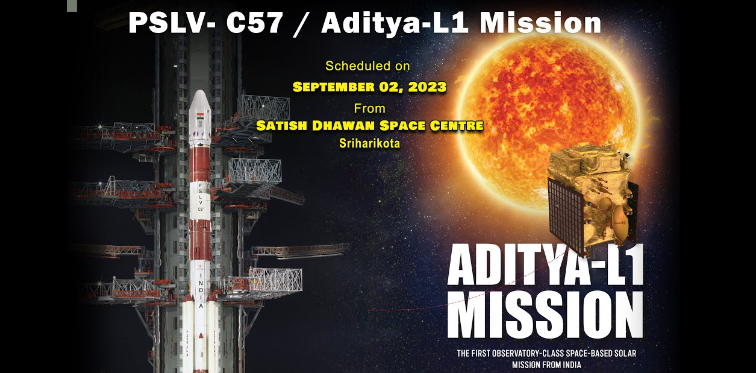
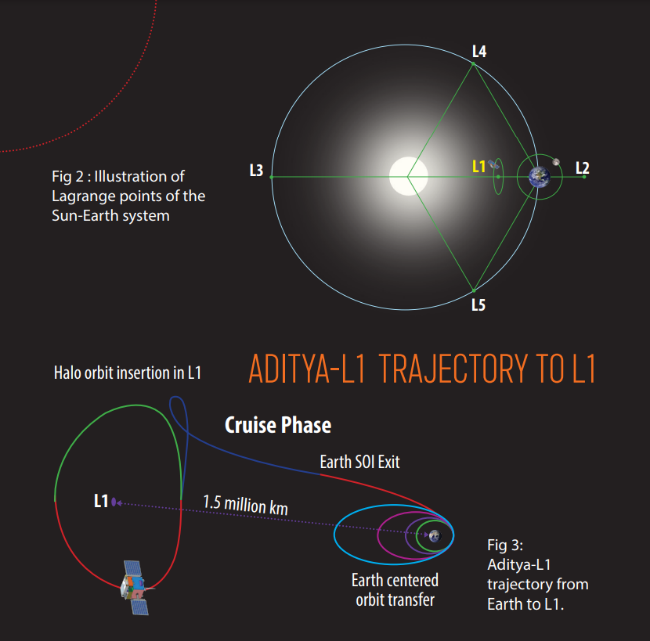
- Aditya L1 is India’s first space-based solar observatory mission designed to study the Sun. The spacecraft will be positioned in a halo orbit around the Lagrangian point 1 (L1) of the Sun-Earth system, approximately 1.5 million km from Earth.
- This orbit provides continuous and unobstructed views of the Sun, without any occultation or eclipse, offering a unique advantage for uninterrupted solar observations.
- ISRO’s Polar Satellite Launch Vehicle (PSLV-C57) on September 2, 2023 had successfully launched the Aditya-L1 spacecraft, from the second launch pad of Satish Dhawan Space Centre, Sriharikota.
- Aditya L1 carries seven payloads designed to observe the photosphere, chromosphere, and the outermost layers of the Sun (corona) using electromagnetic and particle detectors.
- Placed at L1, four payloads directly observe the Sun, while the remaining three conduct in-situ studies of particles and fields at the Lagrange point.
Scientific Goals:
The mission aims to gather crucial information for understanding:
- Coronal heating
- Coronal Mass Ejections (CME)
- Pre-flare and flare activities
- Characteristics of space weather dynamics
- Propagation of particles and fields in the interplanetary medium
- To understand solar wind distribution and temperature anisotropy.
Aditya-L1 Scientific Payloads:
Visible Emission Line Coronagraph (VELC):
- Studies the solar corona and dynamics of Coronal Mass Ejections (CME).
Solar Ultra-violet Imaging Telescope (SUIT):
- Images the Solar Photosphere and Chromosphere in near Ultra-violet (UV).
- Measures solar irradiance variations in near UV.
Aditya Solar wind Particle EXperiment (ASPEX) and Plasma Analyser Package for Aditya (PAPA):
- Study the solar wind and energetic ions.
- Analyze the energy distribution of solar wind particles.
Solar Low Energy X-ray Spectrometer (SoLEXS):
- Studies X-ray flares from the Sun over a wide X-ray energy range.
High Energy L1 Orbiting X-ray Spectrometer (HEL1OS):
- Investigates X-ray flares from the Sun, focusing on a broad X-ray energy spectrum.
Magnetometer:
- Measures interplanetary magnetic fields at the L1 point.
Lagrange Points
- Lagrange Points are positions in space within a two-body gravitational system where a small object experiences a gravitational pull equal to the centripetal force required to move with the two large bodies.
- Spacecraft can utilize Lagrange Points with reduced fuel consumption, as they can effectively “hover” at these points.
- At Lagrange Points, the gravitational pull of the two large bodies equals the necessary centripetal force for a small object. This equilibrium allows for stable positions in the gravitational field.
- In a two-body gravitational system like the Sun and Earth, there are five Lagrange points denoted as L1, L2, L3, L4, and L5.
- L1: Lies between the Sun-Earth line.
- Distance of L1 from Earth: Approximately 1% of the Earth-Sun distance.
Can Aditya-L1 Alone Study All Aspects of the Sun?
- No, it cannot. Space missions, including Aditya-L1, face limitations in mass, power, and volume for scientific payloads. Aditya-L1, stationed at Lagrange point L1, has constraints in studying multi-directional solar phenomena adequately. For example, it lacks the capability to analyze the directional distribution of energy from explosive solar events.
