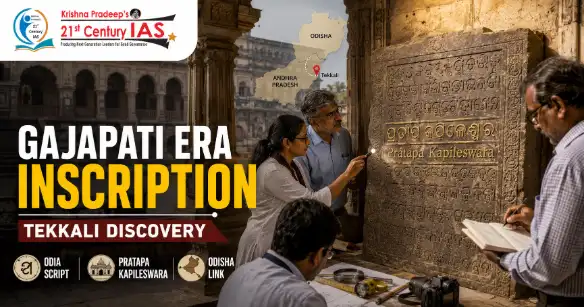
Why in News?
A centuries-old inscription associated with the Gajapati period has been traced inside the Tekkali royal palace in Srikakulam district, Andhra Pradesh. Engraved in the Odia script and language, it contains the name “Pratapa Kapileswara,” referring to Gajapati ruler Kapilendra Deva.The discovery provides further evidence of Tekkali’s historical connections with the Odisha kingdom.

Location and Discovery
The stone inscription was found at:
- Place: Tekkali royal palace
- District: Srikakulam
- State: Andhra Pradesh
The inscription was traced by researchers associated with an organisation that studies and documents Kalinga heritage in South India. A member of the Tekkali royal family assisted them in locating the stone.
Earlier Epigraphical Record
- The inscription was not entirely unknown to historical records. It had earlier been mentioned in the Annual Report on Indian Epigraphy for 1926–27.
- Using this reference, the researchers approached the Tekkali royal family and successfully located the stone within the palace premises.
- The discovery therefore represents the physical retracing and renewed documentation of an inscription that had been recorded approximately a century earlier.
Condition of the Inscription
The inscribed stone had been lying beneath a Tulasi Choura inside the palace.
Its condition is poor because:
- a considerable portion has been damaged;
- some parts have been lost over time;
- the first line is completely destroyed; and
- the surviving lines do not reveal the inscription’s complete purpose.
Despite the damage, researchers obtained an estampage for further examination.
What Is an Estampage?
An estampage is an impression of an inscription taken on paper. It allows researchers to examine and document engraved letters without repeatedly handling or moving the original stone.
It is especially useful when an inscription is:
- weathered;
- partly damaged;
- difficult to move; or
- located in a vulnerable place.
Script and Language
The inscription is engraved in:
- Script: Odia
- Language: Odia
Its script and surviving words connect it with the Gajapati political and cultural tradition of Odisha.
What Does the Inscription Contain?
The surviving inscription consists of at least four identifiable lines.
| Line | Surviving information |
| First line | Completely damaged |
| Second line | Contains part of the ruler’s name |
| Third line | Contains “Pratapa Kapileswara” |
| Fourth line | Contains the expression “Bijeraije” |
The name Pratapa Kapileswara refers to Gajapati Kapilendra Deva.
However, the damaged condition prevents researchers from establishing:
- the exact regnal year;
- the precise date;
- the complete nature of the record; and
- the purpose for which it was issued.
Probable Date of the Inscription
Kapilendra Deva ruled Odisha during the 15th century.
Based on:
- palaeographic features; and
- the historical context,
the inscription is also likely to belong to the 15th century.
However, its exact date has not yet been confirmed and requires further scholarly investigation.
About Gajapati Kapilendra Deva
The inscription refers to Gajapati ruler Kapilendra Deva through the name “Pratapa Kapileswara”.
According to the researchers:
- he ruled Odisha during the 15th century; and
- during his reign, the Odisha kingdom extended from the Ganga River in the north to the Kaveri River in the south.
The inscription’s presence at Tekkali reflects the historical reach of the Gajapati kingdom into parts of present-day North Coastal Andhra Pradesh.
Historical Importance of Tekkali
- Tekkali was formerly an ancient Odia zamindari of Ganjam.
- It later became separated from Odisha during the formation of the separate State of Odisha. Nevertheless, historical and cultural connections have continued.
- A significant number of Odia families still reside in Tekkali, indicating the persistence of linguistic and cultural ties.
Conclusion
The Tekkali inscription is an important epigraphical record of the Gajapati era. Its Odia script, Odia language and reference to “Pratapa Kapileswara” connect the region with the 15th-century rule of Kapilendra Deva.Although its exact date and purpose remain uncertain, the inscription provides valuable evidence of the political, linguistic and cultural links between Tekkali and the historical Odisha kingdom