Why in News?
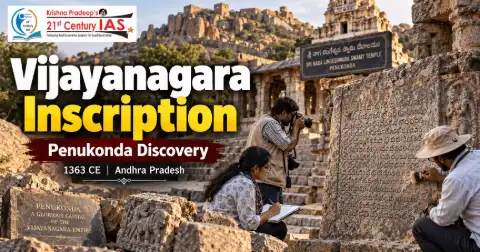
An ancient stone inscription was discovered at the Sri Naga Lingeshwara Swamy Temple on Penukonda hill in the Sri Sathya Sai district of Andhra Pradesh.The inscription belongs to 1363 CE and provides information about the early history of the Vijayanagara Empire during the reign of Emperor Bukka Raya I.
Location of the Discovery
- The inscription was found within the premises of the Sri Naga Lingeshwara Swamy Temple, located on top of Penukonda hill.
- Members of the Penukonda chapter of the Vishwa Hindu Parishad discovered the dilapidated shrine while climbing the hill through its rugged northern and western approaches. They noticed an inscription carved on a large boulder and sent its photographs to historian MyNaa Swamy for decipherment.
About Penukonda
- Penukonda is an important historical town in the present-day Sri Sathya Sai district of Andhra Pradesh.
- It served as the second capital of the Vijayanagara Empire. The discovery strengthens Penukonda’s importance as a centre of political, religious and cultural activity during the Vijayanagara period.
Details of the Inscription
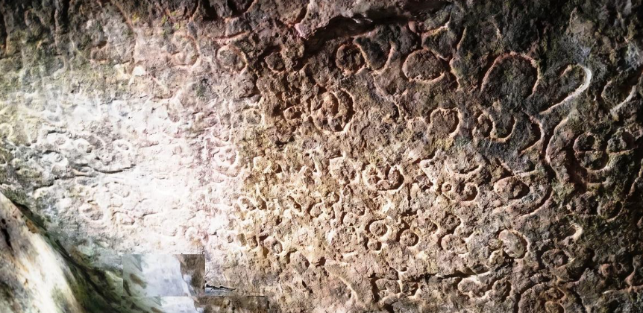 The inscription is written in an ancient Kannada-Telugu script.It begins with the words: “Svasti Sri Saka Varusha 1285”It concludes with:“Mangala Maha Sri”
The date mentioned in the inscription corresponds to:
- Saka year: 1285
- Gregorian date: July 16, 1363 CE
- Traditional calendar: Shravana Shuddha Panchami
- Day: Sunday
- Festival: Naga Panchami
The inscription belongs to the reign of Bukka Raya I, who ruled from 1356 to 1377 CE.
What Does the Inscription Reveal?
The inscription records that Anantharasu Chikka Odeyar, who served as the Prime Minister under Bukka Raya I, commissioned the temple.
It states that Anantharasu:
- Consecrated the Shiva Linga at the temple
- Established the shrine on Naga Panchami
- Constructed a sacred pond beside the temple
The sacred pond is locally called Nagula Bavi, meaning the Well of Serpents.
Supporting Sculptural Evidence
- An intricate sculpture discovered at the site provides additional evidence about the shrine’s association with Naga worship.
- The sculpture depicts eight Naga Kanyas worshipping Lord Shiva. It supports the inscription’s reference to Naga Panchami and the sacred pond known as Nagula Bavi.
- The inscription, Shiva Linga, sacred pond and Naga sculpture together indicate the religious importance of the site.
Conclusion
The Penukonda inscription provides valuable evidence about the early Vijayanagara period, temple patronage and the religious traditions associated with Shaiva and Naga worship. Its discovery also reinforces Penukonda’s historical importance. Scientific documentation and careful restoration are essential to preserve this regional heritage for future generations.