Why in News?
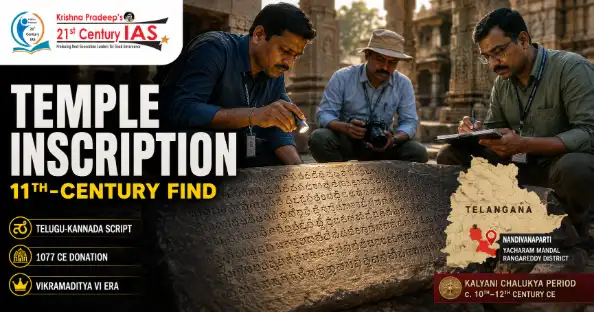
Researchers have identified an inscription lying on the premises of the Siddheshwara Temple at Nandivanaparti, in Yacharam mandal of Telangana’s Rangareddy district, as belonging to the 11th century CE.The record, now called the Nandivanaparti Siddeshwara Temple Inscription, was written in Telugu-Kannada script and records a donation made in 1077 CE during the reign of Kalyani Chalukya ruler Vikramaditya VI.

Location of the Discovery
The inscription was found at:
- Temple: Siddheshwara Temple
- Village: Nandivanaparti
- Mandal: Yacharam
- District: Rangareddy
- State: Telangana
Researchers from Ibrahimpatnam examined the inscription. It was deciphered by a professor from the Government Degree College, Ibrahimpatnam, with assistance from the Kotha Telangana Charitra Brundam.
How Was the Complete Inscription Identified?
Initially, only one side of the inscription slab was visible.
When the pillar was turned over:
- the beginning portion of the inscription was discovered on the other side;
- inscriptions were found on both sides of the slab; and
- researchers were able to identify its script, language, date and political context.
However, parts of the record had already been damaged.
Physical Features
The inscription consists of two sides:
| Side | Details |
| First side | Contains 15 visible lines; several portions are damaged |
| Second side | Contains 20 lines and records a dated donation |
The damage has affected the completeness of the historical information, particularly the details of the donated gifts.
Script and Language
The research team confirmed that the inscription was:
- written in 11th-century Telugu-Kannada script; and
- composed in the Kannada language.
Telugu-Kannada Script
- The term refers to the historical script associated with the development of Telugu and Kannada writing traditions. The inscription shows the linguistic and cultural connections that existed across the Deccan during the medieval period.
Contents of the Inscription
First Side: Royal Eulogy
The first side contains a prasasti, or eulogy, of the Kalyani Chalukya emperor:
- Tribhuvanamalla Vikramaditya VI
It also mentions:
- Kalyana, the emperor’s capital.
Only 15 lines remain visible because part of this side has been damaged.
What Is a Prasasti?
A prasasti is an inscriptional eulogy praising a ruler. It generally records royal titles, achievements, lineage or authority.
Inscriptions containing prasastis help historians understand how rulers presented their political status and legitimacy.
Second Side: Donation Record
The second side contains 20 lines. It records a donation made on:
- Shaka year: 998
- Lunar date: Chaitra Shuddha 12
- Day: Friday
- Equivalent date: April 7, 1077 CE
The donation was made by:
- Tribhuvanamalla’s Mahamandaleshwar, identified in the inscription as “Mogata Rasara”.
The donation was made to:
- “Iinjakeshvara”.
The precise details of the donated gifts cannot be identified because that portion of the inscription has broken away.
Symbols Carved on the Inscription
Half-sculptures appearing at the top of the inscription include:
- the Moon;
- the Sun;
- Nandi;
- a Shiva Linga;
- a sword beneath a cow; and
- elephants.
These carvings form part of the inscription’s visual and cultural setting.
Possible Meaning of the Symbols
The inscription clearly records these symbols, although their precise individual meanings are not explained in the surviving text.
Broadly, their presence indicates the close relationship among:
- political authority;
- religious symbolism;
- temple culture; and
- formal donation records.
About Vikramaditya VI in the Inscription
- The inscription identifies the ruler through the title Tribhuvanamalla Vikramaditya VI and connects him with the Kalyani Chalukya dynasty.
- It also mentions Kalyana as his capital. This establishes the political setting in which the donation was made.
- The reference to his Mahamandaleshwar indicates the participation of a subordinate political authority in making the donation.
Conclusion
The Nandivanaparti Siddeshwara Temple Inscription is an important source for understanding 11th-century Telangana. Its reference to Vikramaditya VI, Kalyana, a local Mahamandaleshwar and a dated donation provides evidence of political authority, religious patronage and linguistic development under the Kalyani Chalukyas.
Although parts of the record are damaged, its surviving text and symbols offer a valuable window into the medieval history of the Deccan.