

Why in News?
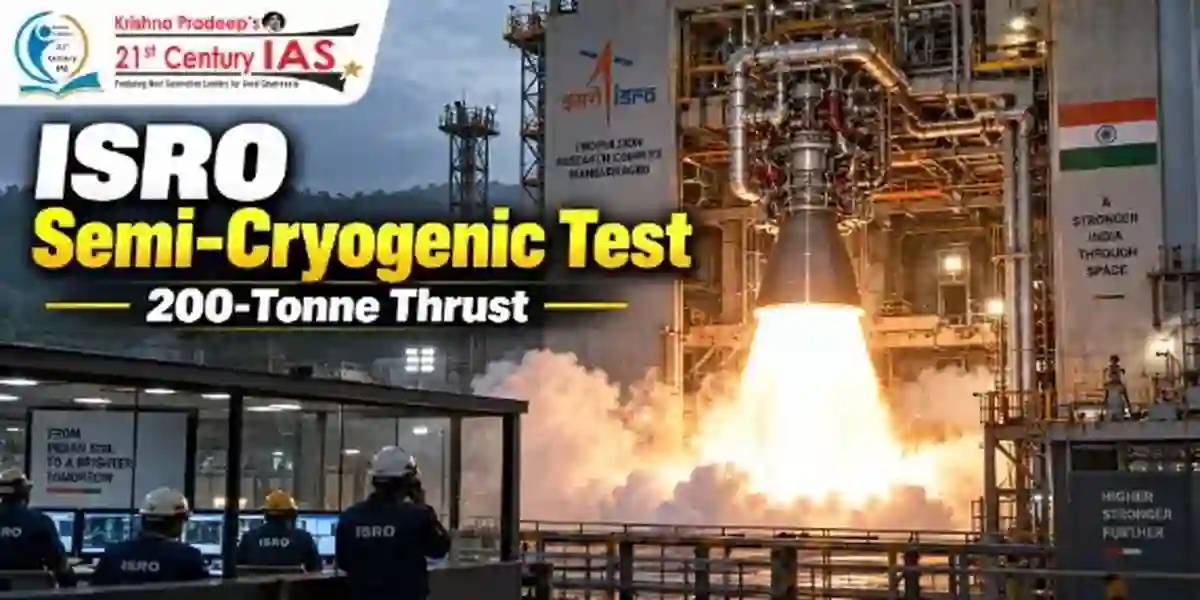
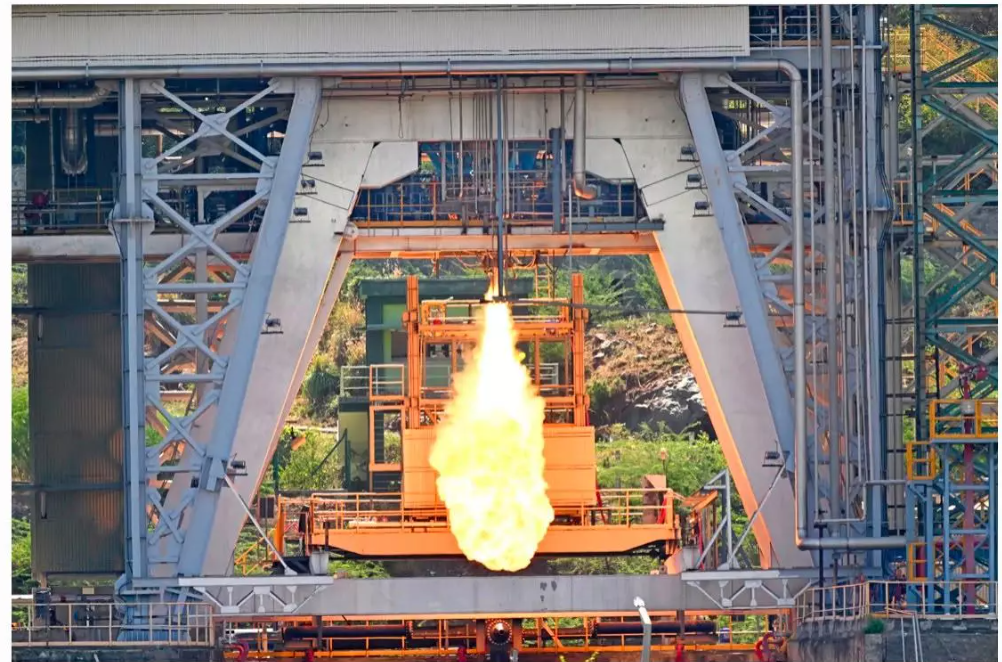
The Indian Space Research Organisation (ISRO) successfully conducted a hot test of its Semi-Cryogenic Engine Power Head Test Article (PHTA) at the full rated level corresponding to 200 tonnes of thrust.The test took place at the ISRO Propulsion Research Complex (IPRC), Mahendragiri, Tamil Nadu. It was the ninth hot test in the series and the first to test the PHTA at 100% of its rated level.
Background
- ISRO is developing the Semi-Cryogenic Propulsion Stage (SC120), powered by the 2,000 kN-class SE2000 engine.
- The SC120 stage is intended to replace the existing L110 core stage of the LVM3 launch vehicle.
- Its integration with the uprated C32 cryogenic upper stage is expected to enhance LVM3’s payload capability.
- Payload capability refers to the amount of useful load, such as satellites, that a launch vehicle can carry to a specified orbit.
Key Features of the Test
First Test at the Full Rated Level
The PHTA was tested at the operating level corresponding to 200 tonnes of thrust, representing 100% of the rated level.
Earlier tests had progressively covered:
| Test level | Reported equivalent thrust |
| 47% | 94 tonnes |
| 60% | 120 tonnes |
| 88% | 175 tonnes |
| 100% | 200 tonnes |
This gradual increase enabled ISRO to assess the power head’s performance at progressively higher operating levels.
Test Duration
- Total test duration: 35 seconds.
- Operation at the full rated level: Five seconds.
Important distinction: The test lasted 35 seconds, but operation at the 200-tonne level lasted only five seconds.
Expected Performance
According to the report:
- The test proceeded as predicted.
- All engine parameters remained within expected conditions.
These results support the next phase of testing.
Propellant Supply Switch-Over
The test successfully validated the transfer of propellant supply from a:
Low-pressure start tank → Medium-pressure run tank
The start tank supplies propellant during the initial phase. The run tank supports continued operation.
Validating this transition enables long-duration PHTA testing in subsequent hot tests.
Understanding the Major Components
| Component | Role |
| PHTA | Includes all engine systems except the thrust chamber |
| SE2000 | A 2,000 kN-class engine being developed to power SC120 |
| SC120 | Semi-cryogenic propulsion stage intended to replace L110 |
| L110 | Existing core stage of LVM3 |
| C32 | Uprated cryogenic upper stage to be integrated with SC120 |
| LVM3 | Launch vehicle whose payload capability is expected to improve |
What Is a Hot Test?
A hot test involves operating propulsion hardware under firing conditions to assess its performance.
What Does the PHTA Exclude?
The PHTA includes all engine systems except the thrust chamber.
Therefore, this milestone represents a power head test. It should not be described as a completed test of the entire engine with its thrust chamber.
Conclusion
The successful full-level PHTA test marks an important milestone in ISRO’s semi-cryogenic propulsion programme. Validation of the propellant supply switch-over prepares the system for longer tests. Further development of SE2000, SC120 and C32 will support the planned enhancement of LVM3’s payload capability.