

Why in News?
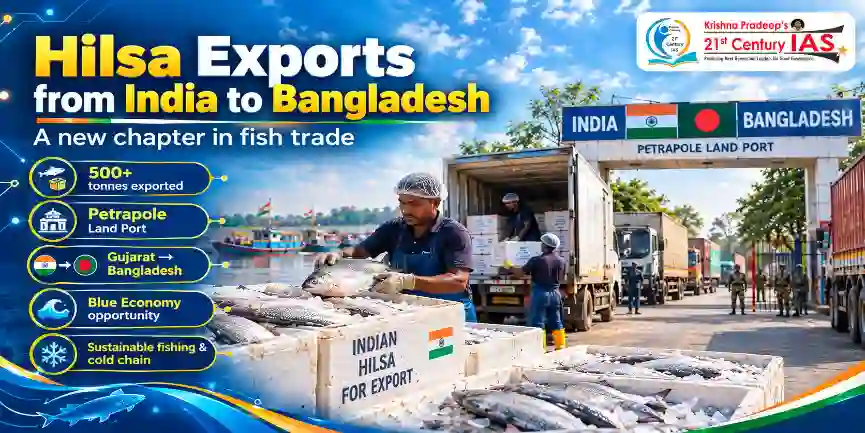
India has started exporting Hilsa fish to Bangladesh, reversing the traditional trade pattern under which Bangladesh supplied Hilsa to India.Around 500 tonnes of Hilsa were exported to Bangladesh through the Petrapole Land Port in West Bengal during the previous two months. Traders expect another 150–200 tonnes to be exported in the coming weeks.
What is Hilsa?
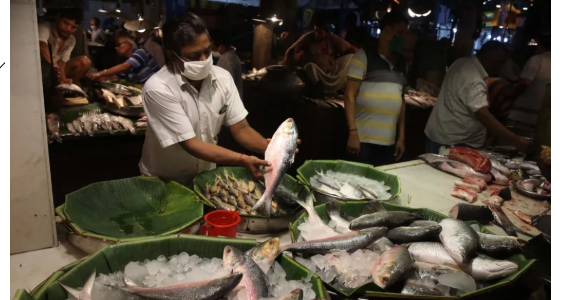
Hilsa, popularly known as Ilish in Bengali, belongs to the Clupeidae family, which also includes herring fish.
It is highly valued for its:
- Delicate flavour
- Distinctive taste
- Soft and oily texture
- Nutritional value
Hilsa has a silvery and relatively flat body, a pointed head and numerous small bones.
Two important species found in the Bay of Bengal region are:
- Tenualosa ilisha
- Tenualosa toli
Hilsa is the State Fish of West Bengal and the National Fish of Bangladesh. Bangladesh produces nearly 70% of the world’s Hilsa.
The fish is classified as Least Concern on the IUCN Red List. However, local populations may still decline because of overfishing and habitat degradation.
Habitat and Distribution
Hilsa lives in both marine and freshwater environments. It is found in rivers, estuaries and coastal waters of:
- India
- Bangladesh
- Pakistan
- Myanmar
- Persian Gulf region
Major river systems associated with Hilsa include:
- Padma and Meghna in Bangladesh
- Hooghly-Bhagirathi, Ganga and Godavari in India
The Bay of Bengal provides an important marine habitat for the species.
Migratory and Breeding Pattern
- Hilsa is an anadromous fish. This means that it spends most of its adult life in the sea but migrates into freshwater rivers for breeding and spawning.
- Its major breeding migrations take place during:
- Mid-February to April
- September to October
- Hilsa may be caught throughout the year, but the monsoon is its peak fishing season. Strong river flows during this period support its upstream movement.
- Therefore, the survival of Hilsa depends on continuous ecological connectivity between the sea, estuaries and rivers.
Cultural and Economic Importance
- Hilsa occupies an important place in the traditions of Bengali communities in India and Bangladesh.
Ilish Utsab
- West Bengal celebrates Ilish Utsab, during which restaurants and households prepare different Hilsa dishes.
Joda Ilish
- A pair of Hilsa fish is called Joda Ilish. It symbolises harmony, prosperity and good fortune and is associated with weddings and festivals.
Livelihood Importance
- Hilsa supports the livelihoods of fishers, traders, transporters, wholesalers and food-processing enterprises. Its high market value makes it economically important for coastal and riverine communities.
Traditional Hilsa Trade
- Traditionally, India imported Hilsa from Bangladesh, especially during the Durga Puja season.
- Bangladesh began restricting Hilsa exports in 2012 to protect domestic stocks and maintain local availability.
- Since 2019, Bangladesh has generally permitted exports to India for a limited period of about one month during Durga Puja.
However, actual imports have remained much lower than the permitted quantities.
| Period | Quantity permitted | Quantity actually imported |
| September 2024 | 2,420 tonnes | 577 tonnes |
| September 2025 | 1,200 tonnes | 150 tonnes |
The short permission period creates difficulties in procurement, transportation and marketing. Bangladesh has currently paused its Hilsa exports to India.
Efforts to Resume Imports
The Fish Importers Association in West Bengal has sought the removal of Bangladesh’s export restrictions.
- Its delegation visited Dhaka in August 2026.
- It met Bangladesh’s Commerce Secretary Ataur Rehman Khan.
- The Association also wrote to the Prime Minister of Bangladesh seeking the lifting of the restrictions.
Despite these efforts, the export restrictions continued.
Current Reversal in Hilsa Trade
For the first time, significant quantities of Indian Hilsa are being exported to Bangladesh.
The present trade has the following features:
- Approximately 500 tonnes were exported during the previous two months.
- An additional 150–200 tonnes are expected to be exported.
- A large part of the catch has come from the Bharuch region of Gujarat.
- Some supplies have moved through the Howrah wholesale fish market.
- The consignments entered Bangladesh through the Petrapole Land Port.
The development represents a reversal of the established Bangladesh-to-India trade flow.
| Aquaculture
Aquaculture is the controlled cultivation of aquatic organisms such as fish, molluscs, crustaceans and aquatic plants. It involves human intervention through activities such as:
Aquaculture differs from capture fishing, which depends mainly on naturally available wild fish stocks. |
Why Has the Trade Reversed?
Increased Availability in India
A substantial catch from Gujarat has created an exportable supply of Hilsa.
Strong Demand in Bangladesh
Hilsa has exceptional cultural and culinary importance in Bangladesh. Strong consumer demand exists even though Bangladesh is the world’s leading producer.
Pause in Bangladesh’s Exports
Bangladesh’s decision to stop exporting Hilsa to India altered the existing market relationship and encouraged traders to develop Indian supplies.
Improved Market Linkages
Connections among Gujarat suppliers, the Howrah wholesale market and the Petrapole border have enabled the movement of Indian Hilsa to Bangladesh.
Changing Production and Demand
The reversal reflects changing patterns of fish availability, production, market prices and consumer demand in the two countries.
Significance for India
New Export Opportunity
Demand from Bangladesh can provide additional income to Indian fishers, traders and exporters.
Fisheries-Based Employment
The trade can support employment in fishing, cold storage, transportation, processing and retail marketing.
Value-Added Hilsa Economy
The development offers an opportunity to build a science-based Hilsa economy through:
- Stock management
- Quality grading
- Hygienic processing
- Cold-chain infrastructure
- Product packaging
- Traceability
- Stronger market connections
Contribution to the Blue Economy
Sustainable Hilsa production and trade can strengthen fisheries exports, coastal livelihoods and India’s Blue Economy.
India–Bangladesh Relations
Hilsa is a shared cultural symbol. Predictable trade in Hilsa can strengthen economic and people-to-people relations between India and Bangladesh.
Government Initiatives for Fisheries Development
Pradhan Mantri Matsya Sampada Yojana
- The Pradhan Mantri Matsya Sampada Yojana (PMMSY) was launched on September 10, 2020 to promote a Blue Revolution through sustainable and responsible development of India’s fisheries sector.
- It is implemented by the Department of Fisheries under the Ministry of Fisheries, Animal Husbandry and Dairying.
The scheme seeks to develop a fisheries sector that is:
- Ecologically healthy
- Economically viable
- Socially inclusive
Areas Supported under PMMSY
PMMSY addresses gaps across the fisheries value chain, including:
- Fish production, productivity and quality
- Technology adoption
- Fishing harbours and fish-landing centres
- Safe docking and berthing facilities
- Post-harvest infrastructure
- Cold-chain and marketing facilities
- Fish retail markets and kiosks
- Ornamental fish-rearing units
- Traceability and fisheries management
- Welfare of fishers and fish farmers
PM-MKSSY
- The Pradhan Mantri Matsya Kisan Samridhi Sah-Yojana (PM-MKSSY) is a Central Sector sub-scheme under PMMSY.
- It aims to formalise the fisheries sector and support fisheries-based micro and small enterprises.
Challenges
Overfishing
Growing demand can result in excessive harvesting of mature and breeding Hilsa.
Capture of Juvenile Fish
Catching young Hilsa before they reproduce can reduce future fish populations.
Obstruction of Migratory Routes
Dams, barrages and other river structures may interrupt the movement of Hilsa between the sea and freshwater breeding grounds.
River and Estuarine Pollution
Sewage, industrial discharge and plastic waste can damage breeding and nursery habitats.
Changes in River Flow
Reduced freshwater discharge and changes in sediment movement can disturb the conditions required for migration and spawning.
Climate Change
Changes in rainfall, water temperature and salinity can affect the geographical distribution and breeding cycle of Hilsa.
Weak Cold-Chain Infrastructure
Inadequate refrigeration, storage and transportation may result in post-harvest losses.
Uncertain Trade Policy
Short export windows and sudden restrictions create uncertainty for fishers, importers and exporters.
Way Forward
Adopt Science-Based Stock Management
Authorities should regularly assess Hilsa populations and determine sustainable fishing limits.
Protect Breeding Seasons
Seasonal restrictions should be enforced during major spawning periods.
Prevent Juvenile Fishing
Minimum catch-size rules and restrictions on harmful fishing nets should be implemented effectively.
Restore River Connectivity
Environmental flows and fish-passage systems should be considered while managing dams and barrages.
Control Water Pollution
River and estuarine pollution must be reduced to protect spawning and nursery habitats.
Strengthen Post-Harvest Infrastructure
Cold storage, refrigerated transport, processing facilities and quality-testing systems should be expanded under PMMSY.
Introduce Traceability
Traceability and certification systems can identify the origin, handling conditions and quality of exported fish.
Establish Predictable Trade Arrangements
India and Bangladesh should develop a transparent and stable Hilsa trade mechanism instead of depending only on short seasonal permissions.
Promote Regional Conservation
Both countries should cooperate in stock assessment, breeding-ground protection, fisheries research and river management because Hilsa is a transboundary migratory resource.
Conclusion
India’s Hilsa exports to Bangladesh represent an important change in the traditional fish trade between the two countries. The shift creates opportunities for fishers, processors and exporters, while strengthening the fisheries value chain. However, rising commercial demand must not lead to the depletion of wild stocks. Scientific management, habitat protection, improved cold-chain infrastructure and stable bilateral cooperation are essential for developing a sustainable and inclusive Hilsa economy.