Table of Contents
Relevance: UPSC GS Paper III: Indian economy, digital economy, financial inclusion, science and technology, cybersecurity
Prelims
Global Fintech Fest 2026 | GFF | Digital Public Infrastructure | Aadhaar | UPI | JAM Trinity | NPCI | Payments Council of India | Fintech Convergence Council | MeitY | RBI | SEBI | IFSCA | PFRDA | NITI Aayog | DBT | DigiLocker | ONDC | Regulatory Sandbox | DPDP Act 2023 | SRO-FT | SACHET Portal
Mains
Digital Economy | Financial Inclusion | Inclusive Finance | Digital Governance | Cybersecurity | Data Protection | Digital Sovereignty | Innovation Ecosystem | Responsible AI | Global South Cooperation | FinTech Regulation
Why in News?
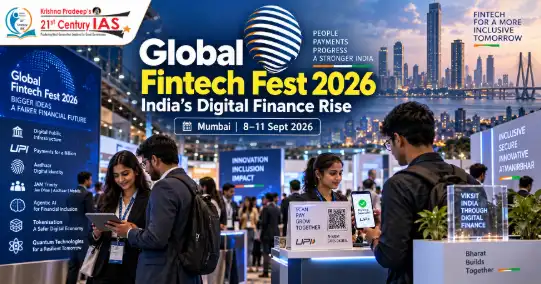
- The 7th Global Fintech Fest 2026 is being held in Mumbai from 8 to 11 September 2026. The event highlights India’s growing role in the global fintech ecosystem through Digital Public Infrastructure, UPI, Aadhaar, JAM Trinity and digital welfare delivery. The theme of GFF 2026 focuses on Agentic AI, Tokenisation and Quantum technologies for building trusted and inclusive financial systems.
Understanding FinTech
- FinTech means the use of technology to improve financial services. It includes digital payments, online banking, digital lending, insurance technology, wealth technology, blockchain-based services and data-driven financial products.
- In simple terms, FinTech helps people access financial services faster, cheaper and more conveniently. For example, a person can transfer money through UPI, open a bank account using digital identity, or receive government benefits directly into a bank account through DBT.
- FinTech is important because it can reduce transaction costs, improve transparency, support financial inclusion and make financial services available to people who were earlier outside the formal banking system.
Global Fintech Fest 2026
The Global Fintech Fest 2026 is the 7th edition of the event. It is being held in Mumbai from 8 to 11 September 2026.
Since its beginning in 2020, GFF has grown into one of the world’s leading fintech gatherings. It reflects India’s increasing importance in digital finance and financial technology.
The event provides a platform for:
- Global dialogue on financial technology
- Collaboration among governments, regulators and fintech firms
- Showcasing India’s digital finance model
- Strengthening India’s engagement with developed economies, emerging markets and the Global South
The principal organisers of GFF are Payments Council of India, National Payments Corporation of India and Fintech Convergence Council.
The event is supported by major institutions such as MeitY, Department of Financial Services, NEST Division of Ministry of External Affairs, NITI Aayog, RBI, SEBI, IFSCA and PFRDA.
Theme and Core Technologies
The theme of GFF 2026 is:
- “Potential to Impact: Agentic AI | Tokenisation | Quantum: Trusted, Connected, Global Systems for Inclusive Finance.”
- This theme shows that the next stage of financial innovation will depend on advanced technologies that can make financial systems more intelligent, programmable and secure.
Agentic AI
- Agentic AI refers to artificial intelligence systems that can sense, decide and act in real time under proper governance frameworks.
- In finance, it can help in fraud detection, regulatory monitoring, customer support, risk assessment and personalised financial services. However, its use must remain transparent, explainable and accountable.
Tokenisation
- Tokenisation means converting assets into digital units that can be securely recorded and transferred.
- It can support fractional ownership, instant settlement and better liquidity. It may transform capital markets, payments and digital asset-based financial services.
Quantum Technology
- Quantum technology can bring major changes in computation and cybersecurity. In finance, it can support risk optimisation, faster computation and quantum-safe cryptography.
- This is important because future financial systems will need stronger protection against advanced cyber threats.
Key Enabling Technologies Used by FinTech
FinTech depends on several technologies. These technologies help financial institutions provide faster and more efficient services.
| Technology | Meaning |
| API | A set of rules that allows software systems to communicate with each other |
| Cloud Computing | Use of online computing resources to improve flexibility and reduce cost |
| Biometrics | Use of unique human features such as fingerprints or iris for identification |
| Distributed Ledger Technology | A system where transaction records are stored in multiple places at the same time |
| Big Data | Large volumes of data analysed through digital tools |
| AI and Machine Learning | Computer systems that learn from data and perform tasks requiring intelligence |
India’s FinTech Transformation
- India’s fintech growth is based on scale, innovation and public digital infrastructure. The introduction of Aadhaar, expansion of internet access and development of UPI have transformed the delivery of financial services.
- India’s model is significant because it combines public infrastructure with private innovation. The government creates open digital systems, and private players build services on top of them.
- This has helped India expand digital identity, instant payments and consent-based data sharing at population scale.
Importance and Benefits of FinTech
- FinTech has changed the financial sector by improving efficiency, inclusion and competition.
- UPI is a major example. It is recognised by the IMF as the world’s largest real-time payment system. In July 2026, UPI processed 2,365.8 crore transactions worth ₹29.88 lakh crore, with 741 banks live on the platform. Its transaction volume has grown nearly 12,000-fold since FY 2016–17.
- FinTech also helps overcome market failures such as high transaction costs and information gaps. India’s Financial Inclusion Index improved from 43.4 in March 2017 to 70.0 in March 2026.
- The growth of fintech has also diversified credit sources beyond traditional banking. This can improve competition, reduce overdependence on a few banks and strengthen the resilience of the financial ecosystem.
Foundation of India’s FinTech Success
- India’s fintech ecosystem is built on Digital India and Digital Public Infrastructure. These systems provide universal access, digital identity, interoperable payments and open digital networks.
JAM Trinity
- The Jan Dhan-Aadhaar-Mobile Trinity is the foundation of digital financial inclusion.
- Jan Dhan accounts provide access to banking. Aadhaar provides digital identity. Mobile connectivity enables people to use digital financial services.
- As of 26 August 2026, 59.15 crore Jan Dhan accounts had been opened. Aadhaar enrolments crossed 144 crore by March 2026.
Unified Payments Interface
- UPI provides an interoperable digital payment system. It allows instant transfer of money between bank accounts.
- UPI transactions reached 24,509 million in August 2026. The platform handles nearly 50% of global real-time digital transaction volume and operates in 11 countries.
- This shows India’s growing global influence in digital payments.
Digital Identity and Documents
- Aadhaar e-KYC helps verify customers digitally. It reduces paperwork and saves time in opening accounts and accessing financial services.
- Aadhaar e-KYC processed more than 2,458 crore transactions as of 29 June 2026.
- DigiLocker had over 73.53 crore registered users and issued 936.03 crore documents. It helps citizens store and share verified digital documents.
Digital Welfare Delivery
- Direct Benefit Transfer uses digital financial infrastructure to send government benefits directly into beneficiaries’ bank accounts.
- This reduces intermediaries, leakages and delays. Cumulative DBT transfers reached ₹53.26 lakh crore as of September 2026.
- DBT shows how digital finance can support welfare governance and transparency.
Open Digital Commerce
- Open Network for Digital Commerce extends India’s open digital approach beyond payments.
- By June 2026, ONDC reached more than 20 crore buyers and 5 lakh sellers across 1,000+ cities.
- Its financial services category can help fintech firms reach new users and markets.
Regulatory and Consumer Protection Framework
As fintech expands, regulation becomes essential to protect consumers and maintain trust. India has created a regulatory framework to support innovation while managing risks.
Major Regulatory Measures
- RBI’s Framework for Self-Regulatory Organisations in FinTech Sector, issued in May 2024, promotes ethical conduct, market integrity and dispute resolution.
- RBI’s Master Directions on Digital Payment Security Controls, 2021 prescribe minimum security standards for digital payment channels such as internet banking and mobile banking.
- NPCI uses AI and Machine Learning-based fraud monitoring for UPI transactions.
- The Digital Personal Data Protection Act, 2023 and Digital Personal Data Protection Rules, 2025 aim to protect personal data.
- The RBI Regulatory Sandbox, introduced in August 2019, allows new financial products and services to be tested in a controlled environment.
- For digital lending, safeguards include a Digital Lending Apps directory, the National Cybercrime Reporting Portal, helpline 1930, and the SACHET portal for complaints related to illegal deposit collection.
Significance
GFF 2026 is important because it presents India as a global leader in inclusive digital finance. India’s model shows how technology can support financial inclusion at population scale.
It also supports India’s economic diplomacy. By sharing its digital public infrastructure experience with emerging economies and the Global South, India can strengthen its role as a trusted technology partner.
For citizens, fintech improves access to payments, savings, credit, insurance and welfare benefits. For the economy, it supports formalisation, transparency and innovation-led growth.
Challenges
- Cybersecurity threats may increase as digital financial transactions expand.
- Digital fraud, fake lending apps and data misuse can affect consumer trust.
- The digital divide may exclude people without smartphones, internet access or digital literacy.
- Overuse of AI may create risks of bias, lack of transparency and weak accountability.
- Dependence on large digital platforms may create concentration risks.
- Strong regulation is needed without discouraging innovation.
Way Forward
- Strengthen cybersecurity and fraud detection systems.
- Improve digital literacy, especially among rural users, senior citizens and first-time users.
- Promote responsible use of AI with transparency and accountability.
- Expand secure digital public infrastructure to more sectors.
- Encourage fintech innovation through regulatory sandboxes.
- Strengthen data protection and consumer grievance redressal.
- Share India’s DPI experience with the Global South through digital cooperation.
Conclusion
India’s fintech journey shows how public digital infrastructure can support inclusive growth. Platforms such as Aadhaar, UPI, DBT, DigiLocker and ONDC have expanded access, reduced costs and improved transparency. However, the next phase of fintech must focus on cybersecurity, data protection, responsible AI and consumer trust. A secure, inclusive and innovation-friendly fintech ecosystem can support India’s digital economy and contribute to Viksit Bharat 2047.
CARE MCQ
Q. Consider the following statements regarding Global Fintech Fest 2026 and India’s fintech ecosystem:
- The 7th Global Fintech Fest 2026 is being held in Mumbai.
- UPI handles nearly 50% of global real-time digital transaction volume.
- The RBI introduced the Regulatory Sandbox framework in August 2019.
- ONDC is limited only to digital payment services.
Which of the statements given above are correct?
(a) 1, 2 and 3 only
(b) 1 and 4 only
(c) 2, 3 and 4 only
(d) 1, 2, 3 and 4
Answer:
(a) 1, 2 and 3 only
Explanation:
Statement 1 is correct: The 7th Global Fintech Fest 2026 is being held in Mumbai from 8 to 11 September 2026.
Statement 2 is correct: According to the given information, UPI handles nearly 50% of global real-time digital transaction volume.
Statement 3 is correct: The Reserve Bank of India introduced the Regulatory Sandbox framework in August 2019.
Statement 4 is incorrect: ONDC is not limited only to digital payments. It is an open digital commerce network and its financial services category is creating new opportunities for fintech products.
FAQs
1. What is FinTech?
FinTech means the use of technology to make financial services faster, cheaper and more efficient.
2. What is Global Fintech Fest 2026?
It is the 7th edition of a major global fintech event being held in Mumbai from 8 to 11 September 2026.
3. What is Digital Public Infrastructure?
Digital Public Infrastructure refers to open digital systems such as Aadhaar, UPI and DigiLocker that enable public and private services at scale.
4. Why is UPI important?
UPI enables instant digital payments and has made India a global leader in real-time digital transactions.
5. What is the main challenge in fintech expansion?
The main challenge is to balance innovation with cybersecurity, data protection and consumer safety.