
Composition of the Atmosphere
The atmosphere, a mixture of gases enveloping the Earth, contains essential gases such as oxygen for humans and animals and carbon dioxide for plants. It is an integral part of the Earth’s mass, with 99% of its total mass confined to a height of 32 km from the Earth’s surface. The air is colorless, odorless, and can be felt as wind.
Gases
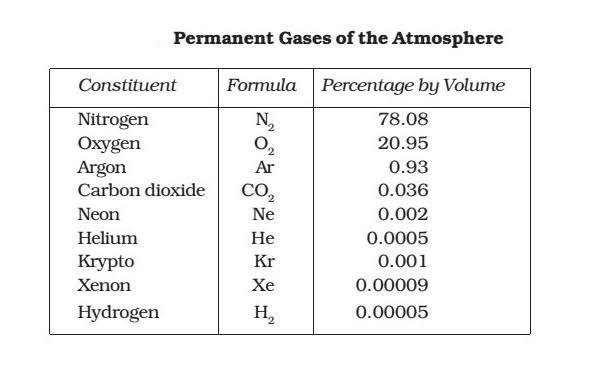 Nitrogen (N₂): About 78% of the atmosphere, it is inert and plays a crucial role in maintaining atmospheric pressure and supporting life.
- Oxygen (O₂): Comprising about 21%, it is vital for respiration in humans and animals and is essential for combustion.
- Argon (Ar): Making up about 0.93%, it is inert and has little effect on atmospheric processes.
- Carbon Dioxide (CO₂): Although only 0.04%, it is crucial for photosynthesis and plays a significant role in the greenhouse effect, trapping heat and maintaining Earth’s temperature.
- Ozone (O₃): Found between 10 and 50 km above the Earth, it absorbs harmful ultraviolet rays from the sun, protecting life on Earth.
- Other Gases: Include neon, helium, methane, krypton, and hydrogen in trace amounts.
The proportion of gases changes with altitude; oxygen is negligible at 120 km, and carbon dioxide and water vapor are found only up to 90 km from the surface.
Water Vapour
- Variability: Water vapor varies with altitude and region, accounting for up to 4% of the air by volume in warm, wet tropics, and less than 1% in cold, dry desert and polar regions.
- Distribution: It decreases from the equator towards the poles and with altitude.
- Role: Water vapor absorbs solar radiation and Earth’s heat, acting like a blanket, maintaining moderate temperatures. It contributes to atmospheric stability and instability, influencing weather patterns.
Dust Particles
- Sources: Include sea salts, fine soil, smoke, soot, ash, pollen, and disintegrated meteors.
- Concentration: Higher in the lower atmosphere, especially in subtropical and temperate regions due to dry winds. Convection currents can transport dust to great heights.
- Function: Dust and salt particles act as nuclei for water vapor condensation, leading to cloud formation.
