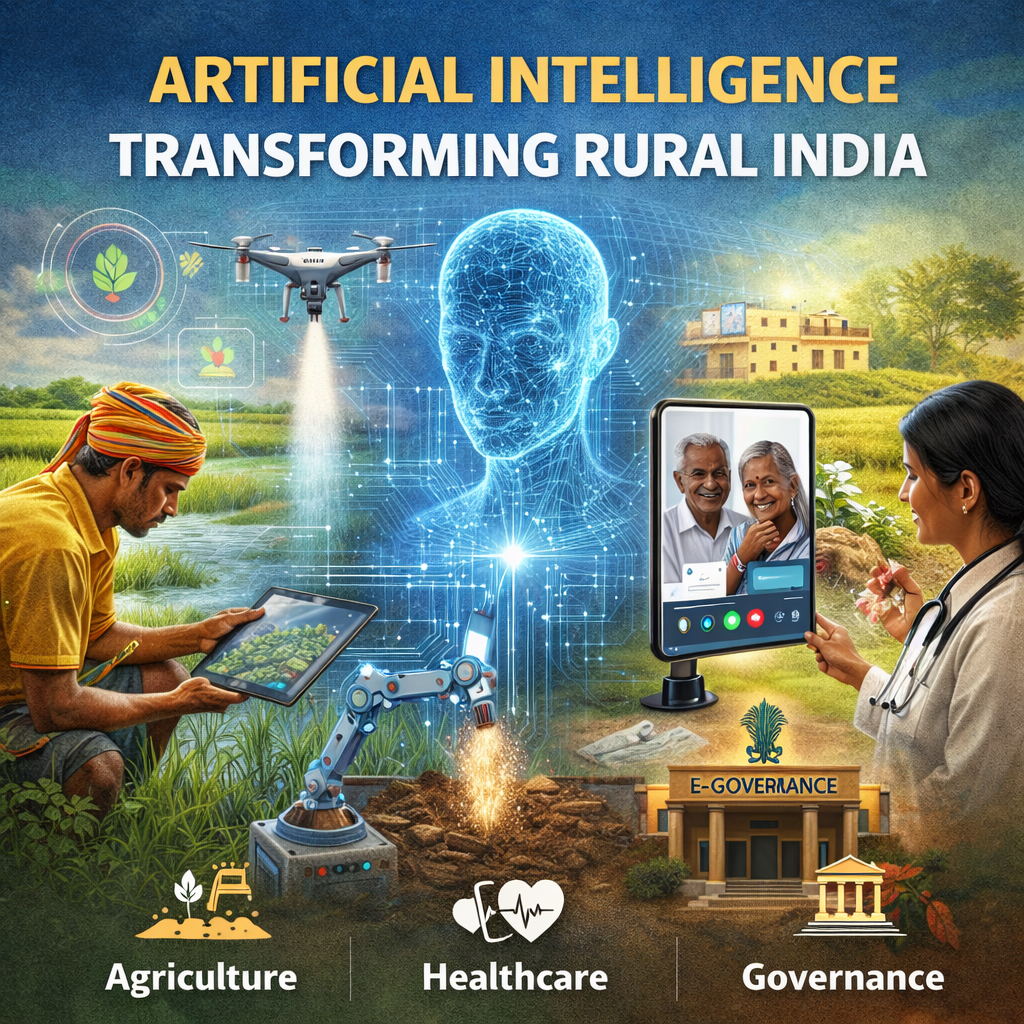
Artificial Intelligence (AI): Transforming Rural India
Table of Contents
Relevance: GS Paper III – Science & Technology, Agriculture, Inclusive Growth, Digital Infrastructure GS Paper II – Governance, Social Justice, Rural Development, Welfare Schemes
For Prelims:
- IndiaAI Mission, National Strategy for Artificial Intelligence (2018), AI Governance Guidelines (2025), #AIforAll, Digital Public Infrastructure (DPI), SabhaSaar, eGramSwaraj, Gram Manchitra, AIKosh, BhuPRAHARI, Digital ShramSetu Mission, Kisan e-Mitra, National Pest Surveillance System, DIKSHA Platform, YUVAI Programme, Suman Sakhi Chatbot, BHASHINI, BharatGen AI, Adi Vaani, India–AI Impact Summit 2026
For Mains:
- Inclusive AI Governance, Responsible AI Framework, Fairness and Accountability in AI, AI for Rural Development, AI in Panchayati Raj Institutions, Geospatial AI for Asset Monitoring, AI in Agriculture Decision Support, AI in Informal Sector, Multilingual AI Platforms, Voice-Enabled Governance, Digital Inclusion in Rural India, AI-Augmented Service Delivery, Linguistic Inclusion, AI for Social Equity, Viksit Bharat@2047
Why in News?
The India–AI Impact Summit 2026 has highlighted Artificial Intelligence as a key driver of inclusive rural development across agriculture, healthcare, education, and governance.
With the IndiaAI Mission and Digital India accelerating system-wide implementation, and the rollout of the AI Governance Guidelines (2025), India is scaling responsible, multilingual, and citizen-centric AI solutions aligned with the vision of Viksit Bharat@2047.
National AI Policy and Governance Framework for Inclusive Development
India’s AI deployment strategy is anchored in a dual framework:
- A forward-looking national development strategy
- A robust governance architecture
This combined structure ensures that AI is deployed in a manner that is responsible, transparent, equitable, and context-sensitive, particularly in rural and socially vulnerable regions.
The objective is not merely technological advancement, but inclusive growth supported by institutional safeguards.
National Strategy for Artificial Intelligence: #AIforAll
Launched by NITI Aayog in June 2018, the National Strategy for Artificial Intelligence identifies AI as a transformative instrument to address India’s developmental challenges.
Core Objectives:
- Improving access to essential services
- Enhancing affordability
- Improving service quality
The strategy prioritises inclusive and socially oriented growth, particularly in underserved regions where service and infrastructure gaps persist.
Sectoral Focus:
In agriculture, healthcare, and education, AI-enabled decision-support systems and data-driven platforms are designed to:
- Strengthen frontline workers
- Support local institutions
- Extend services to remote populations
- Reduce dependence on heavy physical infrastructure expansion
The strategy explicitly emphasises augmentation rather than displacement of human labour. AI is framed as a support system for:
- Farmers
- Health workers
- Teachers
- Administrators
It also promotes inclusive economic participation through decentralised skilling, digital work opportunities, and technology-aligned training.
Under the #AIforAll framework, AI is positioned as a catalyst for rural growth, strengthened governance, and enhanced human capacity.
India AI Governance Guidelines (2025): Responsible AI Deployment

In November 2025, the Ministry of Electronics and Information Technology (MeitY) launched the India AI Governance Guidelines to shift AI policy from application-focused deployment to governance-centered implementation.
The framework establishes people-centric principles including:
- Fairness
- Accountability
- Transparency
Recognising that global AI risk models may not adequately capture India’s socio-economic diversity, the guidelines advocate for India-specific risk assessments, particularly in welfare systems where automated tools influence beneficiary targeting and service provision.
The Governance Framework Includes:
- Seven guiding principles (Sutras) for ethical AI
- Six pillars of AI governance
- An action plan with short-, medium-, and long-term timelines
- Practical deployment guidelines for industry, developers, and regulators
The framework promotes system-level governance through Digital Public Infrastructure (DPI), embedding privacy, interoperability, and accountability by design.
A whole-of-government approach ensures coordination across ministries and states, strengthening transparency, grievance redressal, and institutional capacity.
AI in Rural e-Governance and Decentralised Administration
AI is being integrated into Panchayati Raj Institutions to enhance grassroots governance.
SabhaSaar
SabhaSaar is an AI-enabled tool that generates structured minutes of Gram Sabha and Panchayat meetings from audio and video inputs.
- Reduces manual documentation burden
- Improves consistency
- Ensures unbiased and timely records
- Integrated with BHASHINI for 14 Indian languages
This allows local officials to focus more effectively on governance outcomes.
Digital Platforms Strengthening Rural Governance
eGramSwaraj
Launched in April 2020 under the e-Panchayat Mission Mode Project, eGramSwaraj consolidates Panchayat functions including:
- Planning
- Budgeting
- Accounting
- Monitoring
- Asset management
- Payments
Gram Manchitra
Gram Manchitra provides GIS-based planning tools that:
- Map rural assets
- Monitor infrastructure projects
- Integrate spatial data into Gram Panchayat Development Plans (GPDPs)
AIKosh: National AI Repository
AIKosh functions as a national repository for AI datasets and models, supporting public-sector innovation.
- 7,500+ datasets
- 273 AI models
- 20 industries covered
- 69.80 lakh visits
- 17,500 registered users
- 5,004 model downloads
It lowers entry barriers and accelerates rural e-governance innovation.
AI Infrastructure and Sectoral Integration
AI infrastructure development integrates data resources, computational capacity, and domain expertise through collaboration between government agencies, academic institutions, and national platforms.
BhuPRAHARI (Launched May 2025)
- Collaboration: Ministry of Rural Development & IIT Delhi
- Monitors MGNREGA and VB-G RAM G assets
- Initially used for Amrit Sarovar water monitoring
- Uses satellite and ground-based data
- Enables real-time asset tracking
This enhances transparency and resource optimisation.
Digital ShramSetu Mission
Deploys AI in the informal sector to:
- Enhance service delivery
- Support rural livelihoods
- Align technological deployment with regulatory frameworks
AI in Agriculture
AI operates as a decision-support system at the farm level.
Applications include:
- Weather forecasting
- Pest detection
- Optimisation of sowing and irrigation
Key initiatives:
- Kisan e-Mitra
- National Pest Surveillance System
- Crop Health Monitoring
These systems reduce production risks and enhance farmers’ income security.
AI in Education and Skilling
DIKSHA (NCERT)
- AI-enabled video search
- Read-aloud features
- Supports inclusive learning
YUVAI Programme
- AI education for Classes VIII–XII
- Experiential and socio-technical skill development
These initiatives foster future-ready competencies.
AI for Healthcare: Suman Sakhi
Launched in Madhya Pradesh under the National Health Mission:
- AI-enabled WhatsApp chatbot
- Provides maternal and newborn health information
- Supports ASHAs and ANMs
- Enhances last-mile healthcare access
AI for Language Inclusion
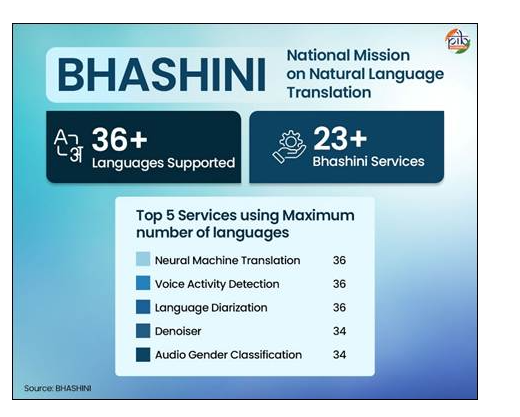
BHASHINI
Launched in July 2022:
- Supports 36+ Indian languages
- Integrated with 23+ government services
- 350 AI language models
- 1 million+ downloads
It promotes voice-first and multilingual governance.
BharatGen (June 2025)
India’s sovereign multilingual and multimodal Large Language Model:
- Supports 22 Indian languages
- Integrates text, speech, and document vision
- Built on India-centric datasets
Adi Vaani
- AI platform for tribal language inclusion
- Digitises endangered languages
- Facilitates governance access in native languages
Conclusion
Artificial Intelligence is steadily evolving into a foundational pillar of rural transformation in India. Through policy frameworks, governance safeguards, digital public infrastructure, multilingual platforms, and sectoral integration, AI is being institutionalised to augment human capacity rather than replace it.
Embedded within principles of fairness, transparency, and linguistic inclusion, AI strengthens last-mile service delivery, enhances participatory governance, and reduces structural inequalities. As India advances toward Viksit Bharat@2047, people-centric AI deployment will remain central to building resilient and equitable rural ecosystems.
UPSC PYQ
Q. With the present state of development, Artificial Intelligence can effectively do which of the following?
- Bring down electricity consumption in industrial units
- Create meaningful short stories and songs
- Disease diagnosis
- Text-to-Speech Conversion
- Wireless transmission of electrical energy
Select the correct answer using the code given below:
A. 1, 2, 3 and 5 only
B. 1, 3 and 4 only
C. 2, 4 and 5 only
D. 1, 2, 3, 4 and 5
Answer: B
CARE MCQ
Q. BHASHINI Sanchalan is primarily aimed at:
A. Promoting satellite-based internet connectivity in rural areas
B. Strengthening multilingual governance through AI-enabled language technologies
C. Establishing new digital universities across India
D. Replacing regional languages with a single national language
Answer: B
Explanation:
BHASHINI Sanchalan is a collaborative initiative of central ministries and the Digital India BHASHINI Division. It aims to strengthen multilingual governance by integrating AI-enabled language technologies into public digital systems.
The initiative incorporates voice-first interfaces and translation capabilities to improve governance processes and service delivery. It supports the development of domain-specific language models, enhances translation accuracy, and standardises terminology through collaborative training.
By promoting linguistic inclusion, especially in rural and underserved regions, it seeks to increase citizen participation and accessibility in digital governance.