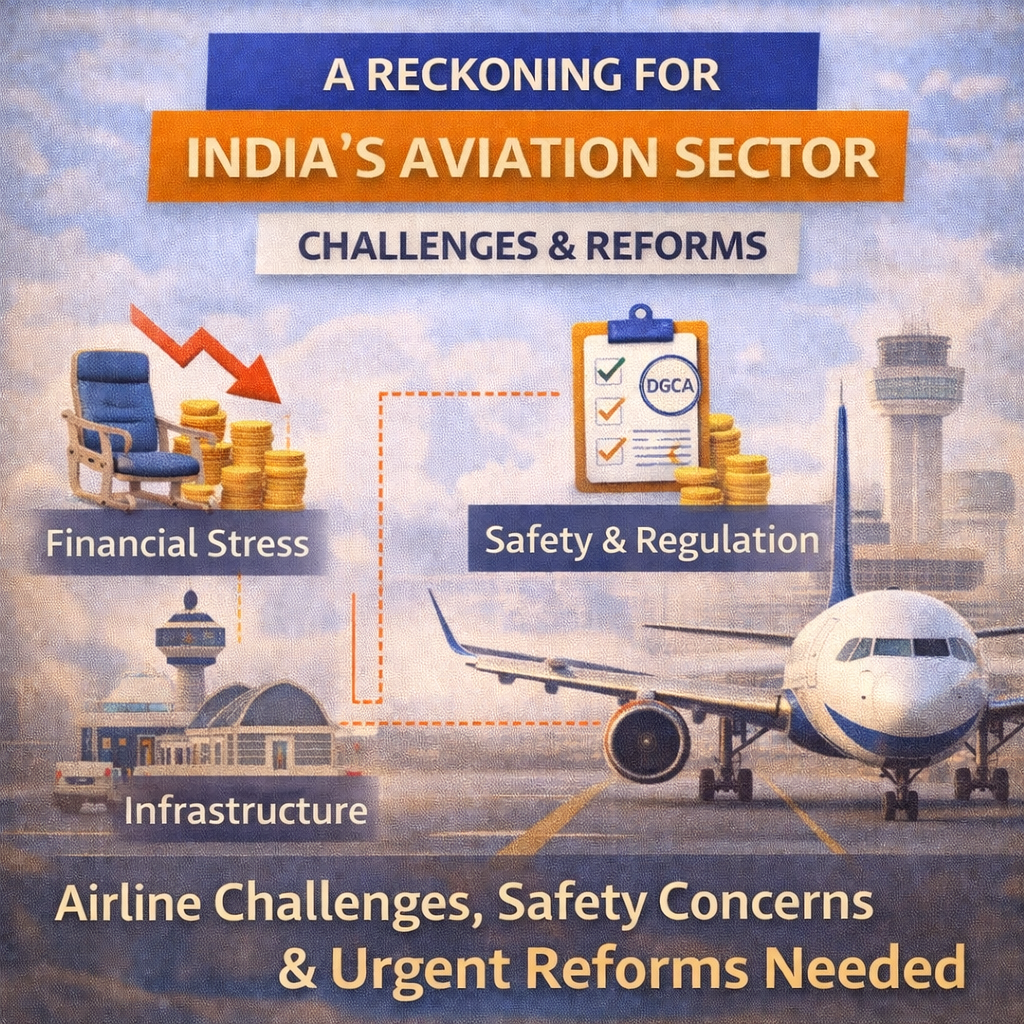
A Reckoning for India’s Aviation Sector
Table of Contents
Relevance:
GS Paper III (Infrastructure, Transport, Economic Development, Regulatory Framework)
For Prelims:
- FDTL norms, DGCA, ATF, UDAN scheme, Aviation Turbine Fuel, Duopoly, NOC (No Objection Certificate), Pilot-to-Aircraft Ratio, Commercial Pilot Licence (CPL), Market Concentration
For Mains:
- Infrastructure Stress, Regulatory Capacity, Aviation Safety Oversight, Market Concentration Risk, Economic Viability of Airlines, Transport Infrastructure, Public Policy Reform, Crisis Management vs Structural Reform, Regional Connectivity, Cost Volatility
Why in News?
India’s civil aviation sector has faced a turbulent year marked by safety incidents, large-scale flight disruptions, pilot shortages, and declining profitability at major carriers. With new regional airlines entering the market and domestic air traffic expanding rapidly, structural weaknesses in the system have come under sharp scrutiny.
India’s Aviation Boom: Growth with Fragility
- India is the third-largest domestic aviation market in the world.
- Operates 840+ aircraft and carries 350+ million passengers annually.
- Rapid expansion has increased connectivity but also strained system capacity.
- The June 2025 Ahmedabad crash highlighted serious safety concerns.
- The December 2025 IndiGo mass disruptions exposed operational weaknesses.
- These events were not isolated incidents but signs of deeper structural stress.
- Initial perception of airline-specific failure evolved into recognition of sector-wide vulnerabilities.
- Key issues include:
- Pilot shortages
- Regulatory bottlenecks
- High aircraft utilisation
- Limited spare capacity
- Tighter operational norms (e.g., duty time regulations) are increasing pressure on airlines.
- Peak travel seasons may further expose systemic fragility.
- Core warning: Rapid growth without parallel institutional strengthening risks long-term instability.

The Pilot Bottleneck: A Structural Weakness
The December disruption highlighted a severe pilot-to-aircraft mismatch.
- IndiGo operated over 360 aircraft with around 5,038 pilots, translating to a ratio of roughly 14 pilots per aircraft, below the global benchmark of 18–20 pilots for fatigue-mitigated operations.
- Implementation of revised Flight Duty Time Limitation (FDTL) norms — reducing night duties and increasing mandatory rest — rendered existing schedules unsustainable.
- India requires an estimated 7,000 pilots (2024–26) and potentially 25,000–30,000 over the next decade.
- Between 2020 and 2024, only about 5,700 Commercial Pilot Licences (CPLs) were issued.
Training bottlenecks, simulator shortages, high costs, and regulatory delays have constrained supply. Airlines have resorted to foreign pilots, but these remain temporary and expensive stopgaps.
Compounding the issue is regulatory capacity. Nearly half of DGCA’s sanctioned technical posts remain vacant, weakening oversight in a rapidly expanding sector.
The Duopoly Problem: Concentration Risk
India’s domestic aviation market is highly concentrated:
- IndiGo controls ~63–65%
- Air India group holds ~27–28%
- Together, they account for nearly 90% of the domestic market
IndiGo operates as the sole carrier on approximately 60% of domestic routes. Disruptions at such a dominant carrier do not merely shift passengers to competitors; they eliminate connectivity altogether.
This concentration transforms operational stress at one airline into a systemic risk affecting national connectivity and fare stability.
New Regional Entrants: Opportunity or Risk?
In December 2025, the government issued No Objection Certificates (NOCs) to:
- Shankh Air (Noida region)
- Al Hind Air (Kochi-based regional network)
- FlyExpress (Telangana low-cost operator)
These entrants aim to strengthen regional connectivity under the UDAN scheme, which has operationalised 625 routes and 85 airports.
UDAN Scheme (Ude Desh ka Aam Nagrik)
1. Launch & Vision
- Launched: 21 October 2016
- First Flight: Shimla–Delhi (27 April 2017)
- Objective: Enhance regional air connectivity and make air travel affordable for the common citizen.
- Tagline idea: “Hawai chappal to hawai jahaz” – democratization of aviation.
2. Key Objectives
- Operationalise unserved & underserved airports
- Make flying affordable through fare caps and subsidies
- Promote balanced regional development
- Boost tourism, trade, healthcare access
- Encourage private sector participation
3. Major Achievements (2016–2025)
- 625 routes operationalised
- 90 airports connected
- 15 heliports
- 2 water aerodromes
- 1.49+ crore passengers benefited
- 3 lakh+ UDAN flights operated
- Airport network expanded from 74 (2014) to 159 (2024)
- ₹4,023.37 crore disbursed under Viability Gap Funding (VGF)
- 2024: 102 new routes launched (including 20 in Northeast)
4. Key Components
- Viability Gap Funding (VGF): Financial support to airlines
- Airfare Cap: Affordable ticket pricing
- Collaborative Federal Model: Centre–States–AAI–Private operators
5. Incentives Framework
For Airlines
- Financial subsidy (VGF)
- Code-sharing flexibility
For Airport Operators
- Waiver of landing & parking charges
- No TNLC charges by AAI
- Discounted RNFC
For State Governments
- VAT on ATF reduced to 1% or less (for 10 years)
- Reduced charges on security, fire, and utilities
For Centre
- Excise duty on ATF capped at 2% (first 3 years)
However, India’s aviation history shows repeated failures — Kingfisher, Jet Airways, Go First, TruJet — driven by high ATF costs, weak demand, poor management, and infrastructure constraints.
Without structural reforms, new entrants may simply redistribute fragility rather than enhance resilience.
Fuel Costs and Financial Strain
Aviation Turbine Fuel (ATF), linked to global crude prices and the U.S. dollar, remains a persistent cost pressure. High volatility exposes airlines to external shocks, affecting ticket prices and profitability.
Despite record passenger numbers, profits at major carriers have plunged, suggesting growth without financial cushioning.
Safety Concerns and Regulatory Gaps
By late 2025, DGCA had issued 19 safety violation notices, citing:
- Breaches of FDTL norms
- Lapses in quality assurance
- Unauthorised cockpit access
- Expired emergency equipment
Globally, airlines maintain 20–25% spare crew capacity to absorb shocks. Indian carriers operate at near-total utilisation, allowing minor disruptions to cascade across networks.
This pattern reflects a shift from proactive regulation to reactive crisis management.
Directorate General of Civil Aviation (DGCA)
- Institutional Status:
- An attached office of the Ministry of Civil Aviation.
- Role:
- The regulatory body in the field of Civil Aviation in India.
- Primarily deals with aviation safety issues.
- Key Responsibilities:
- Regulation of air transport services (to/from/within India).
- Enforcement of civil aviation regulations.
- Ensuring air safety and airworthiness standards.
- Coordination of regulatory functions with the International Civil Aviation Organisation (ICAO).
- Headquarters:
- Located in New Delhi.
- Administrative Presence:
- Has regional offices in various parts of India.
The Way Forward: Systemic Reform
India’s aviation sector requires structural correction rather than episodic fixes:
- Expand pilot training capacity and simulator infrastructure
- Fill DGCA vacancies to strengthen oversight
- Improve Tier-2 and Tier-3 airport infrastructure
- Consider ATF tax rationalisation and hedging mechanisms
- Encourage measured de-concentration without over-fragmentation
With domestic demand projected to reach 715 million passengers by 2030, failure to address systemic weaknesses could convert growth into recurring instability.
Conclusion
India’s aviation sector stands at a crossroads. Rapid expansion has propelled it into global prominence, but operational overstretch, regulatory gaps, pilot shortages, and high market concentration threaten sustainability.
The December disruptions were not aberrations but early warnings. Without structural reforms in manpower, regulation, cost management, and market design, India’s aviation success story risks becoming a cycle of recurring crises borne ultimately by passengers.
UPSC PYQ
Q. Consider the following statements about ‘Ude Desh ka Aam Nagrik (UDAN)’ scheme: (NDA-II 2022)
- It is an innovative scheme to develop the regional aviation market.
- It creates affordability yet economically viable and profitable flights on regional routes.
Which of the statements given above is/are correct?
- 1 only
- 2 only
- Both 1 and 2
- Neither 1 nor 2
Answer: C
Explanation:
Statement 1 – Correct
UDAN (Ude Desh ka Aam Nagrik) is a flagship regional connectivity scheme launched in 2016 under the Ministry of Civil Aviation to develop the regional aviation market. It aims to operationalize unserved and underserved airports across India.
Statement 2 – Correct
The scheme ensures affordability through airfare caps while maintaining airline viability through Viability Gap Funding (VGF) and other concessions (e.g., tax benefits, reduced airport charges).
- VGF is funded via the Regional Connectivity Fund (Centre–State sharing).
- This makes even low-demand regional routes economically sustainable for airlines.
CARE MCQ
Q. Consider the following statements regarding UDAN (Ude Desh ka Aam Nagarik) :
- Launched in October 2016.
- First flight: Shimla–Delhi.
- Boosted tourism, healthcare and trade in Tier-2 & Tier-3 cities.
Which of the statements are correct?
- 1 only
- 1 and 2 only
- 1 and 3 only
- 1, 2 and 3
Answer: D
Explanation:
Statement 1 – Correct:
The UDAN (Ude Desh ka Aam Nagrik) Scheme was launched on 21st October 2016 to enhance regional air connectivity and make flying affordable for common citizens.
Statement 2 – Correct:
The first UDAN flight operated between Shimla and Delhi on 27th April 2017, marking the operational rollout of the scheme.
Statement 3 – Correct:
UDAN improved connectivity to underserved and remote regions, thereby strengthening regional tourism, healthcare access, and trade, and catalysing economic growth in Tier-2 and Tier-3 cities.